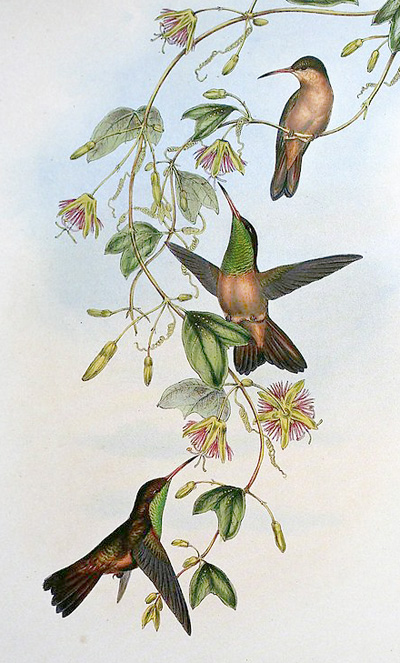
The Buff-bellied Hummingbird is the most common of the Amazilia hummingbirds that have been found in the United States, with a regular breeding area in south Texas. The species is unique in that after the summer breeding season, some birds disperse to the northeast, expanding their winter range along much of the Gulf Coast. They are rather distinctive in appearance among hummingbirds that reach the United States, as Buff-bellied Hummingbirds and Berylline Hummingbirds are the two species that have an overall very dark plumage.
Habitat
Uses a variety of semi-open habitats, including shrublands and thickets with scattered trees, forest edges and clearings, and suburban neighborhoods.
Diet
Typical diet of hummingbirds, primarily nectar, but insects also comprise a portion of the diet.
Behavior
Males establish feeding territories which are defended against other hummingbirds, as well as against large insects that utilize feeding areas. Defense of an area is accomplished through flight displays and aggressive chasing of intruders.
Nesting
Buff-bellied Hummingbirds typically build a nest fairly low in a shrub or small tree. The nest is made of plant fibers and plant down, and spider webs, with the outside covered in lichens, bits of bark, or flower pieces. The nest is evidently built by the female, who also incubates the eggs and raises the young.
Song
Displaying males have a short series of two-syllable notes.
Migration
Buff-bellied Hummingbirds are permanent residents in most of their Mexican range, and in extreme southern Texas. However, some birds disperse northeastward after the breeding season, with small numbers wintering on the Gulf Coast of the United States.
Interactive eBird Map
Click here to access an interactive eBird map of Buff-bellied Hummingbird photos
Feeders
Will attend hummingbird feeders
Similar Species
Similar to Berylline Hummingbird , with overall dark coloring. The Berylline Hummingbird is distinguished by its solid rufous wings and tail that contrast sharply with a brilliant, solid emerald-green throat and chest. In comparison, the Buff-bellied Hummingbird features a distinctively pale, tawny-buff belly and a bright red bill with a dark tip, which sets it apart from the darker-billed and darker-bellied Berylline.
Conservation Status
No conservation concerns are presently noted for the species. The IUCN currently considers the Buff-bellied Hummingbird to be a species of "Least Concern".
Further Information
- eBird - Buff-bellied Hummingbird
- Audubon Field Guide - Buff-bellied Hummingbird
- Cornell Lab of Ornithology - All About Birds: Buff-bellied Hummingbird
Image Information
Colored lithograph by John Gould - 1861 - Public domain, copyright expired in United States .
