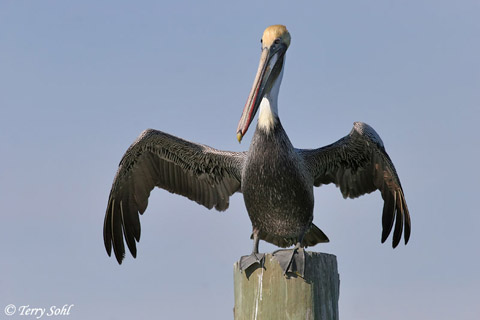
A bird of the coastlines, rarely found inland in South Dakota. The Brown Pelican is a spectacular plunge-diver, rocketing downward from 75 feet or higher as it plunges for fish below the surface. Brown Pelicans were seriously endangered by the 1960s, with North American populations reduced to a small Florida population. With the banning of DDT, Brown Pelicans have made a very strong comeback and are no longer endangered, although it is still officially listed as threatened.
Habitat
The Brown Pelican inhabits coastal marine environments including beaches, bays, estuaries, mangroves, salt marshes, harbors, and nearshore ocean waters. It is most often seen along warm coastlines where shallow waters support abundant fish populations and suitable roosting or nesting sites on islands, docks, and mangrove stands. They are only occasionally seen on freshwater lakes and waters.
Diet
The Brown Pelican feeds mainly on small schooling fish such as menhaden, anchovies, sardines, and mullet. Unlike the American White Pelican, it typically captures prey by dramatic plunge-diving from the air into coastal waters.
Behavior
Primarily feeds by plunge-diving. Will also occasionally dip its bill down for prey while swimming, as well as scavenge for food.
Breeding
Non-breeder in South Dakota. On their breeding grounds, Brown Pelicans typically nest in colonies on small, predator-free islands, where they build their nests either on the ground or within the sturdy branches of mangroves and other shrubs. Ground nests are often simple scrapes lined with feathers and grass, while tree nests are more elaborate platforms of sticks and reeds cemented together with their own droppings.
Song
The Brown Pelican is generally quiet but gives low grunts, croaks, and hoarse growling sounds, especially at nesting colonies. Young birds often produce loud rasping begging calls while adults may hiss or snap their bills when threatened.
Migration
Normally a year-long resident of coastal areas, Brown Pelicans (especially immatures) occasionally wander inland in the summer.
Interactive eBird Map
Click to access an interactive map of Brown Pelican sightings
Similar Species
American White Pelican. The American White Pelican is a massive, snowy-white bird with black wingtips that primarily forages by swimming and dipping its bill, whereas the Brown Pelican is smaller, dark-bodied, and famous for its dramatic high-altitude plunge-dives into saltwater. You can also tell them apart by their bills: the American White develops a unique fibrous "horn" during breeding season, while the Brown Pelican maintains a more slender, grayish-brown profile year-round.
Status
Brown Pelicans declined very sharply by the 1960's, victims of eggshell thinning and breeding failures due to pesticides (primarily DDT). Brown Pelicans have recovered very well following the banning of DDT, and are still increasing in numbers and range. The IUCN lists the Brown Pelican as a species of "Least Concern".
