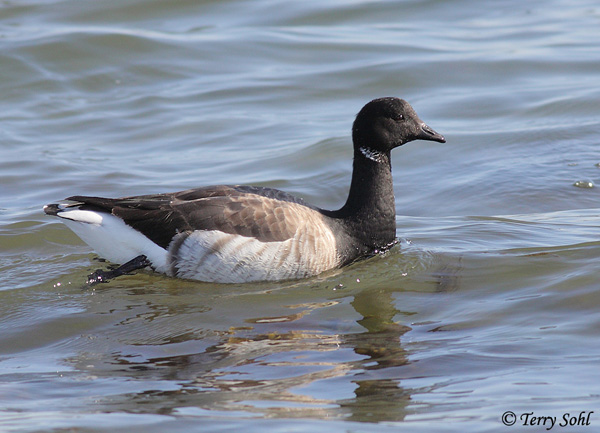
The Brant is a small marine goose that breeds in Arctic tundra regions and winters mainly along coastal estuaries, bays, and salt marshes. It is strongly associated with coastal habitats where it feeds on eelgrass, sea lettuce, and other marine vegetation, although some populations also use agricultural fields during migration and winter. Brant typically migrate in compact flocks and are known for their low, conversational honking calls while in flight. Several subspecies occur across North America and Eurasia, differing somewhat in size and plumage pattern, especially the amount of white and dark coloration on the neck and belly. Two color forms are typically found in the US, the dark-bellied "Black Brant" of western North America, and the lighter-bellied form of eastern North America. Inland sightings, including those in the Great Plains, are uncommon and usually occur during migration or after storms.
Habitat
The Brant inhabits Arctic coastal tundra during the breeding season, especially low grassy areas near ponds, lagoons, and salt marshes. During migration and winter it is strongly associated with coastal bays, estuaries, mudflats, eelgrass beds, salt marshes, and sheltered marine shorelines.
Diet
The Brant feeds mainly on marine vegetation such as eelgrass, sea lettuce, algae, and saltmarsh grasses gathered in shallow coastal waters and tidal flats. During migration and winter it may also graze on agricultural grains, lawns, and other terrestrial vegetation. Will also occasionally feed on aquatic insects, worms, crustaceans, and mollusks.
Behavior
The Brant is highly social and is usually seen in compact flocks during migration and winter along coastal shorelines and estuaries. It spends much of its time grazing on marine vegetation in tidal areas and often flies in tightly coordinated groups while giving constant low honking calls.
Breeding
Non-breeder in South Dakota. Brant nest in the high Arctic tundra, typically choosing sites on small islands or low-lying areas near the coast to stay close to their aquatic food sources. The female constructs a shallow scrape on the ground, lining it with a thick, insulating layer of her own down feathers to protect the eggs from the freezing northern climate. Because of their exposed nesting locations, they often congregate in loose colonies to better detect and deter predators like gulls and foxes.
Song
The Brant gives low, guttural honking and grunting calls often described as conversational rronk or krrr notes. Flocks in flight maintain constant contact with soft rolling calls that are lower and more subdued than those of many other geese.
Migration
Summers in the high Arctic tundra. Winters along both the U.S. Atlantic and Pacific coasts. Generally only rarely migrates through this part of the country.
Interactive eBird Map
Click to access an interactive eBird map of Brant sightings
Similar Species
Canada Goose. The Canada Goose is significantly larger with a distinctive white chinstrap that extends from under the chin up the sides of its head. In contrast, the Brant is a small, dark sea goose with an entirely black head and neck, save for a small, thin white patch on the side of its neck.
Conservation Status
The Brant is generally considered a species of low conservation concern, although some populations have experienced fluctuations related to changes in eelgrass beds, Arctic breeding conditions, and coastal habitat quality. Oil spills, disturbance in wintering estuaries, climate change, and habitat degradation can negatively affect regional populations. The IUCN considers the Brant a species of "Least Concern".
Further Information
Photo Information
Photo taken on April 13th, 2012 - Sachuest National Wildlife Refuge, Rhode Island - Terry Sohl
