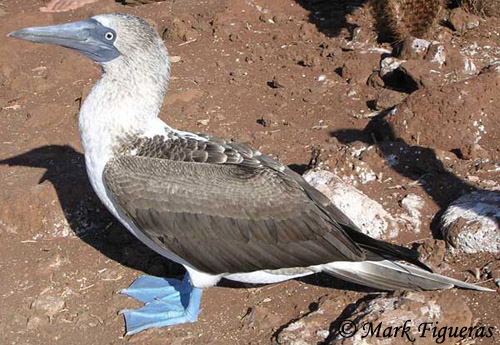
The Blue-footed Booby is probably best known as a resident of the Galapagos Islands, but the species ranges near shorelines across the eastern Pacific. Their mating rituals are a popular feature on nature shows from the Galapagos. Both the females and the males will proudly display their beautiful blue feet to each other in a very elaborate courtship. As with other Booby species, they are named after the Spanish word "bobo", which refers to a lack of intelligence. The term was used because of the species' lack of fear of man, and easy capture. While their normal range is typically south of the United States, strays have been found relatively frequently in southern California, particularly around the Salton Sea, and occasionally elsewhere in the southwestern U.S.
Habitat
The Blue-footed Booby is an oceanic bird, but is rarely found far from land. Their time on land is typically limited to the breeding season, when they use rocky shorelines.
Diet
Fish and squid make up nearly all of the diet.
Behavior
Blue-footed Boobies are plunge-divers, making dives between 3 and 25 feet below the surface in search of fish and squid.
Nesting
No nest is constructed, as eggs are laid directly in a small depression on rocky ground. Both males and females share in the incubation of the eggs (typically 2 eggs), and both parents help to raise the young.
Song
The Blue-footed Booby is generally silent outside the summer breeding season. On breeding grounds, a carrying honking sound can be heard from females and the young.
Migration
The Blue-footed Booby is considered a permanent resident throughout most of its range. However, non-breeding birds do disperse outside of normal breeding grounds.
Interactive eBird Map
Click to access an interactive eBird map of Blue-footed Booby sightings
Similar Species
Similar to other Booby species that have been found in North America, including the Red-footed Booby, Masked Booby, and Brown Booby. These four booby species are primarily distinguished by foot color, plumage, and size. The Blue-footed Booby has bright blue feet and brown-and-white plumage. The Red-footed Booby is the smallest, often white with red feet. The Brown Booby has a brown back and white belly. The Masked Booby is the largest, with a black-masked face, yellow bill, and dark tail
Conservation Status
The Blue-footed Booby is considered a species of "least concern" by the IUCN. They have a wide geographic distribution and are relatively common, with stable populations.
Further Information
- Cornell's Neotropical Birds - Blue-footed Booby
- Audubon - Blue-footed Booby
- eBird - Blue-footed Booby
Photo Information
September 12th, 2004 - Galapagos Islands - Mark Figueras - Licensed under Creative Commons Attribution-ShareAlike 3.0 Unported license .
