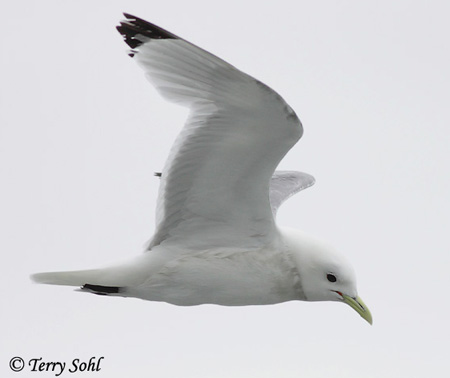
The Black-legged Kittiwake is a small, pelagic gull with a circumpolar distribution, inhabiting northern coastal regions of the Atlantic, Pacific, and Arctic oceans. They are easily identified by their neat white and gray plumage, yellow bills, jet-black legs, and black wingtips. As specialized seabirds, they spend most of their lives on the open ocean, only coming to land during the nesting season. They are highly colonial, nesting in dense colonies on narrow, sheer cliff ledges where they produce a loud, repeated "kitti-wake" call. Their diet consists mainly of small fish, squid, and zooplankton caught near the surface of the water. Outside of the breeding season, they are rarely found near shore, preferring to stay over the deep ocean.
Habitat:
Spends the majority of its life at sea, anywhere from the coastline to far out at sea. Breeds on steep cliffs near the Arctic.
Diet:
Primarily feeds on fish, but will also eat crustaceans, mollusks, marine worms, and insects.
Behavior:
Often forages while in flight, dipping down to the water's surface to grab fish and other prey. They will also swim on the ocean's surface and grab food items.
Breeding:
Non-breeder in South Dakota. On their breeding grounds, Black-legged kittiwakes build compact, cup-shaped nests using mud, grass, and seaweed on narrow, sheer cliff ledges to avoid predators. They nest in large, dense colonies and often reuse the same sites on coastal, rocky, or even man-made structures year after year.
Interactive eBird Map:
Click to access an interactive eBird map of Black-legged Kittiwake sightings
Song:
The Black-legged Kittiwake is known for its loud, shrill, and repetitive call that resembles its own name, often sounding like a shrill "kittee-wa-aaake. Very vocal birds, they are often heard on breeding cliffs, producing a variety of harsh notes, nasal calls, and high-pitched squeaks during social interactions and courtship.
Migration:
Summers in the extreme north around the Arctic. Winters off both coasts of the U.S., generally well offshore.
Similar Species:
Sabine's Gull (winter plumage), Red-legged Kittiwake (not seen in South Dakota). The Black-legged Kittiwake is identified by its yellow bill, jet-black legs, and pale gray back, while the similar Red-legged Kittiwake has red legs, a shorter bill, and darker gray wings. In contrast, Sabine’s Gull is distinguished by its small size, deeply forked tail, and a bold, tri-colored wing pattern of black, white, and gray in flight.
Conservation Status:
Wide fluctuations in local populations, with some areas experiencing huge increases in numbers and others experiencing large decreases. Overall though they have a large population across a very broad geographic area. The IUCN lists the Black-legged Kittiwake as a species of "Least Concern".
South Dakota Hotspot:
A rarity, but most sightings have occurred below the Missouri River reservoir dams.
Photo Information:
August 8th, 2010 -- Near Seward, Alaska -- Terry L. Sohl
