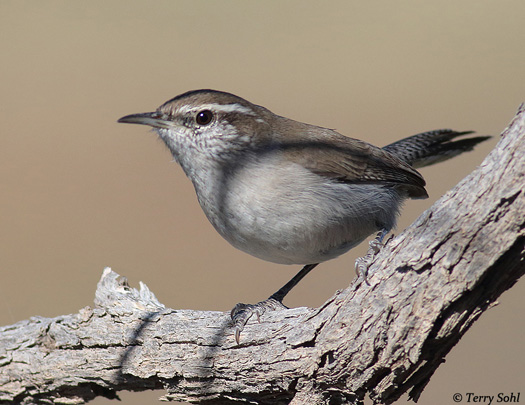
Bewick's Wrens are a very tame wren of the southern and western United States. The species used to be much more common in the eastern United States, but it has disappeared from much of its former range there, for unknown reasons. The Bewick's Wren generally migrates very short distances, if at all, and is normally found well south and west of South Dakota. At the printing of the South Dakota Ornithologist Union's 2002 book, "The Birds of South Dakota", only one specimen had been recorded in the state. The photo to the right is of a Nevada bird.
Habitat:
Bewick’s wrens thrive in brushy thickets, open woodlands, chaparral, and riparian corridors, frequently inhabiting arid environments and suburban gardens in the western United States. They are active foragers that prefer areas with dense, low undergrowth for hiding and nesting, often utilizing abandoned buildings or tree cavities.
Diet:
Bewick’s Wrens are primarily insectivorous birds that forage for insects, spiders, and other small invertebrates in shrubs, trees, and on the ground. They occasionally eat seeds and berries, especially in winter. They are known to visit backyard suet feeders.
Behavior:
Very active foraging, either by clambering and flitting through foliage and vegetation, or by hopping and running along the ground.
Interactive eBird Map:
Click to access an interactive eBird map of Bewick's Wren sightings
Song:
The Bewick's Wren has a loud, rich, and highly variable song composed of clear whistles, trills, buzzes, and musical phrases. Males possess extensive song repertoires and frequently sing from exposed perches, while both sexes give sharp scolding calls such as tzeet notes when alarmed.
Click here to hear the song of a Bewick's Wren
Click hear to hear a scolding type call of a Bewick's Wren
Migration:
Year-round resident of much of the southern and western United States, with some migrating slightly northward in the spring.
Similar Species:
Carolina Wren , Marsh Wren. Bewick’s Wren is best identified by its gray-brown back, clean white underparts, bold white eyebrow stripe, and a long tail that is white-tipped with black barring, which it often flicks side-to-side. Unlike the larger, warmer cinnamon-brown Carolina Wren, Bewick’s has no reddish tones. Compared to the smaller Marsh Wren, Bewick’s lacks the white streaks on the back
Birdhouses:
Will use nest boxes (not in South Dakota).
Conservation Status:
The Bewick's Wren has experienced a drastic, mysterious decline in the eastern United States, where it is nearly extirpated due to habitat change and competition with House Wrens. Conversely, they remain common and widespread in the West, with some populations even expanding their range. The IUCN considers the Bewick's Wren to be a species of "Least Concern".
Photo Information:
November 10th, 2015 - Coronado National Forest, Arizona - Terry Sohl
