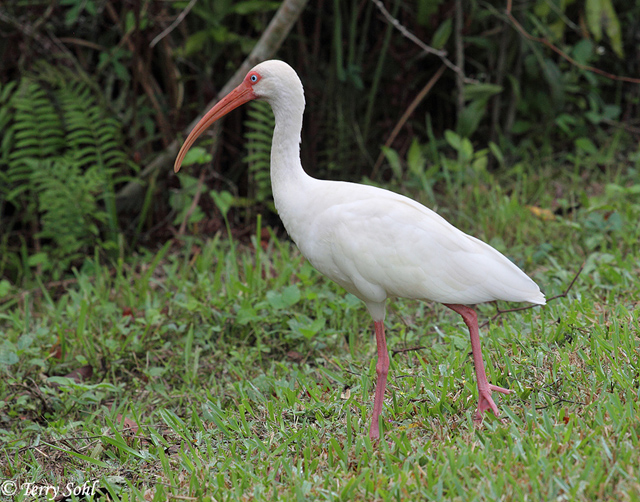
ID Keys: All white plumage, long reddish decurved bill, reddish legs.
The mature White Ibis is
easily distinguished from other Ibis, thanks to its stark all-white
plumage. Generally a bird found near the coastlines in the Southeastern
United States, strays do occasionally wander well north of the normal breeding
range. It remains an extremely rare visitor to South Dakota,
however. While they often feed in wetland environments, they also often
will forage on manicured lawns in the Southeast, searching for large insects.
Habitat
The White Ibis inhabits shallow freshwater and coastal wetlands including marshes, swamps, mudflats, mangroves, lagoons, ponds, and flooded fields. It prefers areas with soft mud or shallow water where it can probe for food with its long curved bill.
Diet
Eats large numbers of
crustaceans, including crabs in salt water and crawfish in fresh water.
They also feed heavily on fish, frogs, snails, and insects. They will
also sometimes eat other small vertebrates like snakes or small rodents.
Behavior
Forages both in the water and on land.
In shallow water, wades slowly, probing with its bill in the mud below the
water, or by sweeping its bill from side to side, grabbing food when it is
felt with the bill.
Nesting
Non-breeder in South Dakota. In
breeding range, White Ibis are colonial nesters, with nesting colonies often
including other wading bird species as well. The nest is a platform of
sticks, placed relatively low in a tree or thicket (between 3 and 15 feet
off the ground). The female usually lays 2 or 3 eggs, and both parents
help to incubate them. When the eggs hatch, both parents feed the
young by regurgitating prey. The young usually fledge at around 6
weeks.
Song
The White Ibis gives low nasal honks, grunts, and croaking calls, especially at nesting colonies and communal roosts. In flight, flocks often produce soft conversational hunk-hunk or squealing contact notes by male during courtship.
Migration
Generally a permanent resident throughout its range, but some of the more
northerly birds do move south in the fall. Strays do occasionally move
well inland during the breeding season.
Juveniles are similar to Glossy Ibis
and White-faced Ibis. The White Ibis is easily distinguished from the White-faced Ibis and Glossy Ibis by its mostly white plumage, black wing tips, and bright red bill and legs. White-faced and Glossy Ibises are much darker overall with chestnut and iridescent greenish plumage, and both lack the striking white body pattern of the White Ibis.
Conservation Status
The White Ibis is generally considered a species of low conservation concern, although local populations can be affected by wetland drainage, coastal development, pollution, and disturbance at nesting colonies. Protection and restoration of wetlands have helped support stable populations in many parts of its range.. The IUCN
lists the White Ibis as a species of "Least Concern".
Photo Information
December 10th, 2012 -
Everglades National Park in Florida - Terry Sohl