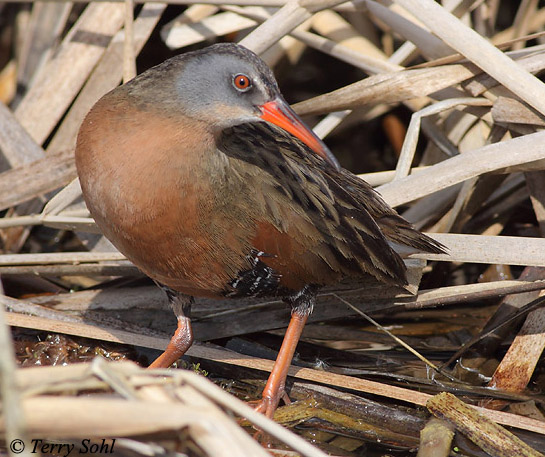
Unlike other similar Rails, the Virginia Rail is a rather common breeding bird in South Dakota. Like other Rails, however, they are more often heard than seen. They prefer to stay hidden in marsh vegetation, and are typically found in cattail marshes in South Dakota. When disturbed, they will almost often move away on foot, and with their long toes and compressed bodies, they are able to maneuver very well in the thick vegetation. While typically not flying once they reach their summer breeding grounds, they are actually relatively strong fliers, and are very long-distance migrants. In South Dakota, when Virginia Rails are found, typically you also will be able to find Sora.
Habitat
Uses a variety of shallow fresh- and brackish-water habitats, provided dense cover is available. They will also use saltwater marshes during the winter. During migration, they have the odd tendency to occasionally show up in almost any habitat.
Diet
Eats a great many aquatic insects and insect larvae. Also eats mollusks and crustaceans, earthworms, small fish, and seeds of aquatic plants.
Behavior
Typically forages by moving through wetland vegetation, plucking insects and other food items from the ground or foliage. They will also often probe in mud or shallow water for food.
Nesting
June through early August. The nest of a Virginia Rail is a platform of cattails and other wetland vegetation, often with surrounding live vegetation partially pulled down and woven into the nest to give it a partial canopy. They nest along the shores of water bodies or wetlands, typically on a dry spot adjacent to the water, or with the nesting platform constructed a few inches above the water in a very shallow part of a marsh. Females lay between 5 and 12 eggs, with both parents helping to incubate them. The young hatch after about 3 days, and typically leave the nest within a few days and start gathering their own food, while protected by the parents.
Song
Metallic tdik-tdik-tdik-tdik. Virginia Rails also have a unique grunting call that descends in tone and speed towards the end. I call it the Three Stooges "Nyuck-nyuck-nyuck-nyuck" call.
- Click here to hear the metallic tdik-tdik-tdik calls of a Virginia Rail1
- Click here to hear the grunting calls of a Virginia Rail2
Migration
Summers throughout most of the western U.S., the northern half of the eastern U.S., and southern Canada. Winters along the Atlantic, Pacific, and Gulf Coasts, as wells as locally in the southwestern U.S., Mexico, and Central America.
-
Birders in the Black Hills area have recently made a very interesting discovery. Starting in the winter of 2003/2004, they found Virginia Rails in at least 3 different locations north of the Black Hills, and now in many subsequent winters as well. Note that most of the literature shows them wintering near the U.S. coasts, or in the extreme SW or SE part of the U.S., but nowhere near South Dakota. It's a potentially important finding, and certainly an interesting one.
Interactive eBird map
Click here to access an interacive eBird map of Virginia Rail sightings
Similar Species
Virginia Rail are unlikely to be a big identification challenge in South Dakota, as other similar rail species typically are not found in the state. Overall, the following species are the most likely to be potentially confused with a Virginia Rail.
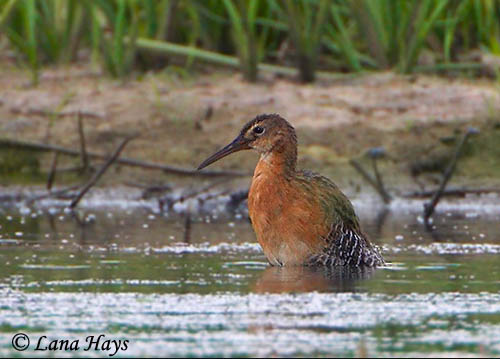
- King Rail - King Rails have been seen in the southeastern part of the state on extremely rare occasions. They are larger than a Virginia Rail, and have a much less colorful bill. The face of King Rail is also typically buffy or rusty, compared to the gray face of a Virginia Rail.
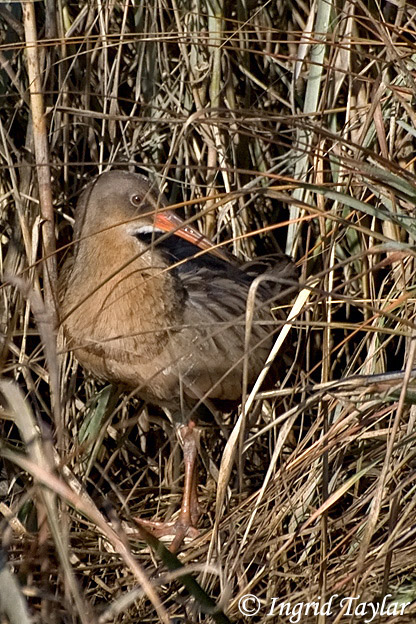
- Clapper Rail - Clapper Rails are a bird of coastal marshes, and thus not an identification challenge in South Dakota. In range, they can be differentiated from Virginia Rail by their more drably colored bill. They also tend to be less colorful on their breast and flanks than a Virginia Rail.
- Sora - Listed here because Sora are a very common rail species in South Dakota, and they are often found in the same habitats as Virginia Rail. The easiest way to differentiate the two species is the much shorter and more stout yellow bill of a Sora, compared to the longer, thinner orange bill of a Virginia Rail.
 |
 |
 |
 |
| King Rail | Clapper Rail | Sora | Sora |
Conservation Status
Numbers are undoubtedly much lower than they were prior to European settlement of the continent, as much of their wetland habitat was drained or otherwise destroyed. While numbers declined in the 20th century, systematic surveys in the last several decades show numbers have recovered substantially. They are found over a very broad geographic region, and are common in parts of their range. The IUCN considers the Virginia Rail to be a species of "Least Concern"
Photo Information
July 4th, 2006 -- Near Tea in Lincoln County -- Terry Sohl
Audio File Credits
- 1Scott Crabtree. Recorded in Pima County, Arizona on February 11th, 2021. Original recording and information available from xeno-canto.
- 2Will Sweet. Recorded in York County, Maine on June 16th, 2019. Original recording and information available from xeno-canto.
