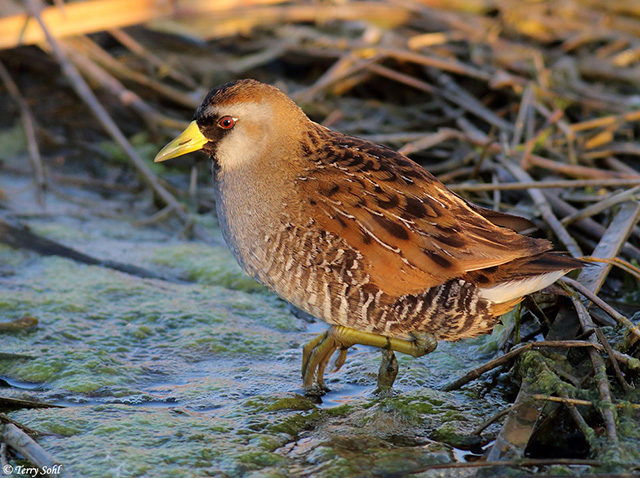
As is the case with most of the Rails, Sora are often quite difficult to observe due to their preference for thick marshy vegetation. They are one of the most common of Rails, and are usually found in most extensive cattail marshes in South Dakota. Unlike the long-billed Rails, their short bill prevents them from probing mudflats for small animals. Instead, they feed heavily on seeds, other vegetative matter, and insects.
Habitat
During the breeding season, Sora can be found in a wide variety of freshwater marshy habitats, including wetlands, river and pond edges, and damp meadows. They will inhabit saltwater marshes as well during the winter.
Diet
Feeds heavily on vegetative material, especially seeds and wild rice. Also feeds on aquatic insects, snails, small crustaceans, and spiders.
Behavior
Walks slowly through wetland vegetation, plucking food items from the surface of the water, from vegetation, or from the ground. Will also occasionally probe in soft mud with its bill for food items.
Nesting
June through August. The nest of a Sora is constructed in dense vegetation at the fringes of a cattail marsh. The nest is anchored to vegetation above any water line, and is primarily constructed of cattails/bulrush stems. The female initially builds a platform for her eggs, starting to lay eggs while she continues construction on her nest. She will lay 8 to 11 eggs, with both parents helping to incubate them. The eggs hatch about 18-20 days.
Song
The most commonly heard vocalization starts with a note or two before beginning a long descending whinny that's decreases in pace towards the end. They also have a piercing two-syllable call with the second note higher in pitch.
- Click here to hear the two-note calls of a Sora1
- Click here to hear the descending whinny calls of a Sora.2
Migration
Summers throughout much of Canada and the northern two-thirds of the United States. Winters along U.S. coastlines, in the far southern portions of the U.S., and points south.
Interactive eBird map
Click here to access an interactive eBird map of Sora sightings
Similar Species
The species most likely to be confused with a Sora are some small Rail species.
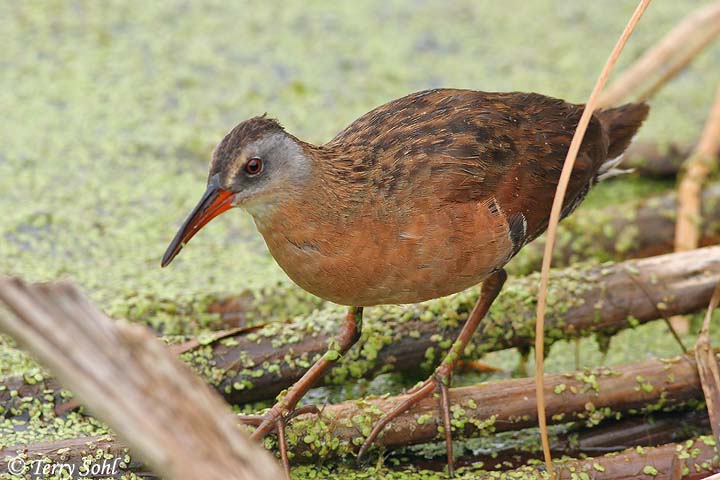
- Virginia Rail - Virginia Rail and Sora often go hand-in-hand in the cattail marshes of South Dakota. Both are small stocky skulkers of the wetland vegetation. However if seen well they are easily differentiated. Virginia Rail have a long, reddish bill, compared to the shorter, yellow bill of a Sora. Both species have a bronwish back with streaks, but on a Virginia Rail, the underparts are a rusty color, while they're gray on a Sora. Virginia Rail have a rusty chin and throat with a gray face, while Sora have a gray face with a black throat and area in front of the bill.
- Yellow Rail - An incredibly secretive bird and one of the most difficult birds to observe in North America, they are considered a very rare bird in South Dakota. They generally prefer wet meadows as compared to the cattail marshes where Sora are found, but given the frequent juxtaposition of those two habitats, the two species may come into contact at times. Yellow Rail are quite a bit smaller than Sora, and have a brownish face and throat, compared to the gray face and black throat of a Sora. And note, no I do not have any photos of a Yellow Rail! And I consider it miraculous that ANYONE does. :-)
 |
 |
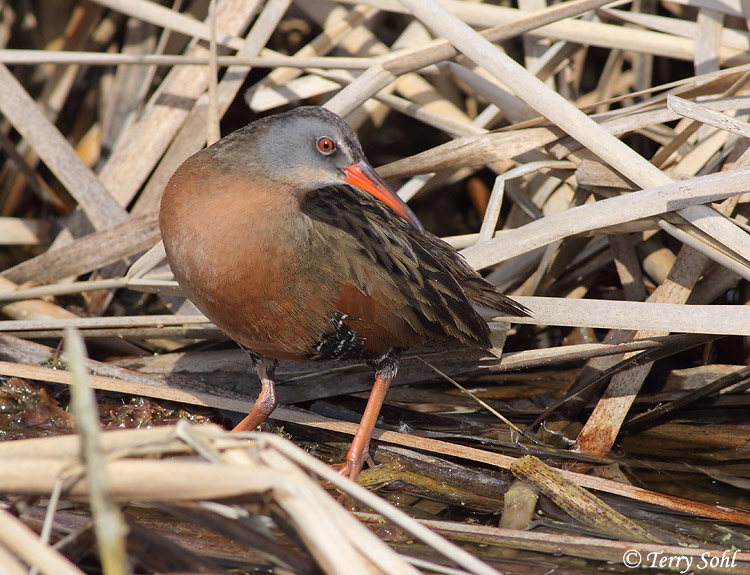 |
| Virginia Rail | Virginia Rail | Virginia Rail |
Conservation Status
Generally widespread, but local declines have been noted due to loss of freshwater marshes. However, they are found across a very broad geographic area, are quite common in parts of their range, and overall populations are strong and relatively stable. The IUCN considers the Sora to be a species of "least concern".
Photo Information
April 18th, 2018 - Lincoln County, South Dakota - Terry L. Sohl
Audio File Credits
- 1Ted Floyd - Recorded in Boulder County, Colorado on June 3rd, 2018. Original recording and information from xeno-canto.
- 2Patrick Turgeon - Recorded in Saskatchewan on July 2nd, 2015. Original recording and information from xeno-canto.
