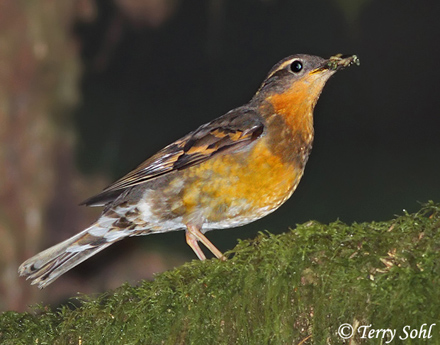
ID Keys: Orange throat, breast and eyebrow, black necklace, orangish
wing-bars.
The Varied Thrush is normally a bird of the Pacific Northwest,
western Canada, and Alaska. In winter, however, some birds wander widely,
reaching South Dakota and occasionally even reaching the East Coast of the
U.S. They generally spend the majority of their time on the ground, and
can be difficult to spot as they forage through dense forest
undergrowth. Their haunting calls are often heard echoing through the
forest, however.
Habitat
Generally
breeds in wet, dense coniferous forest near the coast. During migration
and in the winter, still prefers dense coniferous forest, but can be found in
other areas with thick undergrowth.
Diet
Primarily feeds on insects and spiders in the summer,
along with earthworms and snails. Primarily feeds on fruit and berries in
the winter, along with some seeds.
Behavior
Often forages on the ground, walking or
hopping along in its search for food, sometimes using its bill to look under
leaves and other debris. Will also forage up in the foliage of trees
and shrubs.
Breeding
Non-breeder in South Dakota. The Varied Thrush nests in dense coniferous forests of the Pacific Northwest, Alaska, and western mountains, usually placing its nest on a horizontal tree branch or against the trunk of a conifer. The female builds a sturdy cup nest of twigs, mosses, bark, and grasses lined with softer material, and typical clutches contain 3–5 eggs.
Song
The Varied Thrush is known for its haunting, single-note whistles that echo through dense conifer forests, often sounding slow, clear, and mournful. Calls also include sharp chucks and harsh scolding notes, especially when alarmed or foraging in winter flocks.
Migration
Summers from the Pacific Northwest of the U.S., up through western Canada and
most of Alaska. Usually winters near the western coast of Canada or the
western tier of U.S. states, although some wander widely in the winter and may
even reach the east coast of the United States.
American Robin. The Varied Thrush differs from the American Robin by its bold dark breast band, orange eyebrow stripe, and darker slate-gray upperparts. American Robins lack the strong breast band and facial pattern, instead showing a more uniform reddish-orange breast and paler gray-brown back.
Feeders
Will sometimes attend feeders for fruit
and some seeds.