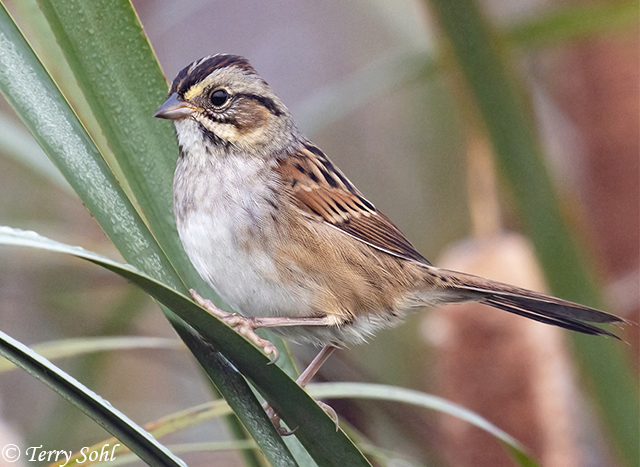
The Swamp Sparrow is aptly named, as they are most often found in dense thickets of freshwater swamps and wetlands. They are normally quite solitary, and while they may be locally common, they are most often encountered as single birds or pairs. Males will sing day or night from high perches to establish nesting territories during the breeding season.
Habitat
During the summer breeding season, they are found in freshwater wetlands with dense emergent vegetation, such as cattails and sedges, and often where woody vegetation such as alder or willow thickets are present. A race on the Atlantic Coast breeds in salt-water marshes. They are usually found in similar habitats in migration and in winter.
Diet
The summer diet is mostly insects. They also feed heavily on seeds, fruit, and other vegetative material, where it may make up the majority of the diet during the fall and winter months.
Behavior
Most of its feeding is done while on the ground or at the water's edge. They will also occasionally wade in very shallow water or feed in the dense wetland vegetation.
Nesting
June and July in South Dakota. The nest of a Swamp Sparrow is a cup composed of reeds, grasses, leaves, and coarser material, with an inner lining of finer material such as grasses, hair, down, and small roots. It is built in thick wetland vegetation such as reeds, in shrubs, or in other thick vegetation, with the nest placed within 4 feet of the ground and sometimes placed over water. They will also sometimes nest directly on the ground itself. The female alone builds the nest, lays 3-6 eggs, and incubates them. The young hatch after about 14 days, with another 10-14 days before they fledge from the nest.
Song
A slow, strong, one-pitched trill, with a tempo that may vary based on season or geography. From the same wetland habitat you may hear variations on the theme, with faster trilling birds and slower trilling birds. They also have multiple short calls that may vary from being buzzy to short and sweet.
- Click hear to hear the rolling trill song of a Swamp Sparrow1
- Click here to hear a short crisp call of a Swamp Sparrow2
- Click here to hear the short rapid alarm calls of a Swamp Sparrow3
Migration
Summers throughout central and eastern Canada, and the eastern U.S. north of Arkansas, Tennessee, and Virginia. Winters in the southeastern quarter of the U.S., in parts of the southwestern U.S., and in Mexico.
Interactive eBird map
Click here to access an interactive eBird map of Swamp Sparrow sightings
Similar Species
Habitat is a primary clue for Swamp Sparrows, as they are well named and are often found in and around wetland vegetation. However, there are other sparrow species that are similar in appearance, or even sometimes use similar habitat:
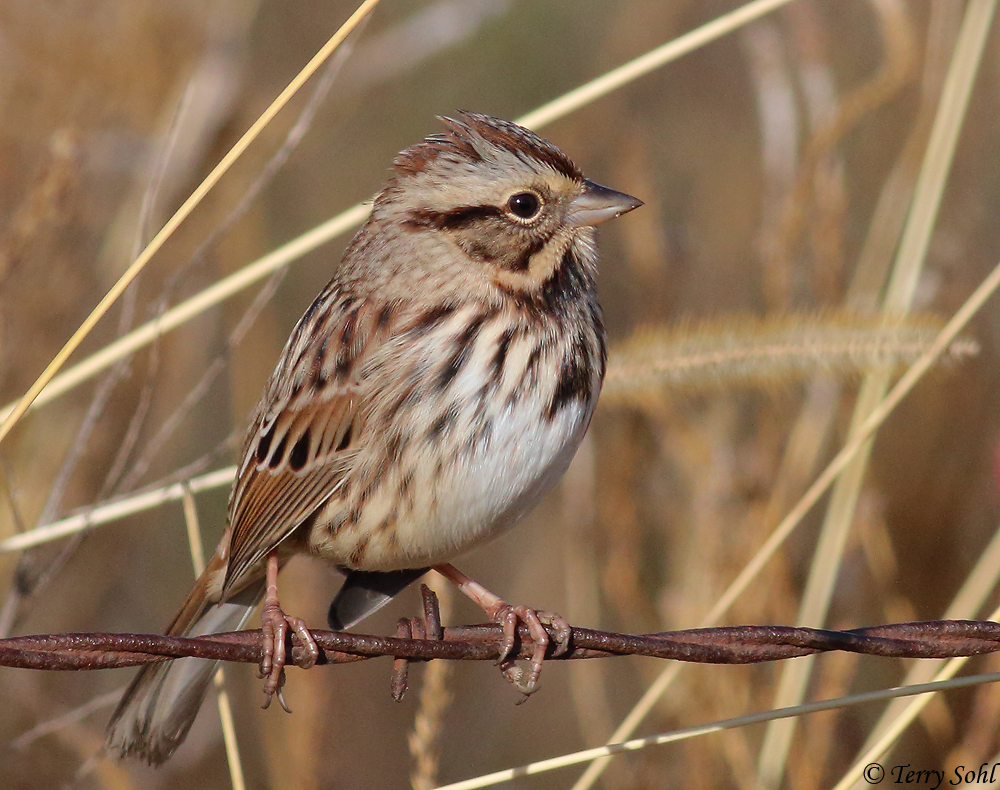
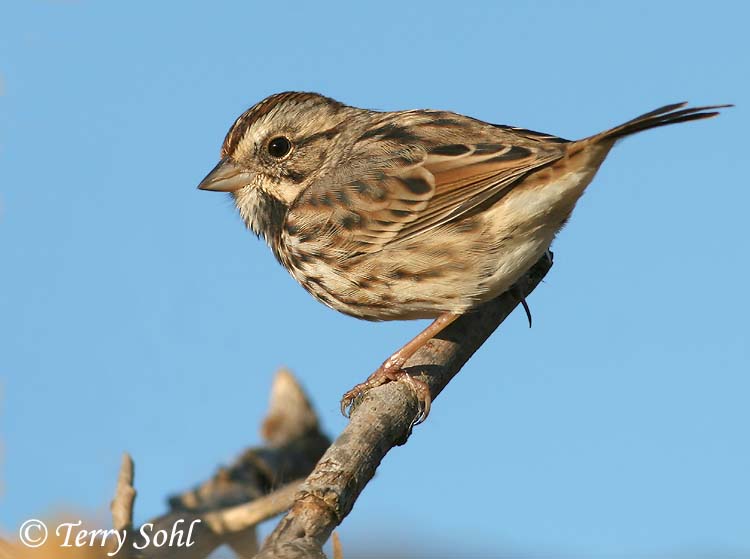
- Song Sparrow - Song Sparrows can sometimes be found in and around the same wetland/thicket vegetation that Swamp Sparrows are found in. They are similar in appearance...if you only see their upperparts and head. The strong streaking on the underparts and chest of a Song Sparrow (and lack of nearly any streaking on a Swamp Sparrow) differentiate the two species.
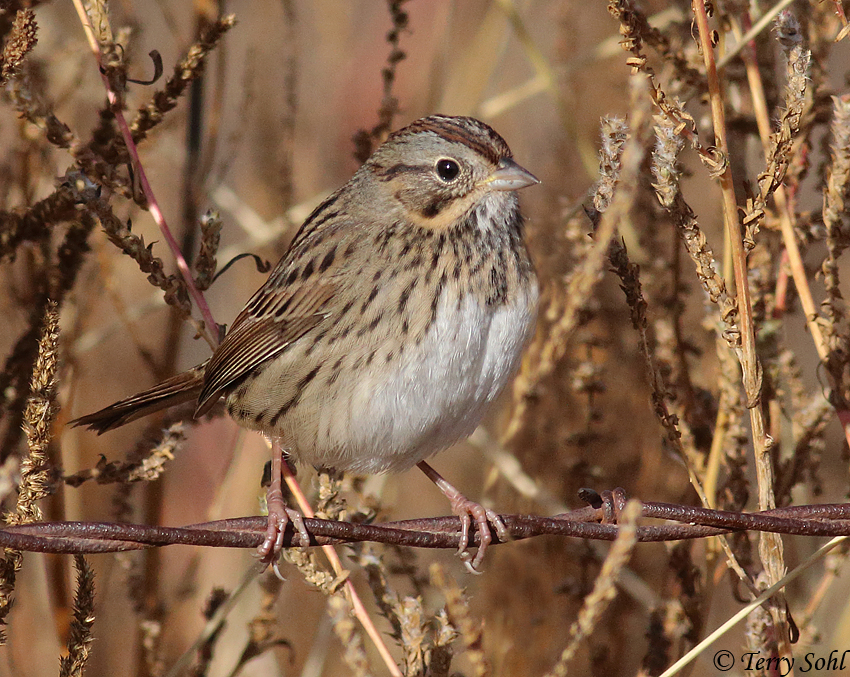
- Lincoln's Sparrow - As with Song Sparrows, Lincoln Sparrows will sometimes use similar habitat as Swamp Sparrows, particularly in migration. However, the extensive fine streaking on a Lincoln's differentiates it from a mature Swamp Sparrow. Note that immature Swamp Sparrows may have streaking that leads to some confusion.
- Chipping Sparrow - As one of the common "unstreaked" sparrow species, a Chipping Sparrow could potentially be confused with a Swamp Sparrow. Note the habitat differences (with Chipping Sparrows more often found in habitats away from wetlands). Swamp Sparrows are also more (subtly) colorful and darker overall than a Chipping Sparrow, with richer reddish-brown tones on the wings and darker brown crown and tail than a Chipping Sparrow.
 |
 |
 |
 |
| Song Sparrow | Song Sparrow | Lincoln's Sparrow | Chipping Sparrow |
Conservation Status
Still widespread and fairly common, although numbers are much lower than historical levels due to loss of wetland habitat. In recent decades numbers may be rebounding. The IUCN currently lists the Swamp Sparrow as a species of "Least Concern".
Photo Information
September 17th, 2004 -- Outdoor Campus in Sioux Falls -- Canon 300D, 400 5.6L lens
Audio File Credits
- 1Laura Stewart. Recording from Saskatchewan, Canada, on June 24th, 2018. Original file and information from xeno-canto.
- 2Bobby Wilcox. Recording from near Des Moines, Iowa on December 16th, 2018. Original file and information from xeno-canto.
