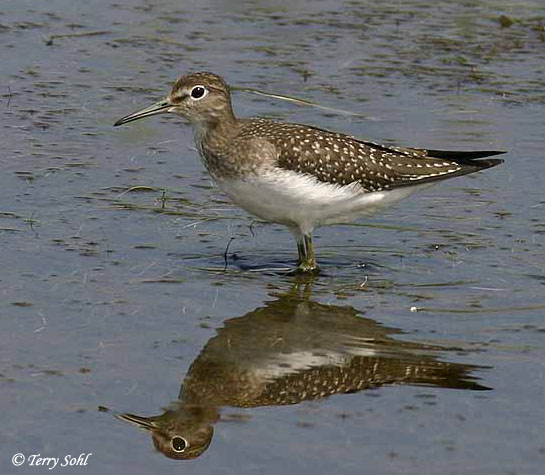
Well named, the Solitary Sandpiper is usually seen as a single bird, shunning the more gregarious nature of most other sandpipers. Also unlike nearly all other sandpipers, they don't nest on the ground, but instead use old songbird nests in trees. Another unusual characteristic for a shorebird, Solitary Sandpipers sometimes practice nest parasitism, laying their eggs in the nests of different species of birds.
In South Dakota, Solitary Sandpipers are migrants, seen in both the spring and fall seasons.
Habitat
In migration through the state, they are generally found in flooded fields, wet meadows, and along edges of streams and ponds. They are generally not found on open mudflats like their close relatives, the Yellowlegs.
Diet
Primarily feeds on insects, especially aquatic insects, but also terrestrial insects such as grasshoppers and beetles. Also will feed on small crustaceans, mollusks, worms, small amphibians, and occasionally small fish.
Behavior
Prefers shallow water along shorelines for foraging, both by probing with its bill in the mud and water, and by picking food items from the water's surface. Solitary Sandpipers will occasionally stir up the stream or lake bottom with their feet to reveal food items.
Nesting
Non-breeder in South Dakota. On their nesting grounds, Solitary Sandpipers are a shorebird that nest in trees. They don't typically build their own nest, instead using the nest of a songbird species that they adapt to their purposes. Typical nesting sites used by Solitary Sandpipers are former nests of American Robins, Canada Jays, Rusty Blackbirds, Cedar Waxwings, or Bohemian Waxwings. They typically do some slight modifications to the existing nest, lining it with fresh, fine material such as grasses and rootlets. The female lays 3 to 5 eggs, and she alone incubates them. The young hatch after 22 to 24 days, and leave the nest within a day of hatching. Both parents will tend to the young until they become independent.
Song
A crisp, rising pee-EET flight call. Alarm call is a sharp, short kleek.
- Click here to hear the alarm calls of a Solitary Sandpiper1
- Click here to hear flight calls of a Solitary Sandpiper2
- Click here to hear more flight calls of a Solitary Sandpiper3
Migration
Summers throughout much of Canada and Alaska. Winters in South America. In South Dakota, they are migrants that could be found in both the spring and fall seasons. Note some birds migrate southward quite early in the "fall" (hence photos of Solitary Sandpipers in July below).
Interactive eBird map
Click here to access an interactive eBird map of Solitary Sandpiper sightings
Similar Species
Solitary Sandpipers could potentially be confused with the following species:
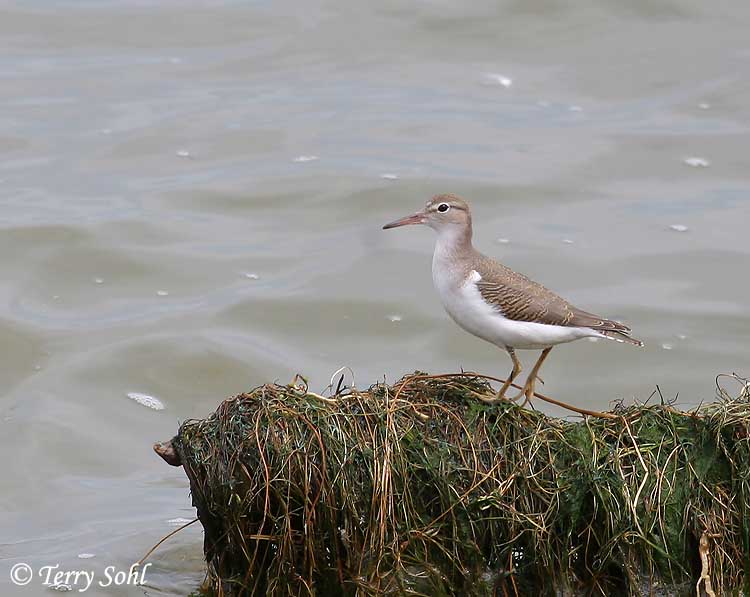
- Spotted Sandpiper - Spotted Sandpipers are fairly common migrants and summer breeding birds in South Dakota. They're similar in size to a Solitary Sandpiper, but as the name implies, have noticeable spots on their underside when in breeding plumage, easily distinguishing them from Solitary Sandpipers. However, non-breeding birds lose the spots and are much more likely to cause an identification issue. Non-breeding Spotted Sandpipers a plainer plumage on their upperparts, while Solitary Sandpipers have flecks of white on a dark brown background. Spotted Sandpipers also have yellow legs, compared to black legs on a Solitary Sandpiper.
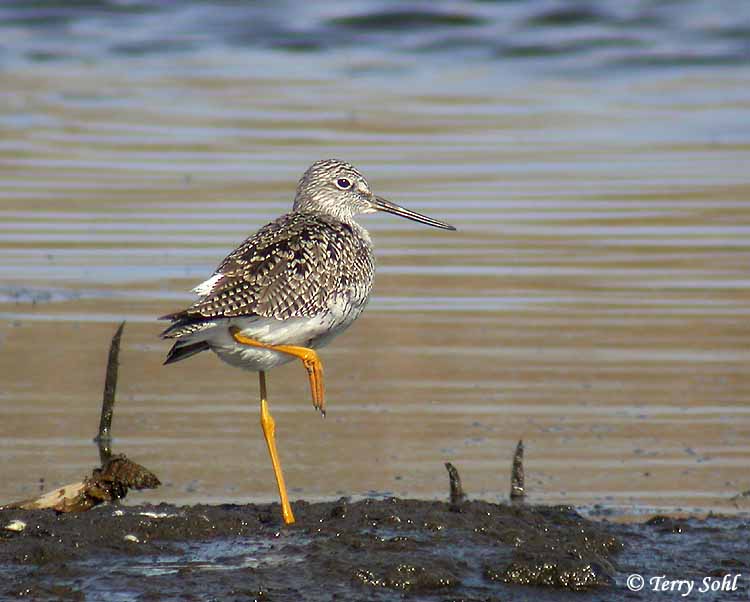
- Lesser Yellowlegs and Greater Yellowlegs - Yellowleg species provide the biggest identification challenge for me, if a bird isn't seen clearly. Each of the two yellowleg species and the Solitary Sandpiper have yellow legs, white underparts, and a bronwish black with white markings. The legs on both species of yellowlegs are a brighter yellow than those of a Solitary Sandpiper, whose legs are more of an olivish-yellow. The spotting on the back of a Solitary Snadpiper is "cleaner" and more simple in pattern, with a dark brown base and small white flecks. The backs of both Yellowleg species are a more complex pattern of brown tones and white bits. Note the eye of a Solitary Sandpiper also has a more noticeable eye-ring than Yellowleg species.
- Stilt Sandpiper - Non-breeding Stilt Sandpipers cause the biggest identification challenge. In breeding plumage, Stilt Sandpipers have heavily barred underparts, and chestnut tones on their head that easily differentiate them from Solitary Sandpipers. In non-breeding plumage, the underside of a Stilt Sandpiper is white, without barring, giving them a more similar appearance to Solitary Sandpipers. However, the distinctive spotted pattern on the back of a Solitary Sandpiper is still diagnostic. The longer, slightly drooped bill of a Stilt Sandpiper also stands out compared to the shorter, straight bill of a Solitary Sandpiper. Stilt Sandpipers also lack the white eye-ring of a Solitary Sandpiper.
 |
 |
 |
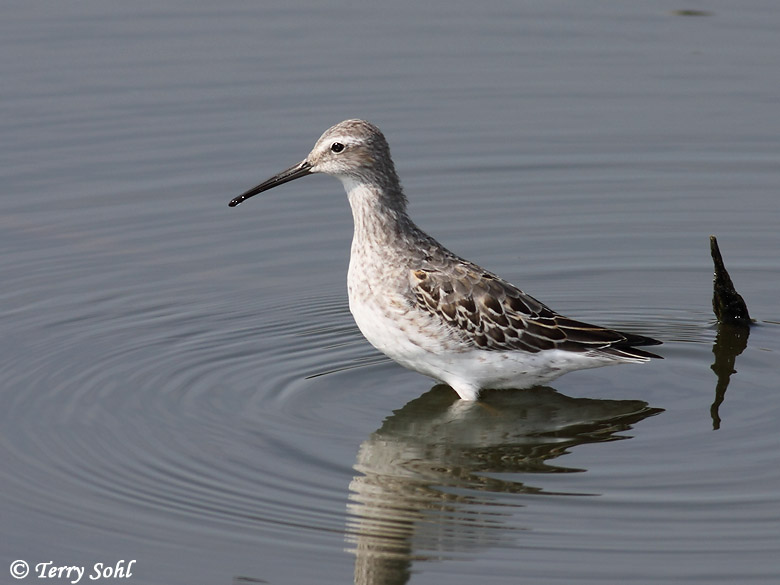 |
| Spotted Sandpiper | Lesser Yellowlegs | Greater Yellowlegs | Stilt Sandpiper |
Conservation Status
The widely dispersed population makes analysis of populations trends difficult. Howeer, where systematic surveys are conducted, substantial populations declines have been noted in recent decades. However, they are still found across a very broad geographic area, and have healthy populations in parts of that range. The IUCN considers the Spotted Sandpiper to be a species of "Least Concern".
Photo Information
August 17th, 2004 - Lake Thompson, Kingsbury County - Terry Sohl
Audio File Credits
- 1Peter Ward and Ken Hall. Recorded near Cariboo, British Columbia on July 10th, 1985. Original recording and information available on xeno-canto.
- 2Jayrson Araujo de Oliveira. Recorded in Brazil on October 11th, 2017. Original recording and information available on xeno-canto.
- 3Jeff Dyck. Recorded in Peace River area of British Columbia on June 16th, 2016. Original recording and information available on xeno-canto.
