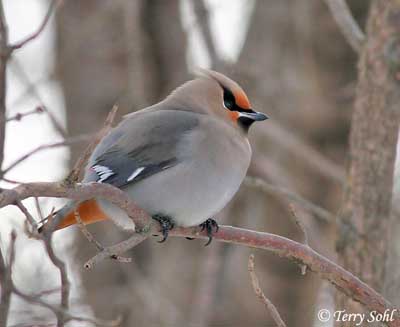
Similar to its close relative, the Cedar Waxwing, Bohemian Waxwings are irregular winter visitors to the state. Summering in the northwestern part of Canada and Alaska, Bohemian Waxwings may appear in large numbers in the state during some winters, and be largely absent in others, staying true to their "nomadic" name. They are generally found in mixed flocks with Cedar Waxwings when in the state.
Habitat
Bohemian Waxwings inhabit northern boreal forests and coniferous woodlands during the summer breeding season, often near water sources. In winter, they become nomadic, moving south into open woodlands, agricultural areas, and urban environments in search of berries, particularly mountain ash, juniper, and apple
Diet
Primarily insects in the summer, also some fruits and berries. Fruits and berries are the primary food in the winter. Will also eat seeds of some trees such as birch.
Behavior
In winter in South Dakota, moves through berry trees, snagging berries while climbing or hovering. In summer, flies out from a perch to capture flying insects.
Breeding
Non-breeder in South Dakota. In their breeding range, Bohemian Waxwings nest in northern boreal forests during June and July, building cup-shaped nests in coniferous or deciduous trees near water. Pairs, which form monogamous bonds, build nests using twigs, moss, and grass, often hiding them on branches. Females incubate 4–6 spotted, blue-gray eggs for roughly 14–15 days.
Song
The Bohemian waxwing’s voice is characterized by a high-pitched, rapid, and rattling trill, often described as a "zeee. Their calls are lower-pitched and coarser than the similar Cedar Waxwing. They produce soft, melodic, and lisping sounds in flocks
Click here to hear Bohemian Waxwing calls.
Migration
Summers in northwestern Canada and Alaska. Difficult to predict winter movements, with heavy irruptions well into the interior of the United States in some winters.
Interactive eBird Map
Click to access an interactive eBird map of Bohemian Waxwing sightings
Similar Species
Cedar Waxwing . See Comparison Chart.
Conservation Status
The Bohemian Waxwing is classified as Least Concern by the IUCN due to its large range and population, though populations are experiencing a long-term decline. While not currently threatened, North American populations have dropped by roughly 55% since 1970, facing risks from habitat loss, car strikes, and window collisions.
Feeders
Will come to feeders for fruits and berries.
Further Information
- eBird - Bohemian Waxwing
- Audubon Field Guide - Bohemian Waxwing
- Cornell Lab of Ornithology - All About Birds: Bohemian Waxwing
Photo Information
February 12th, 2006 -- Near Brandon -- Terry Sohl
