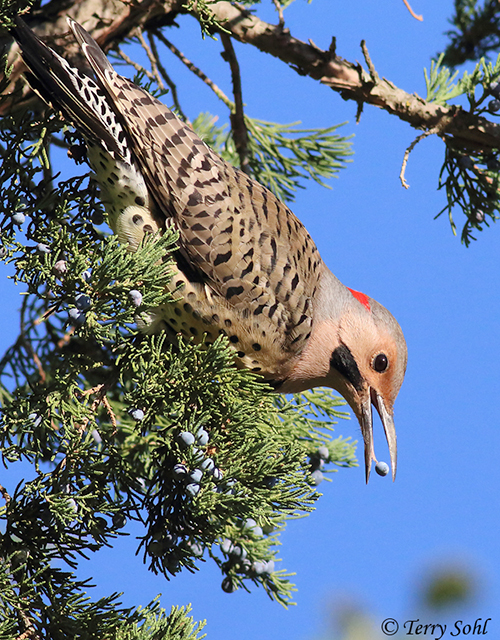
The Northern Flicker is a somewhat unique North American Woodpecker with an affinity for ants. Unlike most woodpeckers, they spend much of their time on the ground foraging for ants and other prey items. Two color forms occur, the yellow-shafted and the red-shafted. The two forms have similar bodies but different color patterns on the head. The red-shafted is generally found in the western half of the U.S., while the yellow-shafted is generally found in the eastern half. There is a broad zone, including South Dakota, where interbreeding between the two forms create a wide variety of intermediates.
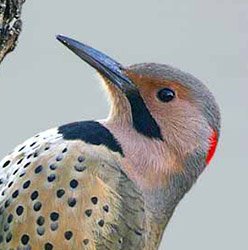
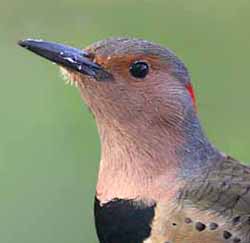
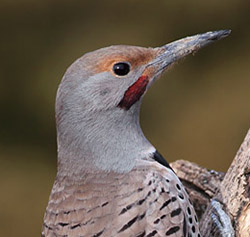
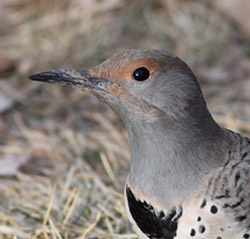
The difference between the yellow-shafted and red-shafted morphs of the Northern Flicker are quite apparent when they take flight, with the yellow underwings present on the yellow-shafted and a deep salmon-pink underwing on the red-shafted. Differences in the head pattern are also apparent, as follows (See below for comparison photos of differences between the color morphs)
- Male Yellow-shafted Northern Flicker - Brownish face and throat, black "mustache" stripe, and a red crescent on the back of the head
- Female Yellow-shafted Northern Flicker - Brownish face and throat, lacks the black mustache stripe, but still has the red crescent on the back of its head.
- Male Red-shafted Northern Flicker - Grayish face and throat, red mustache stripe, and no mark on the back of the head
- Female Red-shafted Northern Flicker - Grayish face and throat, lacking any mustache stripe or mark on the back of the head.
Habitat
The Northern Flicker inhabits open woodlands, forest edges, parks, shelterbelts, riparian corridors, burned forests, suburban neighborhoods, and scattered tree groves. Unlike many woodpeckers, it spends considerable time on the ground, favoring habitats with open areas where it can forage for ants and other insects.
Diet
The Northern Flicker feeds primarily on ants and beetles gathered from the ground, making it one of the most terrestrial of North American woodpeckers. It also eats other insects, fruits, berries, seeds, and nuts, particularly during fall and winter when insect prey is less available.
Behavior
Does much of its foraging on the ground, often in pursuit of its favorite prey, ants. Will also forage in foliage and on branches, and will occasionally fly out to capture insects in mid-air.
Nesting
Late May through mid-July in South Dakota. Northern Flickers are cavity nesters. The will excavate a cavity in a tree trunk or large branch of a tree, usually a diseased or dead tree where excavation is easier. The cavity is about 12 to 18 inches deep with only wood chips at the bottom for the nesting platform. The female lays between 4 and 10 eggs, with both the male and female helping to incubate them. The young hatch after 12-14 days, not fledging from the nest until 21-28 days after hatching.
Song
The short call of a Northern Flicker is a sharp kyeer. A longer rapid series of notes is also often given. They also will drum like other woodpecker species.
- Click here to hear the single note kyeer call of a Northern Flicker1
- Click here to hear the drumming of a Northern Flicker2
- Click here to hear the longer call series of a Northern Flicker3
Migration
Northern Flickers are considered permanent residents in much of their range. While some birds may indeed be resident, the presence of Northern Flickers in many locations in the US is based on a southern movement of many birds in the fall, with summer resident birds replaced by birds moving southward from further north. Northern Flickers may be found in South Dakota in any season, but they are much less common in winter than during the summer months.
Interactive eBird Map
Click here to access an interactive eBird map of Northern Flicker sightings
Similar Species
Generally distinctive if seen well in South Dakota, with plumage patterns (and behavior) that distinguish it from other woodpecker species in the state. Inside the state there's perhaps one species they may be confused with (if not seen well), while there are multiple species outside of South Dakota that may sometimes pose an ID challenge:
- Red-bellied Woodpecker - A species that overlaps in range with the Northern Flicker in South Dakota (and in much of North America), the Red-bellied Woodpecker is similar in overall size and structure, and could potentially be confused with a Northern Flicker if not seen well. If seen well, the Red-bellied Woodpecker has a black and white barred back, compared to the brownish tones on a Northern Flicker. The head patterns and colors are different, as are the patterns and colors on their underside. In fact, the two don't look anything alike! Let me strike what I said earlier about potentially confusing the two species. Perhaps they could be confused at 1) long distance, 2) by someone in very dark sunglasses, and 3) in a blinding snowstorm. :-)
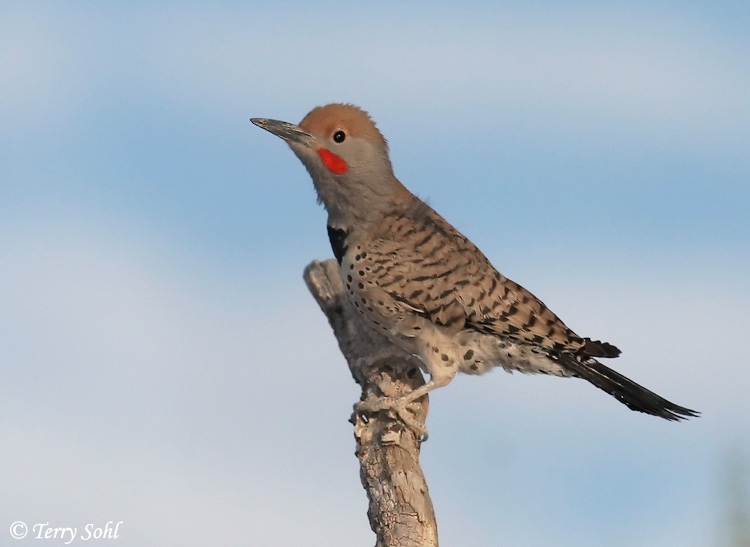
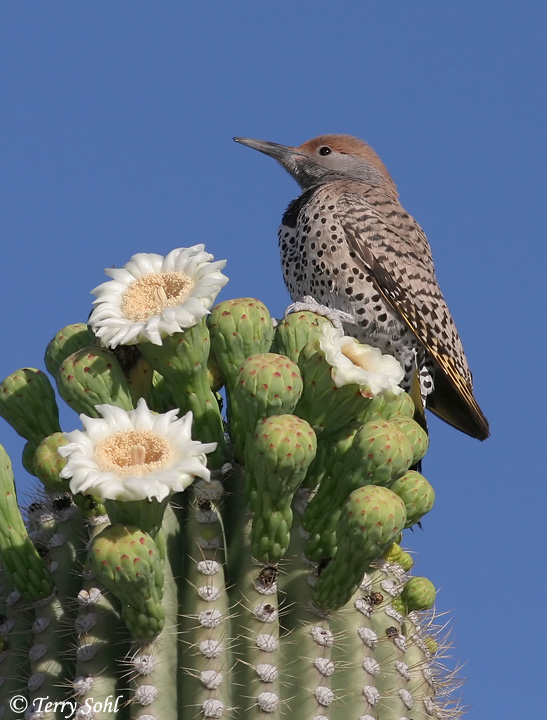
- Gilded Flicker - In the Desert Southwest, both the Northern Flicker and Gilded Flicker may occasionally cross paths and pose an identification challenge. The two are very similar in overall size, plumage, and structure. Gilded Flickers have a brownish crown, while Gilded Flickers is more gray. Where they overlap, note that the predominant form of the Northern Flicker is the Red-shafted version, with a reddish town on their underwings. That contrasts to the yellowish tone of the underwing of a Gilded Flicker.
- Gila Woodpecker - Another species that could potentially overlap in range with the Red-bellied Woodpecker in the Desert Southwest, with a similar size and structure, a darker upperbody, lighter lowerbody, and red markings on the head. However, the Gila Woodpecker has black and white barring on its back (very similar to the Red-bellied Woodpecker noted above), and few contrasting markings on the head and underside compared to the strongly patterned Northern Flicker.
 |
 |
 |
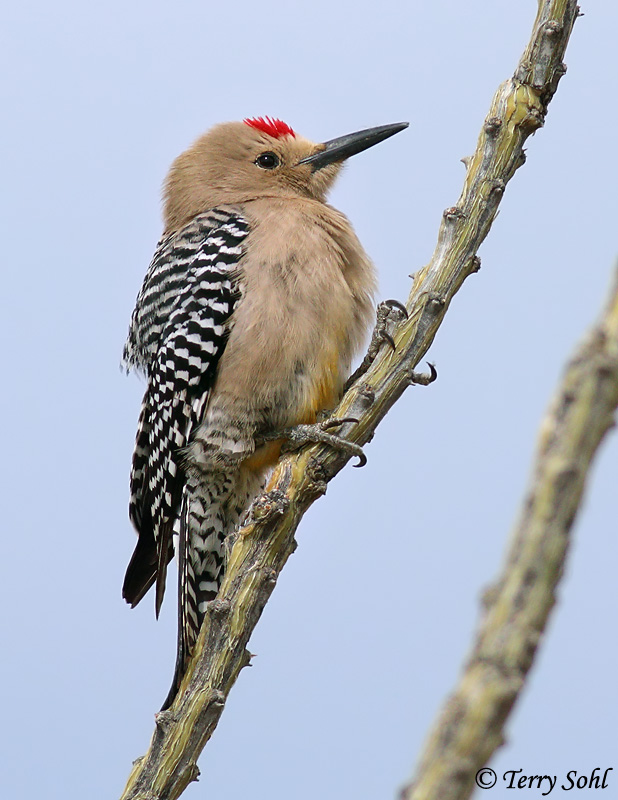 |
| Red-bellied Woodpecker | Gilded Flicker | Gilded Flicker | Gila Woodpecker |
Bird Feeders
Will attend feeders for suet, nuts, and fruits.
Birdhouses
Northern Flickers will use appropriately sized nest boxes, preferably with a hole about 2 1/2 inches in diameter. Click here for instructions on building an appropriately sized nest box for a Northern Flicker.
Conservation Status
Indications are that Northern Flickers have declined in recent decades, likely in response to competition for nesting cavities with European Starlings. However, they are still found across a very broad geographic area in North America, and are common in parts of their range. The IUCN considers the Northern Flicker to be a species of "Least Concern".
Photo Information
October 2016 - Minnehaha County, South Dakota - Terry Sohl
Audio File Credits
- 1Sunny Tseng. Recorded in Pacific Regional Spirit Park in Canada on May 12th, 2019. Original file and information from xeno-canto.
- 2Sunny Tseng. Recorded in Kitslano Beach in Canada on February 28th, 2020. Original file and information from xeno-canto.
- 3Richard E. Webster. Recorded in Sonora, Mexico on July 10th, 2006. Original file and information from xeno-canto.
Differences between Yellow- and Red-shafted Northern Flicker Plumages
 |
 |
 |
 |
| Yellow-shafted Male: Brownish face and throat Black "mustache" Red spot on nape |
Yellow-shafted Female: Brownish face and throat No "mustache" Red spot on nape |
Red-shafted Male: Grayish face and throat Red "mustache" No spot on nape |
Red-shafted female: Grayish face and throat No "mustache" No spot on nape |
