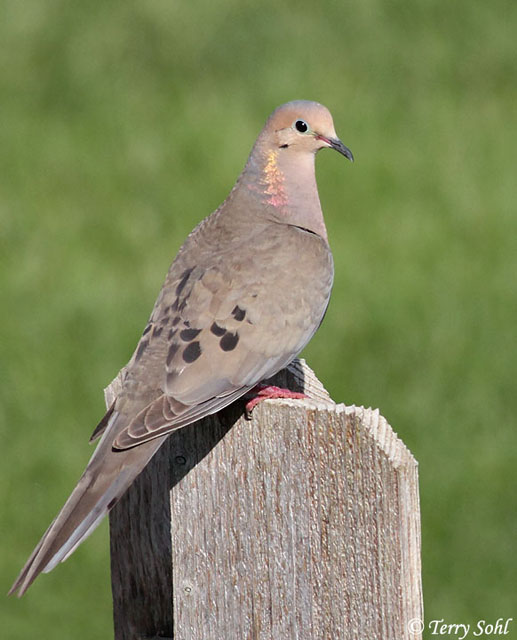
One of the most common birds across the state in the summer time, Mourning Doves are a very common sight across a variety of open and semi-open habitats. A prolific breeder, they will often raise multiple broods per year, and has been documented raising up to 6 broods in a single year in warmer southern states. Their mournful cooing songs are a common sound in much of the United States during the spring and summer months.
Habitat
Farms, residential areas, roadsides, grasslands, open woods. Found in nearly any open or semi-open habitat.
Diet
Feeds almost exclusively on seeds. Will rarely take insects or tiny invertebrates.
Behavior
Does the majority of foraging on the ground, filling its crop with seeds before moving off to digest seeds at rest. They will also occasionally feed on seeds while perched in vegetation.
Nesting
Late April through mid-September, often with multiple broods in one year. Mourning Doves are monogamous, forming strong bonds that may span multiple years. When constructing a nest, the male gathers material and passes it to the female, who constructs the actual nest. The nest is a very poorly built, flimsy platform of twigs and grasses, typically built amongst the foliage of a dense bush or tree, but they will also nest on the ground or on man-made structures. Two eggs are laid, with both the male and female helping to incubate them. Incubation lasts about 2 weeks, and the young fledge from the nest about 2 weeks after hatching.
Song
The song of a Mourning Dove is a mournful cooing consisting of multiple phrases. They also have a distinctive whistling sound that comes from the wings when they take flight.
- Click here to hear the song of a cooing Mourning Dove, from Chautauqua County, New York.1
- Click here to hear the typical sound of a Mourning Dove taking flight, from Edwards County, Texas.2
Migration
Most northern Mourning Doves migrate south in the fall, but some may remain in winter.
Interactive eBird Map
Click here to access an interactive eBird map of Mourning Dove sightings
Similar Species
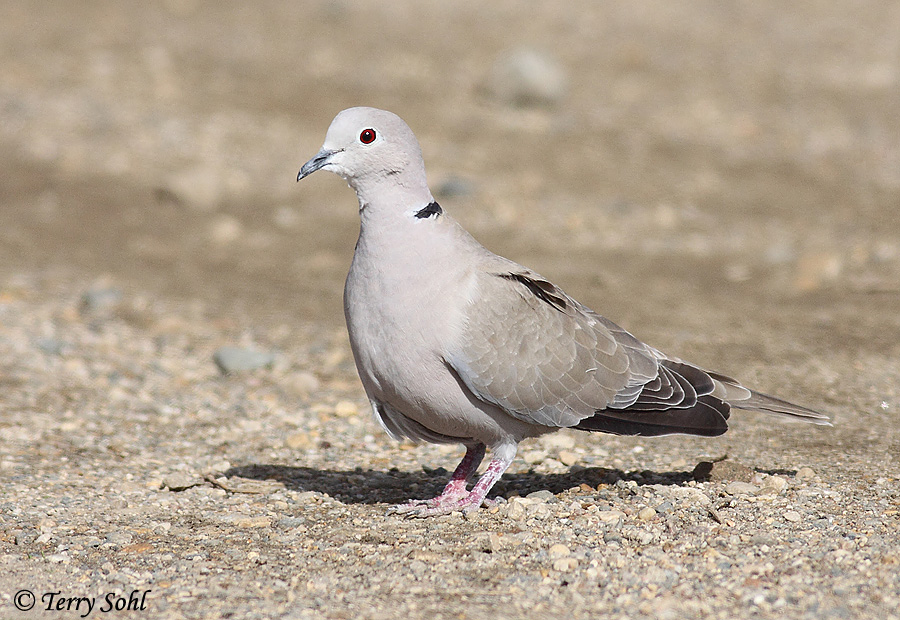
Until around 2000, there wasn't much of a chance of confusing Mourning Doves with other species in South Dakota. With the rapid spread of Eurasian Collared Doves that's changed, as both are common in many parts of the state. Also, climate change seems to be driving White-winged Doves northward in recent years, with many records in Nebraska and increasing numbers of records in South Dakota.
- Eurasian Collared Dove - Structurally similar to Mourning Doves and sharing the same overall grayish body tone, the easiest way to differentiate between the two species is the obvious black crescent on the back of the neck of a Eurasian Collared Dove. Mourning Doves also have black spots on their wings, which are lacking from Eurasian Collared Doves.
- White-winged Dove - A rarity in South Dakota but seemingly more sightings each year. The obvious mark of a White-winged Dove is a white wing patch that's visible both in flight and while the bird is at rest. White-winged Doves also lack the black wing spots of a Mourning Dove, and have a shorter tail.
 |
 |
 |
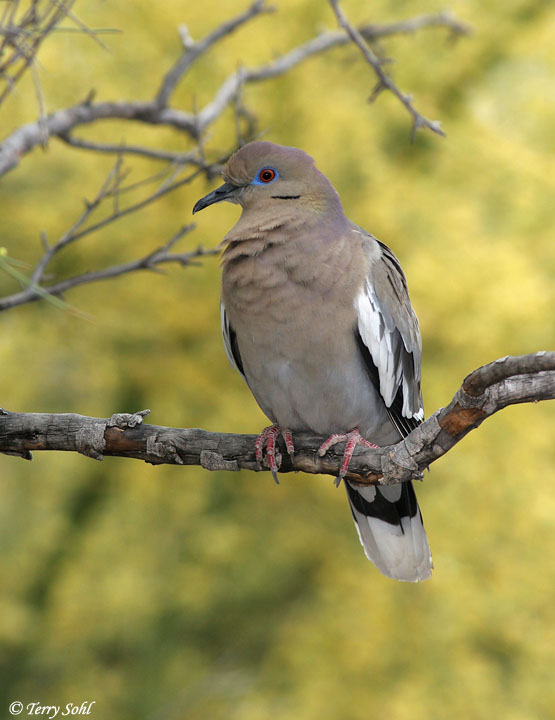 |
| Eurasian Collared Dove | Eurasian Collared Dove | White-winged Dove | White-winged Dove |
Bird Feeders
Will attend for sunflower seeds, millet, cracked corn, and other seeds.
Conservation Status
Very common and widespread, there are probably many more Mourning Doves now than before European Settlement, due to man's fragmentation of habitat. They are hunted heavily in many parts of the United States, but it hasn't been a threat to overall populations. The IUCN considers the Mourning Dove to be a species of "Least Concern".
Photo Information
July 5th, 2009 - Brandon, South Dakota -- Terry L. Sohl
Audio File Credits
- 1Jim Berry, XC407859. Accessible at www.xeno-canto.org/407859
- 2Andrew Spencer, XC35100. Accessible at www.xeno-canto.org/35100
