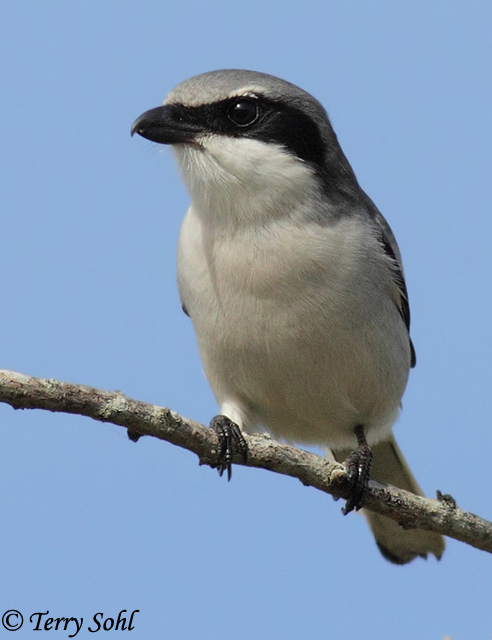
The Loggerhead Shrike is the smaller of the two Shrike species found in South Dakota. Loggerhead Shrikes are very similar in overall appearance to Northern Shrikes. They are birds of two different seasons in the state, with Loggerhead Shrikes breeding in the state and found here during the summer months, while Northern Shrikes are birds of the winter months in South Dakota. However there are times of the year when both may potentially be found in South Dakota (both species are a possibility in the state in March and April, for example). Keys to differentiating the two species is found below.
The Loggerhead Shrike can often be found perching on a post or fence line as it searches for food. Loggerhead Shrikes have the nickname of "Butcher Bird", because of its habit of impaling the bodies of prey items on spines of plants or on barb wire. While usually returning later to consume the stored prey, the impaled prey may also serve as a territory marker, and to attract mates to a territory.
Habitat
Can be found in nearly any open to semi-open country, as long as hunting perches are present.
Diet
Primarily feeds on large insects, especially grasshoppers and crickets. Will also eat small rodents and small birds. Less common prey includes fish, frogs, salamanders, lizards, snakes, and snails.
Behavior
Loggerhead Shrikes most frequently hunt by observing from a perch, and swooping down to capture prey when spotted. Food is typically captured on the ground. They may also hover for a short time in search of prey, or even hunt while on the ground.
Nesting
April through June. The nest of a Loggerhead Shrike is a cup of sticks, weeds, grasses, and other material, lined with softer material such as hair, grasses, moss, and feathers. The female lays between 4 and 8 eggs, and she alone incubates them. When the eggs hatch, both parents help feed the young. The young fledge after about 3 weeks, and typically stay with the parents for another 3 or 4 weeks after fledging.
Song
Loggerhead Shrikes have a variety of notes in their repertoire which they may string together in long, unpredictable, and variable songs. Songs may consist of whistles, buzzes, trills, warbles, and harsh call notes.
1Click here to hear the song of a Loggerhead Shrike, recorded in San Bernardino County, California.
2Click here to hear the begging calls of young Loggerhead Shrike, recorded in Cameron Parish, Louisiana
3Click here to hear the screeching alarm calls of a Loggerhead Shrike, recorded on San Clemente Island off the California coast.
Migration
Found year round in the southern half of the United States. Birds in the Northern Plains and Canada move southward in the fall (including those in South Dakota).
Interactive eBird Map
Click here to access an interactive eBird map of Loggerhead Shrike sightings
Similar Species
The unique plumage with the dark eye mask make it relatively easy to identify, particularly if the "hooked" beak is seen at close range. There is one species however that's extremely similar, and others that could potentially be confused with Loggerhead Shrike:
- Northern Shrike - Very similar in overall plumage and size, seasonality is a big clue for which Shrike species is present. While there is some possibility of overlap in the shoulder seasons, Northern Shrikes are a bird of the winter months in South Dakota, while Loggerhead Shrikes are summer breeding residents. During seasons when ID may be in doubt (both species may be present during the months of March and April, for example) plumage is one clue, as Northern Shrikes often have a "scaly" pattern on their breast, with fine darker markings against the gray underside. Loggerhead Shrikes lack that pattern and have a much "cleaner" underside. The mask is also a clue, as the mask of a Loggerhead Shrike is more extensive than a Northern Shrike. On a Loggerhead Shrike, the mask is thicker and typically goes over the eye and above the bill. It's thinner on a Northern Shrike, often with much less black in front of the eye. Note one exception to ID keys...Young Loggerhead Shrikes often look very similar to a Northern Shrike, with less black on the mask and even with some pattern on the upper breast somewhat similar to a Northern Shrike. Note that these young birds though will only be seen in the early summer in South Dakota, when Northern Shrike are long gone.
- Gray Catbird - If seen well, ID isn't an issue. Gray Catbirds are gray overall like a Loggerhead Shrike, but have a black crown and lack the black facial mask. Gray Catbirds are also more uniformly brown, while Loggerhead Shrikes are pale underneath. Gray Catbirds lack the black wings of a Loggerhead Shrike. And clearly, the hooked "hunting" bill of a Loggerhead Shrike is markedly different than the thin bill of a Gray Catbird.
- Northern Mockingbird - Both share an overall gray appearance, and lighter underparts than upperparts. The Northern Mockingbird lacks the dark mask, and has a thin bill compared to the thick hooked bill of a Loggerhead Shrike. Loggerhead Shrikes also have obvious, black wings while Northern Mockingbirds do not.
Conservation Status
Populations have declined in recent decades. Loggerhead Shrikes are now nearly absent from the Northeastern United States and locally elsewhere. It's unclear as to the cause of the decline, although pesticide use (and consumption of poisoned insects) is likely one culprit. Loggerhead Shrikes still have a very wide geographic range and aren't uncommon in parts of their range. However, given the relatively rapid decline in populations, the IUCN lists the Loggerhead Shrike as a "Near Threatened" species.
Photo Information
December 10th, 2012 - Everglades National Park in Florida - Terry Sohl
Audio File Credits
1Ed Pandolfino, XC455607. Accessible at www.xeno-canto.org/455607
2Jim Holmes, XC317046. Accessible at www.xeno-canto.org/317046
3James Bradley, XC297257. Accessible at www.xeno-canto.org/297257
