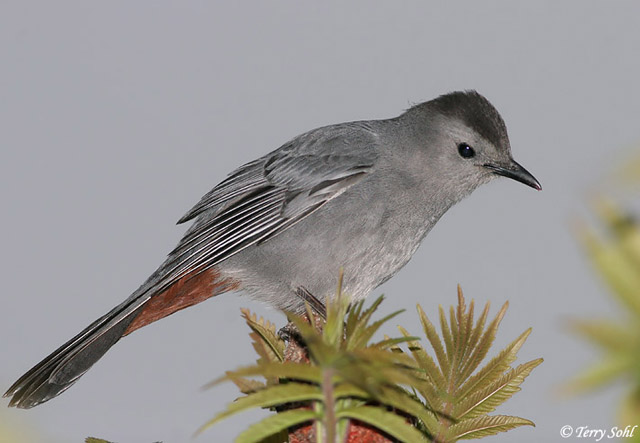
The Gray Catbird is named for the occasional cat-like mewing that the bird makes. Appropriately, a group of Gray Catbirds is also sometimes called a "mewing". Gray Catbirds have a remarkably varied vocabulary beyond the mewed call notes. A singing male has a long and complex song. He rarely repeats the same phrase as he sings a mix of melodic and grating noises, with individual phrases sometimes "borrowed" from sounds they hear around them (other birds, or even noises such as creaky hinges). They will attend feeders for a wide variety of items, some of which are rarely consumed by other birds attending feeders.
Habitat
The Gray Catbird inhabits dense shrubby habitats, including woodland edges, hedgerows, thickets, overgrown fields, riparian corridors, parks, gardens, and suburban neighborhoods. It prefers areas with thick, tangled vegetation that provide excellent cover for nesting and foraging. During migration and winter, Gray Catbirds also frequent fruiting shrubs, forest edges, and tropical scrub habitats.
Diet
The Gray Catbird feeds on a wide variety of insects, spiders, berries, and fruits. During the breeding season, insects and other invertebrates make up most of its diet, while berries and other fruits become increasingly important in late summer, fall, and winter. It forages primarily in dense shrubs and low vegetation, gleaning prey from leaves and branches or picking fruit directly from plants.
Behavior
Feeds on berries and fruit in bushes and trees. When foraging for insects, many are caught on the ground, but they will also catch insects in the foliage of vegetation. They are often found moving through dense underbrush, but will also sometimes forage out in the open.
Nesting
June and July. The nest of a Gray Catbid is a large cup of twigs, grasses, leaves, weed stems, and other material, placed relatively close to the ground (3 to 10 feet) in a dense shrub or small dense tree. The female usually lays 3 or 4 eggs, and she alone incubates them. When the eggs hatch, both parents help to feed the young, who leave the nest after about 12 days.
Song
The song of a male Gray Catbird is a complex series of whistles, chirps, harsher mewing, and other notes. The song often contains snippets of noises heard in the bird's environment, including sounds of other birds, insects or frogs, or even man-made sounds. The call (and namesake) of a Gray Catbirds is a mewing that does indeed sound similar to a mewing cat. They also have other various calls and vocalizations given in alarm, when flushed, or when interacting with other birds.
- Click here to hear the long extending singing of a male Gray Catbird, recorded in Des Moines, Iowa1
- Click here to hear the mewing call of a Gray Catbird, recorded in Orange County, Florida2
Migration
Summers throughout the eastern three-fourths of the United States. Winters in the Southeastern United States and points south, into Mexico, the Caribbean, Central America, and northern South America.
Interactive eBird Map
Click here to access an interactive eBird map of Gray Catbird sightings
Similar Species
Overall gray plumage, dark cap, and the rusty undertail are diagnostic, but there are some other grayish or plain looking birds that could potentially be confused with the Gray Catbird.
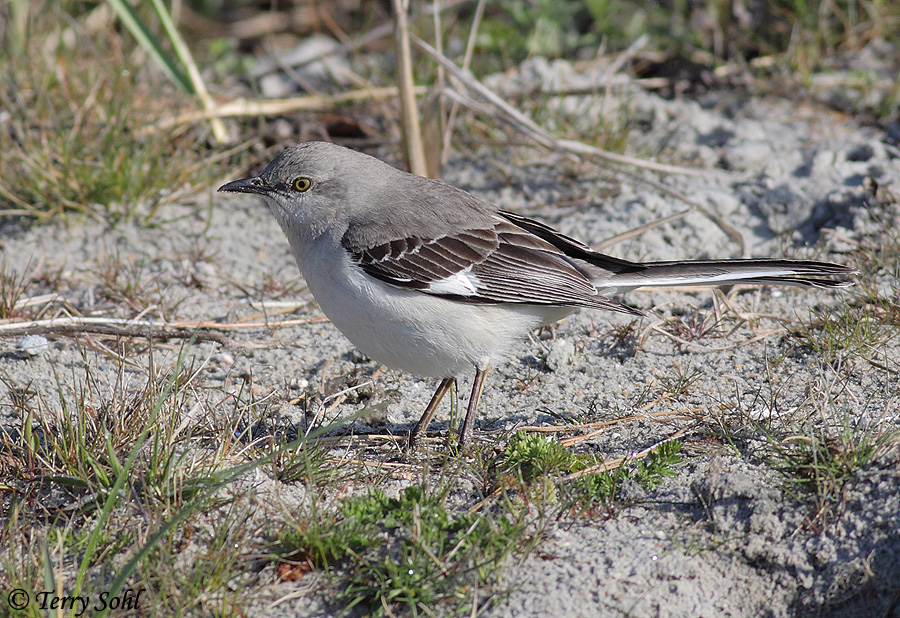
- Northern Mockingbird - Northern Mockingbirds are primarily found south of South Dakota, but their range is expanding and there are increasing sightings in the state.Northern Mockingbirds are larger than a Gray Catbird, and have more of a two-toned look, with gray plumage on the upperparts and lighter plumage underneath. They also lack the rusty undertail and black cap of a Gray Catbird, and have white wingbars that are absent on the Gray Catbird.
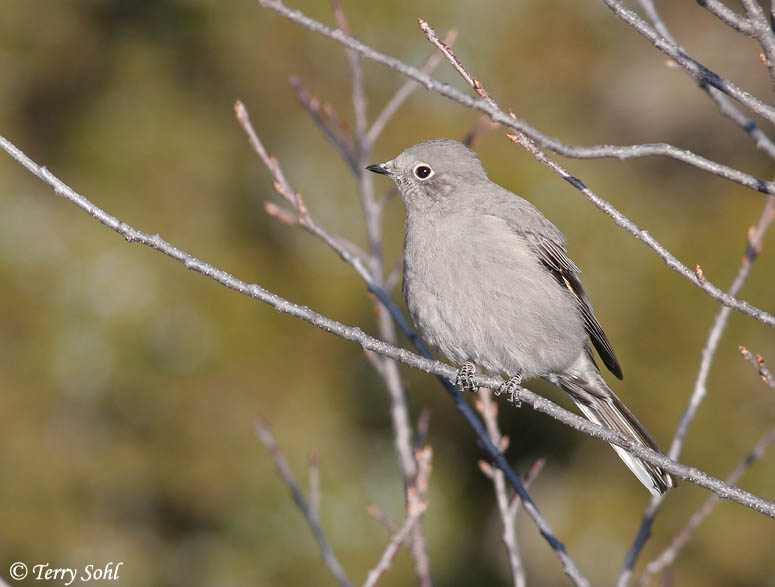
- Townsend's Solitaire - Townsend's Solitaire are breeding residents in the Black Hills, and are rare winter visitors elsewhere in the state. They too are a species with a gray overall plumage. However, they have an obvious white eye-ring, and lack the dark cap and rusty undertail of a Gray Catbird.
 |
 |
 |
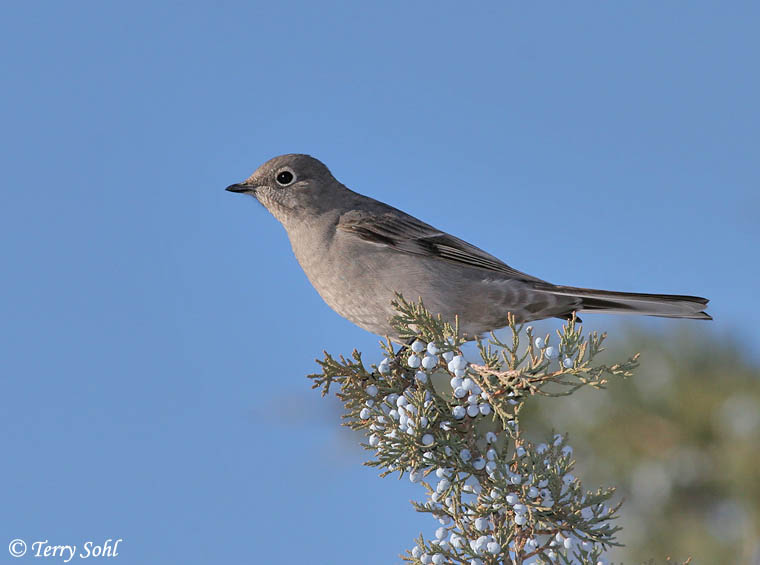 |
| Northern Mockingbird | Northern Mockingbird | Townsend's Solitaire | Townsend's Solitaire |
Conservation Status
Declining in some parts of the country due to local habitat loss, but overall populations are stable, and they are found over a wide geographic region. The IUCN lists the Gray Catbird as a species of "Least Concern".
Feeders
Nuts, fruit, bread and other baked products, boiled potato, cheese, cornflakes...you get the idea. Will eat a very wide array of items at feeders. In my yard they primarily come for berries growing on bushes and trees in my landscaping (viburnum, serviceberry, crabapple), but I also sometimes see them picking at suet.
South Dakota "HotSpot"
Gray Catbirds are quite easy to find in the eastern part of the state, particularly in around riparian areas and other woodlands, including in Newton Hills State Park, the Big Sioux Recreation Area, Beaver Creek Nature Area, the Outdoor Campus in Sioux Falls, and other similarly wooded areas.
Further Information
- eBird - Gray Catbird
- Audubon Field Guide - Gray Catbird
- Cornell Lab of Ornithology - All About Birds: Gray Catbird
Photo Information
May 27th, 2008 - Big Sioux Recreation Area near Brandon, South Dakota - Terry Sohl
Audio File Credits
- 1Bobby Wilcox, XC425777. Accessible at www.xeno-canto.org/425777
- 2Paul Marvin, XC460766. Accessible at www.xeno-canto.org/460766
