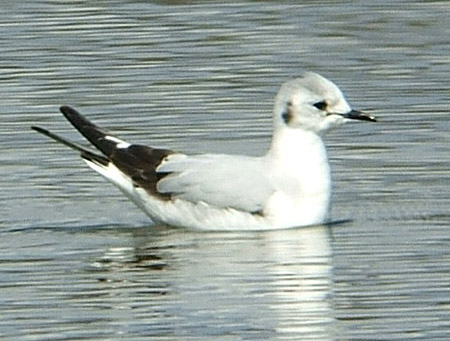
ID Keys: Black underwings, black head (breeding), small thin bill
The
Little Gull is a fairly recent arrival in North America, having invaded from
Eurasia during the 1900s. The first documented breeding on the
continent occurred in 1962, and small numbers now breed around the Great
Lakes and Hudson Bay. It's unclear at this time whether Little Gull's
have become established and have self-sustaining breeding populations in
North America, or if they rely on incoming birds from Eurasia to sustain the
population. The photo on the right is of a first-summer bird.
Habitat
Found around low marshy areas in
and around inland lakes during the summer breeding season. During the
winter, most winter along the coastlines.
Diet
Primarily feeds on insects and
insect larvae in summer. Also will feed on small crustaceans and mollusks,
spiders, marine worms, and small fish.
Behavior
Often feeds while in flight, flying
slowly and dipping down to the water's surface when food is spotted.
Will also feed on land, or by wading and swimming in shallow water.
Breeding
Non-breeder in South Dakota
Song
A soft kek-kek-kek-kek.
Migration
The few in North America primarily summer around
the Great Lakes and Hudson Bay, with most migrating to the Atlantic coast in
winter.
Populations in North America are still
very small, and its not clear whether there's currently a self-sustaining
breeding population on the continent, or if most of the small numbers of
birds here are migrants from Eurasia.
Photo Information
April 19th, 2006 - St. Mary's
Wetland, Northumberland, UK - Source: Wikipedia Commons