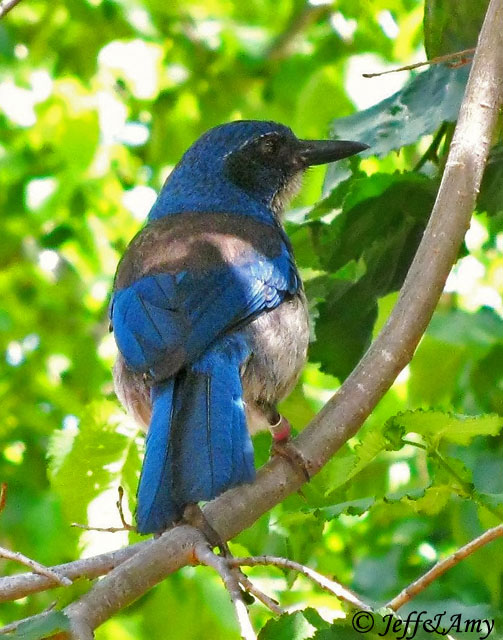
ID Keys: Dark blue plumage on upperparts, brown patch on upper back,
light underparts with blue undertail coverts, long thick bill
compared to other Scrub Jays
The
Island Scrub-Jay likely has the smallest geographic range of any North
American bird species. The entire population is found on one small
island off the coast of California, Santa Cruz Island. There, recent
estimates put the total population at no more than 4,000 individuals, and
there may be as few as 1,000 breeding pairs in existence. While the
current population appears to be stable, given the very small breeding
range, they are susceptible to a single disturbance or disease event.
Given that West Nile Virus has taken a heavy toll on other Jay species in
parts of North America, there is some concern that the arrival of West Nile
Virus on Santa Cruz Island could have a strong negative impact on Island
Scrub-Jay populations. Note that the Island Scrub-Jay, the
Western Scrub-Jay, and the
Florida Scrub-Jay were until
relatively recently all considered one Scrub-Jay species.
Habitat
The Island Scrub-Jay is found exclusively on Santa Cruz Island, where it inhabits oak woodlands, pine forests, chaparral, riparian woodlands, and patches of coastal sage scrub. It prefers areas with dense shrubs and mature trees that provide acorns, nesting sites, and cover. Because the entire species is confined to this single island, its habitat is extremely limited and of high conservation importance.
Diet
The Island Scrub-Jay feeds on a wide variety of foods, including acorns, seeds, nuts, berries, fruits, insects, spiders, lizards, eggs, nestlings, and small mammals. Acorns from island oak species are a particularly important food source, and the jays cache thousands of them each year for later use. They also take advantage of seasonal fruits and a variety of animal prey throughout the year.
Behavior
The Island Scrub-Jay is an intelligent, inquisitive, and highly territorial bird that usually lives in family groups year-round. It spends much of its time foraging on the ground and in trees, caching thousands of acorns and other food items for later use. Family members cooperate in defending territories, and young birds may remain with their parents to help raise subsequent broods. Because it evolved in isolation on Santa Cruz Island, the species is relatively tame and less wary of humans than many mainland jays.
Nesting
The nest of an Island Scrub-Jay is
constructed of sticks and twigs, lined with finer material such as grasses
and rootlets. It is placed in a shrub or small tree, anywhere from
ground-level to 40 feet up. The female lays between 2 and 5 eggs. The
female alone incubates the eggs, with the male bringing her food during the
incubation period. When the eggs hatch, both parents help tend to and
feed the young. The young leave the nest after about 18 days.
Song
The Island Scrub-Jay has a rich repertoire of loud, harsh skree and rasping scolding calls used to defend territories and warn of predators. It also produces softer whistles, rattles, and quiet contact notes that help maintain communication among family members. Like other scrub-jays, it is an extremely vocal species, and its varied calls are heard throughout the oak woodlands and chaparral of Santa Cruz Island.
Migration
The Island Scrub-Jay is nonmigratory, spending its entire life on Santa Cruz Island. Individuals occupy and defend territories year-round, making only short local movements in search of food or nesting sites.
Similar in appearance to the
other Scrub-Jay species, the Western
Scrub-Jay and the Florida
Scrub-Jay. However, the Island Scrub Jay is the only Jay species
found on Santa Cruz Island, so in range, it is unmistakable. They can be
distinguished from the other Scrub-Jay species by their larger size, their
larger and thicker bill, and the increased amount of black on the forehead
and nasal tufts.
Conservation Status
The Island Scrub-Jay is classified as Near Threatened by the International Union for Conservation of Nature because its entire global population is restricted to Santa Cruz Island. This extremely limited range makes the species vulnerable to disease, wildfire, habitat changes, invasive species, and other catastrophic events. Although the population is currently stable and protected within Channel Islands National Park and adjacent conservation lands, its restricted distribution means continued monitoring and habitat protection are essential.