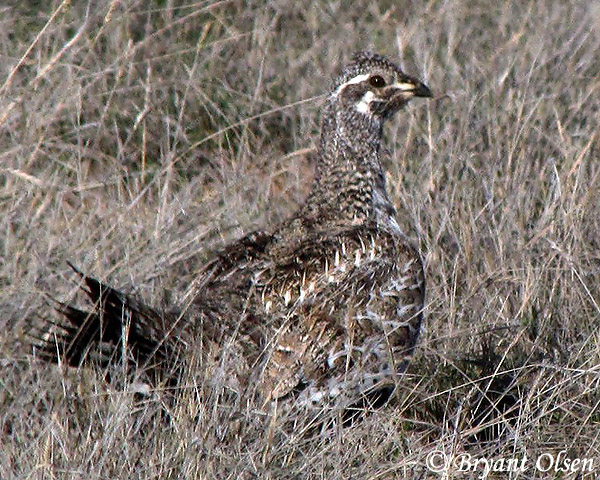
The Gunnison Sage-Grouse and the Greater Sage-Grouse were once considered a single Sage-Grouse species. However, range differences, size differences, and differences in the males' courting displays led to genetic testing which revealed the two should be split into two distinct species. Official designation of the Gunnison Sage-Grouse as a distinct species occurred in the year 2000.
Gunnison Sage-Grouse are only about 2/3rds the size of the Greater Sage Grouse. They have differences in plumage as well, with the Gunnison Sage Grouse generally having a paler tail, as well as longer and thicker "filoplumes" on displaying males. Displays of the males are decidedly unique as well. The ranges of the two species evidently have very little overlap, and genetic testing shows little if any cross-breeding between the two species.
Habitat
The Gunnison Sage-Grouse inhabits extensive sagebrush shrublands, mountain valleys, and high desert basins of southwestern Colorado and southeastern Utah. It depends on healthy stands of big sagebrush throughout the year, using them for nesting, brood-rearing, winter cover, and food. During the breeding season, males gather on open display grounds called leks, while females nest beneath sagebrush shrubs surrounded by grasses and wildflowers that provide concealment and food for chicks.
Diet
Feeds on both plant and animal matter. In the winter, they depend heavily on the buds and leaves of sagebrush. Summer diet also consists of significant numbers of insects, especially for the young-of-year birds. Other food items include fruit and berries, flowers, and seeds.
Behavior
Foraging is typically done in the early morning or late evening, with birds walking along the ground and consuming plant material or chasing insects.
Nesting
Breeding activity occurs at traditional Lek sites, with males performing elaborate displays to attract females. Only 1 or 2 dominant males typically breed with the females. After breeding, the females move to nearby nesting grounds, building a nest under the base of sagebrush plants. The nest is a simple depression in the soil, lined with plant material and down. The female alone incubates the eggs, and raises the young.
Song
The display of a male Gunnison Sage-Grouse consists of 9 low-pitched whooping sounds with three swishing wing movement sounds in the middle.
Migration
The Gunnison Sage-Grouse is a nonmigratory species that remains within its limited range throughout the year. Individuals make only short seasonal movements between breeding leks, nesting areas, brood-rearing habitats, and wintering sagebrush stands in response to snow cover and food availability. Unlike many birds, it depends on suitable sagebrush habitat year-round and does not undertake long-distance migrations.
Interactive eBird Map
Click here to access an interactive eBird map of Gunnison Sage Grouse sightings
Similar Species
Greater Sage-Grouse. The Gunnison Sage-Grouse is noticeably smaller than the Greater Sage-Grouse, with a shorter tail, finer barring, and a more compact appearance. Males have smaller white breast ruffs and shorter, less conspicuous yellow air sacs during courtship displays. Gunnison Sage-Grouse are also restricted to southwestern Colorado and southeastern Utah, whereas Greater Sage-Grouse occupy a much broader sagebrush range across the western United States and southern Canada.
Conservation Status
The Gunnison Sage-Grouse is classified as Endangered by the International Union for Conservation of Nature and is also listed as Threatened under the U.S. Endangered Species Act. Total population of the species is likely under 5,000 individuals. Its small, fragmented population faces ongoing threats from habitat loss and fragmentation, energy development, invasive plants, altered fire regimes, and climate change. Intensive conservation efforts focus on protecting and restoring sagebrush ecosystems, maintaining breeding leks, and improving habitat connectivity to support the species' long-term survival.
Further Information
- eBird - Gunnison Sage-Grouse
- Audubon Field Guide - Gunnison Sage-Grouse
- Cornell Lab of Ornithology - All About Birds: Gunnison Sage-Grouse
Image Information
Photo by Bryant Olsen - March 28th, 2012 - San Juan County, Utah - Photo licensed through Creative Commons Attribution Non-Commerical 2.0 Generic License .
