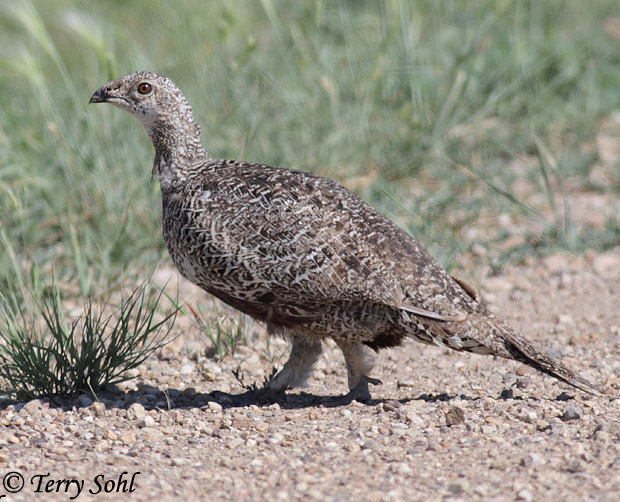
The largest of the North American Grouse, the Greater Sage Grouse and the very similar Gunnison Sage Grouse were just recently split into two separate species, when it was discovered that Gunnison Sage Grouse (not found in South Dakota) were genetically distinct and had different breeding displays and calls. Greater Sage Grouse have spectacular spring mating displays on their leks (traditional breeding grounds), with male birds struting and rapidly inflating and deflating the large air sacs in their breast (see photo to the right). Sage Grouse are heavily dependent on sagebrush habitat, and quickly disappear from areas where this habitat is converted to agricultural fields or grasslands for grazing. A female is depicted in the photo on the right.
Habitat
The Greater Sage-Grouse inhabits vast expanses of sagebrush-dominated landscapes, including sagebrush steppe, high desert shrublands, and mountain foothills of western North America. It depends on large, intact stands of sagebrush year-round, using them for nesting, brood-rearing, winter cover, and food. During the breeding season, males gather on open display grounds known as leks, while females nest in nearby sagebrush with abundant grasses and forbs that provide concealment and food for chicks.
Diet
Relies very heavily on leaves and fresh shoots of sagebrush, especially during the fall and winter. Will eat other leaves, flowers, buds, and fresh shoots in other seasons, and also consumes some insects during summer months.
Nesting
May and June. The nest is a shallow scrape in the ground, lined with sparse bits of vegetation. It is usually placed under a sagebrush plant, or at the base of other vegetation. The female usually lays between 7 and 9 eggs, and she alone incubates them. After the eggs hatch, the young quickly leave the nest. They are tended to by the female, but find their own food.
Song
The Greater Sage-Grouse is best known for the male's remarkable courtship display, during which it produces a series of deep pops, swishes, and bubbling sounds by inflating and rapidly deflating large yellow air sacs on its chest. These distinctive booming vocalizations can carry long distances across sagebrush leks and are used to attract females and compete with rival males. Outside the breeding season, the species is generally quiet, giving only soft clucks and low contact calls.
Migration
The Greater Sage-Grouse is a nonmigratory species, but many populations make seasonal movements between breeding, brood-rearing, and wintering habitats. These movements are typically short to moderate in distance and are driven by snow depth, food availability, and the distribution of suitable sagebrush. Most birds remain within the same general landscape throughout the year rather than undertaking long-distance migrations.
Interactive eBird Map
Click here to access an interactive eBird map of Greater Sage Grouse sightings
Similar Species
Gunnison Sage Grouse , not found in South Dakota.
Conservation Status
The Greater Sage-Grouse is classified as Vulnerable by the International Union for Conservation of Nature because of significant long-term population declines and the continuing loss and fragmentation of sagebrush habitat. Major threats include energy development, agriculture, invasive grasses, increasingly frequent wildfires, and climate change. Extensive conservation efforts across the western United States and Canada focus on protecting and restoring sagebrush ecosystems that are essential to the species' survival.
Further Information
- eBird - Greater Sage Grouse
- Audubon Field Guide - Greater Sage Grouse
- Cornell Lab of Ornithology - All About Birds: Greater Sage Grouse
Photo Information
July 23rd, 2012 - Harding County, South Dakota - Terry Sohl
