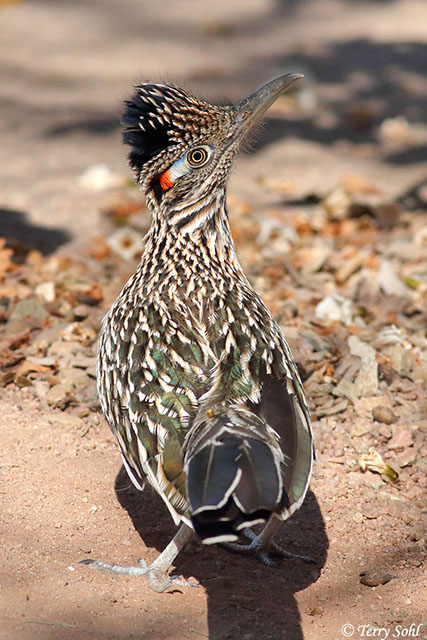
The Greater Roadrunner is a unique bird most commonly found in the dry Sonoran desert habitat of the American Southwest, but with a range that extends eastward to Louisiana and Arkansas. They are unique in appearance and in behavior. They are large birds with long tails that double their total length. They are most commonly seen walking or running along the ground as they forage for food, and will only take flight if threatened or disturbed. They are the largest member of the North American cuckoo family.
Habitat
Found in a variety of brushy habitats, but is the most common in Sonoran desert habitats with scattered scrubs and cactus. They are much less commonly found in grassland or woodland edges.
Diet
Omnivorous, feeding on a wide variety of items. Mostly feeds on animals, including large insects, lizards, snakes, small rodents, small birds, eggs, scorpions, and large spiders like tarantulas. They will also eat fruits and berries, sometimes feeding heavily on cactus fruits in season in appropriate habitats. Seeds and nuts are also sometimes eaten if available.
Behavior
The Greater Roadrunner is a fast-running, ground-dwelling bird that spends much of its time searching for prey across deserts, scrublands, and open woodlands. It feeds on insects, lizards, snakes, rodents, and other small animals, capturing prey with quick bursts of speed and powerful strikes. Although capable of flight, it prefers to run and often escapes predators by sprinting through dense vegetation. Greater Roadrunners are generally solitary or found in pairs, and they vigorously defend their territories throughout the year.
Nesting
The Greater Roadrunner is thought to possibly mate for life, as nesting pairs will defend a territory at all times of the year. The nest is a platform of sticks, lined with softer vegetative material and feathers, placed between 2 and 10 feet from the ground in a bush, cactus, or small tree. Both the male and female help to incubate the eggs, and both parents help to feed and tend to the young after they hatch.
Song
The Greater Roadrunner gives a variety of low, dove-like coos, often heard as a slow series of coo-coo-coo-coo notes during the breeding season. It also produces clucking, growling, bill-snapping, and rattling sounds used in territorial defense, courtship, and communication between mates.
Migration
The Greater Roadrunner is a nonmigratory species that remains within its territory throughout the year. Individuals occupy the same general home range in deserts, scrublands, and open woodlands, making only short local movements in response to food availability or weather conditions. Pairs often maintain and defend permanent territories year-round.
Interactive eBird Map
Click here to access an interactive eBird map of Greater Roadrunner sightings
Similar Species
Distinctive, not likely to be confused with another species in range. For additional identification clues, look for a trailing coyote, trying to capture a Greater Roadrunner, or perhaps trying to drop a safe on its head from a high cliff top. :-)
Feeders
Will sometimes come to feeders for offered fruit or seeds.
Conservation Status
The Greater Roadrunner is classified as Least Concern by the International Union for Conservation of Nature because of its wide distribution across the southwestern United States and Mexico and its large overall population. Although localized declines may occur because of habitat loss, road mortality, and urban development, the species remains common throughout much of its range and is not currently considered globally threatened.
Further Information
- eBird - Greater Roadrunner
- Audubon Field Guide - Greater Roadrunner
- Cornell Lab of Ornithology - All About Birds: Greater Roadrunner
Photo Information
Photo taken at the Phoenix Botanical Gardens on December 28th, 2018 - Terry Sohl
