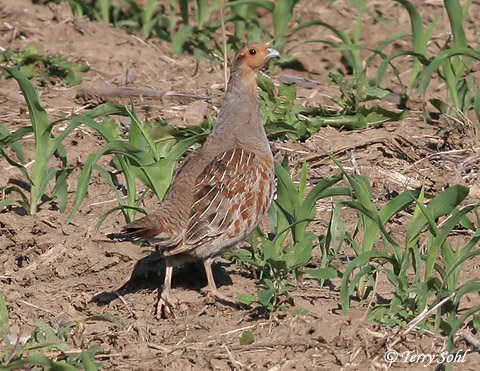
The Gray Partridge is native to Eurasia but was introduced into North America in the early 1900's as a game bird. They have become well established, and can be found through much of the upper Great Plains and parts of the West. The agricultural lands of eastern South Dakota are an ideal habitat, providing shelter along fencerows and other brushy areas and also a readily available winter food source in waste grain.
Habitat
The Gray Partridge inhabits open grasslands, agricultural fields, pastures, hayfields, and prairies with abundant herbaceous cover. It prefers landscapes with a mixture of cropland, weedy field margins, hedgerows, and native grasses that provide nesting sites, food, and protection from predators. In North America, it is most common in the northern Great Plains and Canadian Prairies, where suitable farmland and grassland habitats are available.
Diet
Feeds heavily on seeds and grain, relying heavily on waste grain (corn, sunflowers, wheat) during the winter. Also feeds on insects during the summer months, and green leaves, shoots, and buds.
Behavior
Primarily forages on the ground, although will also take insects and seeds from standing vegetation. They are usually found in small groups, but can be found singly or in pairs early in the breeding season in spring.
Nesting
May through July in South Dakota. The Gray Partridge nests on the ground in a shallow depression concealed by grasses, weeds, or other dense vegetation, often along field edges, hedgerows, or grasslands. The female lines the nest with grasses and feathers and typically lays a large clutch of 10–20 eggs, though even larger clutches occasionally occur. She performs most of the incubation, while both parents protect and care for the chicks, which leave the nest shortly after hatching and feed themselves under adult supervision.
Song
The Gray Partridge gives a loud, raspy, two-syllable call often described as kee-rik, most frequently heard during the breeding season. Males use these calls to advertise territories and attract mates, particularly at dawn and dusk. The species also produces softer clucks, whistles, and contact calls to maintain communication within family groups and coveys.
Migration
The Gray Partridge is a nonmigratory species that remains within its home range throughout the year. Rather than migrating, it makes only short local movements in response to weather, snow cover, and food availability. During winter, family groups gather into coveys and remain in areas with adequate cover and accessible food.
Interactive eBird map
Click here to access an interactive eBird map of Gray Partridge sightings
Similar Species
Chukar. The Gray Partridge is smaller and more subtly colored than the Chukar, with a gray face, orange face patch, finely barred flanks, and a chestnut horseshoe-shaped belly patch. Chukars have bold black-and-white facial markings, a black necklace, bright red bill and legs, and heavily barred flanks. Gray Partridges also favor grasslands and agricultural fields, whereas Chukars are birds of rocky slopes, canyons, and arid mountains.
Conservation Status
The Gray Partridge is classified as Least Concern by the International Union for Conservation of Nature because of its broad distribution across Europe and parts of Asia, as well as introduced populations in North America. However, the species has experienced declines in parts of its native range due to agricultural intensification, habitat loss, and pesticide use. Despite these regional declines, it remains widespread and is not currently considered globally threatened.
Further Information
- eBird - Gray Partridge
- Audubon Field Guide - Gray Partridge
- Cornell Lab of Ornithology - All About Birds: Gray Partridge
Photo Information
June 10th, 2008 - Minnehaha County, South Dakota - Terry Sohl
