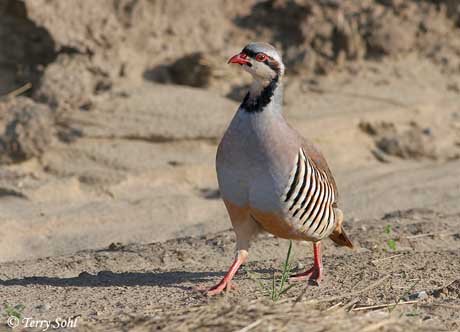
he Chukar is a stocky, ground-dwelling game bird native to Eurasia that has been widely introduced across western North America. It is recognized by its gray-brown body, black facial mask, white throat, and boldly barred flanks. Chukars inhabit dry, rocky hillsides, canyons, grasslands, and shrub-covered slopes, where they feed primarily on seeds, leaves, and insects. In South Dakota, the species is considered rare and local, with occasional records resulting from releases, escapees, or small introduced populations that have generally not become firmly established. Most South Dakota birders regard any Chukar sighting as unusual and often associated with human introductions rather than a naturally occurring population.
Habitat
The Chukar prefers dry, rocky slopes, canyonlands, foothills, sagebrush shrublands, desert mountains, grasslands, and sparsely vegetated hillsides. It prefers rugged terrain with steep rocky areas for escape cover and nearby grasses, forbs, and shrubs that provide food and shelter. In North America, established populations are most common in the arid western United States and southern Canada.
Diet
The Chukar feeds primarily on seeds, grasses, leaves, buds, and other plant material gathered from the ground. During spring and summer it also consumes insects such as grasshoppers, beetles, ants, and other invertebrates, which are especially important for growing chicks.
Behavior
The Chukar is a highly terrestrial bird that spends most of its time walking or running across rocky slopes and open hillsides while searching for food. It typically occurs in coveys outside the breeding season and is known for its ability to run rapidly uphill on steep terrain rather than immediately taking flight. When flushed, it often bursts into strong, fast flight before gliding downhill to cover. Chukars are especially active during the cooler parts of the day and frequently travel between feeding areas and water sources in arid environments.
Breeding
The Chukar nests on the ground in a shallow scrape concealed beneath grasses, shrubs, rocks, or other protective cover. The nest is lightly lined with grasses, leaves, feathers, and other plant material. Typical clutches contain 8–20 eggs, and the female performs most of the incubation while the male often remains nearby to help defend the nesting area.
Song
The Chukar is best known for its loud, repetitive calls often rendered as chuk-chuk-chukar-chukar , from which its common name is derived. These ringing calls carry long distances across rocky hillsides and are frequently given by males during the breeding season, as well as by coveys maintaining contact with one another.
Migration
The Chukar is generally considered nonmigratory. Most birds remain year-round within their home ranges, making only local movements in response to weather, food availability, snow cover, or access to water. In mountainous regions, some populations may shift to lower elevations during severe winter conditions, but the species does not undertake regular long-distance migrations.
Similar Species
Gray Partridge. The Chukar is larger, more colorful, and more boldly patterned than the Gray Partridge. Chukars have a distinctive black band that runs through the eye and around the throat, creating a bold facial mask around a white throat. They also show striking black-and-white barred flanks and bright reddish-orange legs and bill. In contrast, the Gray Partridge has a plain buffy face, orange-brown tail, gray breast, and a much subtler overall appearance. Gray Partridges lack the black facial mask and strongly barred flanks of the Chukar.
Habitat can also be helpful. Chukars are primarily birds of dry, rocky hillsides, canyonlands, and rugged terrain, whereas Gray Partridges favor agricultural fields, grasslands, prairie edges, and open farmland. In areas where both could occur, the bold facial pattern and barred sides make the Chukar relatively easy to identify.
Conservation Status
Has become well established in parts of the west. Introductions in the state evidently have failed. Individual birds seen in the state are likely escapees from captivity. Globally the IUCN considers the Chukar to be a species of "least concern".
Photo Information
October 7th, 2006 - Minnehaha County - Terry Sohl
Interactive eBird Map
Click to access the interactive eBird species sightings page for Chukar
