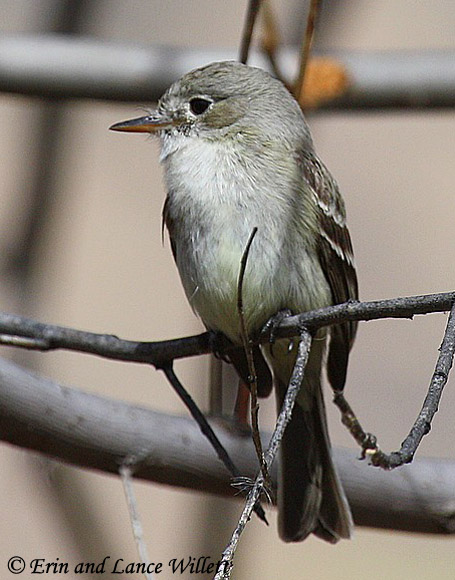
The Gray Flycatcher is the largest of the "Empidonax" flycatchers, but is very similar in appearance to some other western flycatchers, particularly the Dusky Flycatcher and the Hammond's Flycatcher. They are shorter distance migrants than the other Empidonax flycatchers and winter further north than the other species. They are most often found in arid shrublands, such as sagebrush flats or open pinyon and juniper woodlands.
Habitat
Found in open, arid habitats of the western United States in summer, with most found in sagebrush flats. They winter in mesquite groves and other areas of lowland shrubs and trees.
Diet
The Gray Flycatcher feeds almost entirely on insects and other small arthropods, including flies, beetles, moths, bees, wasps, ants, and spiders. It hunts by sallying from exposed perches to capture flying insects in midair and also gleans prey from leaves and twigs. Small berries and other fruits are eaten occasionally, especially during migration and on the wintering grounds.
Behavior
Forages by observing from a perch, and flying out to capture insects. They will catch insects in mid-air, by hovering and gleaning insects from foliage, and by grabbing them off the ground. They usually forage relatively close to the ground.
Nesting
The nest of a Gray Flycatcher is a deep cup built of grasses, twigs, strips of bark, weed stems, and other material, lined with softer materials such as feathers and plant down. The female usually lays 3 or 4 eggs, and she alone incubates them. When the eggs hatch, both parents help feed the young. The young fledge after about 17 days.
Song
The Gray Flycatcher is best known for its distinctive song, a soft, two-note che-bek that is repeated at regular intervals during the breeding season. It also gives sharp whit calls used for contact and alarm. Like many Empidonax flycatchers, its vocalizations are among the most reliable ways to identify the species in the field.
Migration
The Gray Flycatcher is a migratory species that breeds in the Great Basin and other arid regions of the western United States and southwestern Canada. It winters primarily in central and southern Mexico, with some birds reaching northern Central America. Migration occurs mainly at night, with birds traveling between breeding and wintering grounds during spring and fall.
Interactive eBird Map
Click here to access an interactive eBird map of Gray Flycatcher sightings
Similar Species
Dusky Flycatcher, Hammond's Flycatcher , Willow Flycatcher.
Compared with Dusky Flycatcher: The Gray Flycatcher has a longer tail that is frequently dipped downward while perched, a behavior rarely shown by the Dusky Flycatcher. Gray Flycatchers also have a longer, straighter bill and plainer gray underparts with little or no yellow wash.
Compared with Hammond's Flycatcher: The Gray Flycatcher has a noticeably longer tail, a longer bill, and a characteristic tail-dipping behavior, whereas the Hammond's Flycatcher has a shorter tail, shorter bill, and a larger-headed appearance. Hammond's Flycatchers also show a more prominent white eye ring and are more closely associated with coniferous forests.
Compared with Willow Flycatcher: The Gray Flycatcher is paler gray with a thinner, longer bill and frequently dips its tail while perched, unlike the Willow Flycatcher. Willow Flycatchers are greener above, have a broader bill, favor wetter riparian habitats, and are best identified by their emphatic "fitz-bew" song.
Conservation Status
The Gray Flycatcher is classified as Least Concern by the International Union for Conservation of Nature because of its large range and stable overall population. Although localized habitat changes may affect some breeding areas, the species remains widespread across the western United States and is not currently considered globally threatened.
Further Information
- eBird - Gray Flycatcher
- Audubon Field Guide - Gray Flycatcher
- Cornell Lab of Ornithology - All About Birds: Gray Flycatcher
Photo Information
Photo taken by Erin and Lance Willett - Photo licensed under Creative Commons Attribution NonCommercial NoDerivs 2.0 Generic License.
