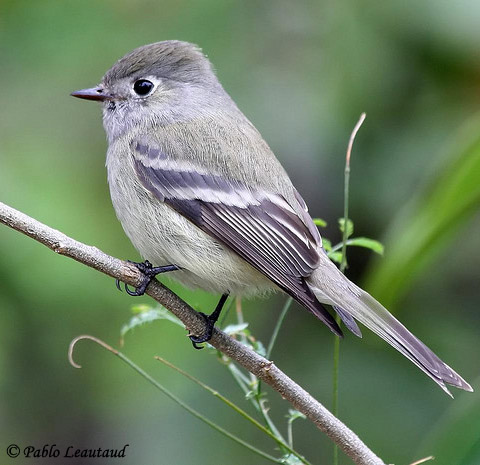
The Hammond's Flycatcher is one of the very similar Empidonax flycatchers, and can be quite difficult to tell apart from it's close relatives, especially the Dusky Flycatcher. The Hammond's even has the same general geographic distribution as the Dusky Flycatcher, but while that species is typically found in low brush and chaparral, the Hammond's Flycatcher is typically found high in conifer stands, typically at higher elevations.
Habitat
Typically found at higher elevation conifer forests, often where conifers mix with deciduous trees such as aspens. Uses mountain woods on its wintering grounds, but typically deciduous forests.
Diet
Feeds exclusively on insects, including caterpillars, moths, beetles, bees, wasps, and other small insects.
Behavior
Forages in typical flycatcher fashion, observing from a perch, and then flying out to snag insects when spotted, returning to its perch to consume them. They will capture flying insects in mid-air, or will glean insects from branches or the foliage.
Nesting
Nests at mid to high heights in trees, typically conifers, but sometimes aspen.
Breeding Map
Non-breeder in South Dakota
Song
Has a three-phrase song, typically beginning with a si-tik , then tsvi-vik with the first syllable higher, and ending with a lower and gruff rrrrr-vik .
Migration
Summers in the mountains of western North America, from New Mexico up through Canada and into Alaska. Winters in Mexico and Central America.
Interactive eBird Map
Click here to access an interactive eBird map of Hammond's Flycatcher sightings
Similar Species
Dusky Flycatcher , Gray Flycatcher
Conservation Status
Widespread and common, with no conservation concerns at this time.
Further Information
- eBird - Hammond's Flycatcher
- Audubon Field Guide - Hammond's Flycatcher
- Cornell Lab of Ornithology - All About Birds: Hammond's Flycatcher
Photo Information
January 7th, 2009 - Colomos, Guadalajar, JA, Mexico - Pablo Leautaud - Photo licensed under Creative Commons Attribution-NonCommercial 2.0 Generic license .
