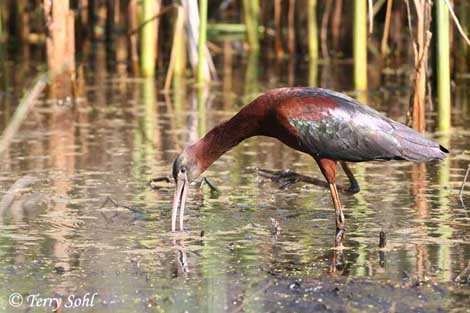
The Glossy Ibis is virtually identical to its close relative, the White-faced Ibis, and extreme care should be taken when trying to differentiate between the two. However, while the White-faced Ibis can be common in parts of the state (primarily the Northeast), the Glossy Ibis is normally only found near the Gulf Coast and southern Atlantic Coast. "The Birds of South Dakota" (SDOU 2002) lists only a single sighting of this species within the state, but several sightings have occurred in the years since that publication.
Habitat
Generally found in wetland habitats, including fresh- or salt-water marshes, estuaries, shallow edges of lakes and ponds, and flooded lands. Generally nests in trees and shrubs around water.
Diet
Large numbers of insects and insect larvae are eaten, mostly aquatic insects, but some terrestrial. When available, crayfish may be the primary diet item. Other items include fish, frogs and toads, crustaceans, mollusks, leeches, and snakes.
Behavior
Forages by probing in mud for food as they wade. They will also pick up visible items on water or land surfaces.
Breeding
Non-breeder in South Dakota. In their breeding range, the Glossy Ibis nests colonially in marshes, wetlands, and shallow lakes, often alongside herons, egrets, and other wading birds. The nest is usually a platform of reeds, sticks, and marsh vegetation placed in cattails, shrubs, or low trees over water.
Song
The Glossy Ibis is generally quiet but gives low grunts, croaks, and nasal “greh-greh” calls, especially at nesting colonies or during flight. At close range, birds may also produce hissing or rasping sounds during courtship and territorial interactions.
Migration
Birds in the northern part of its normal range move southward in the winter. Those in more tropical areas are year-round residents.
Interactive eBird Map
Click here to access an interactive eBird map of Glossy Ibis sightings
Similar Species
White-faced Ibis. The Glossy Ibis is very similar to the White-faced Ibis but breeding adults of the White-faced Ibis show a distinct white border around the face and bright red eyes. Glossy Ibises lack the bold white facial border and usually have darker eyes, with facial skin that appears more uniformly dusky.
Conservation Status
The Glossy Ibis is widespread globally and generally considered a species of low conservation concern, with many populations stable or increasing. However, wetland drainage, habitat degradation, pollution, and disturbance at nesting colonies can negatively affect local breeding populations. The IUCN considers the Glossy Ibis to be a species of "least concern".
Further Information
- eBird - Glossy Ibis
- Audubon Field Guide - Glossy Ibis
- Cornell Lab of Ornithology - All About Birds: Glossy Ibis
Photo Information
June 23rd, 2005 -- Chincoteague, Virginia -- Terry Sohl
