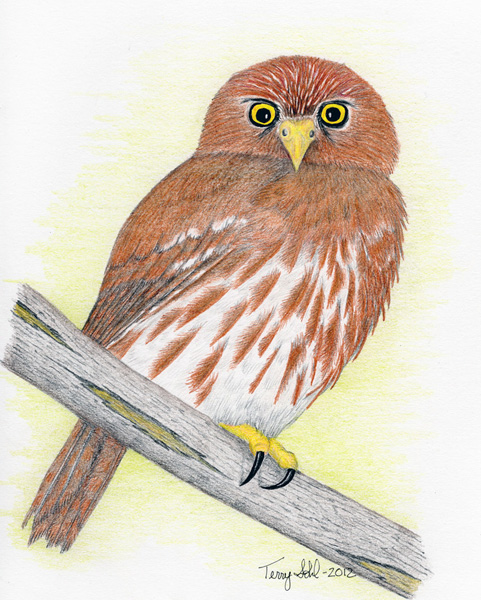
ID Keys: Rufous-brown overall, obvious streaking on underparts,
streaked crown
The
Ferruginous Pygmy-Owl is a small owl of the tropics, with a range that just
extends into the United States in Arizona. Once common in parts of
Arizona, they have disappeared from much of the region and are now
relatively rare in the United States. They once preferred mesquite stands
along river valleys in Arizona, but much of that habitat has been destroyed.
Competition for nesting cavities may also be contributing to the species'
decline. Ferruginous Pygmy-Owls have a very large range that extends
southward from Arizona, through Mexico and Central America, and into parts
of South America. Owls in different parts of their range may be
specialized feeders on local prey, and there are some indications that
Ferruginous Pygmy-Owls may comprise more than one species.
Habitat
Ferruginous Pygmy-Owls can be found in a variety of semi-open habitats throughout much of their range in the tropical Americas. In the small United States portion of its range, they are found in saguaro cactus areas of the Sonoran Desert, and mesquite and live oak thickets in Arizona. When using mesquite or live oak, they are typically found in riparian areas.
Diet
Feeds on a variety of small prey, including large numbers of large insects, as well as small lizards, small rodents, small birds, small snakes, and scorpions.
Behavior
Hunting is most often done near dawn and near dusk, but Ferruginous Pygmy-Owls are often active during the daylight hours. They will observe from a perch and fly out quickly to catch prey when spotted.
Nesting
The nest of a Ferruginous Pygmy-Owl is a cavity in a tree or a cactus. The cavity is often a woodpecker cavity, but it will also use other cavities if present. The female does most of the incubation eggs, but the male will bring food to the female during incubation. Both the male and female will help to raise the young.
Song
Song of the Ferruginous Pygmy-Owl is a series of repeated notes, rapid in pace and with each note slightly higher in pitch than the previous note.
Migration
Considered a permanent resident through its range in the Americas.
Northern Pygmy-Owl: The Ferruginous Pygmy-Owl is slightly larger and longer-tailed than the Northern Pygmy-Owl. Ferruginous Pygmy-Owls typically inhabit thorn scrub, desert woodlands, and tropical or subtropical forests, while Northern Pygmy-Owls are primarily birds of coniferous and mixed mountain forests. Ferruginous Pygmy-Owls often show warmer brown or rufous coloration and are more likely to occur in lowland habitats, whereas Northern Pygmy-Owls tend to have grayer plumage and are most often found at higher elevations.
Conservation Status
The IUCN currently lists the Ferruginous Pygmy-Owl as a species of "Least Concern". Globally, the population has a very large range, and isn't threatened with extinction. The species is widespread and common over much of its range in the American tropics. However, it is considered threatened in the U.S. portion of its range, where it has declined significantly in recent decades.