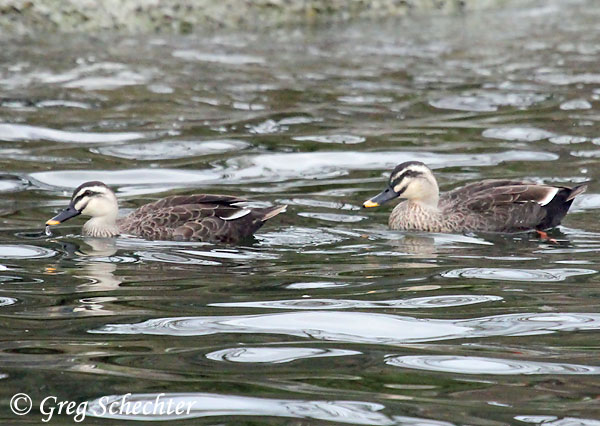
The Eastern Spot-billed Duck is a medium-sized dabbling duck native to eastern Asia, where it breeds and winters across parts of China, Korea, Japan, and eastern Russia. It is recognized by its mottled brown plumage, pale face, and distinctive bill marked with a bright yellow tip. The species inhabits freshwater wetlands, lakes, ponds, marshes, rivers, rice fields, and other shallow aquatic habitats. It feeds on seeds, aquatic plants, insects, mollusks, and other small aquatic organisms gathered while dabbling in shallow water. Most populations are resident or make relatively short seasonal movements within eastern Asia. In North America, the Eastern Spot-billed Duck is an exceptionally rare visitor, with only a small number of records, and some sightings may involve escaped or released birds rather than naturally occurring vagrants.
Habitat
The Eastern Spot-billed Duck inhabits a variety of freshwater wetlands, including lakes, ponds, marshes, reservoirs, rivers, flooded fields, rice paddies, and slow-moving streams. It favors shallow waters with abundant aquatic vegetation and often occurs in agricultural landscapes as well as natural wetlands. During winter, it may also use estuaries, coastal lagoons, and other brackish-water habitats.Diet
The Eastern Spot-billed Duck feeds on a variety of seeds, aquatic plants, grasses, sedges, and other vegetation. It also consumes insects, crustaceans, mollusks, worms, and other small aquatic animals, especially during the breeding season. Like other dabbling ducks, it typically forages by tipping forward in shallow water or feeding along shorelines and mudflats.Nesting
The Eastern Spot-billed Duck nests on the ground in dense grasses, reeds, shrubs, or other vegetation near wetlands, ponds, rivers, and marshes. The female builds a shallow bowl lined with grasses, leaves, and down feathers, usually well concealed from predators. Typical clutches contain 7–12 eggs, and the female alone performs incubation while the male generally departs after pair formation and early nesting activities.Behavior
A dabbling duck, foraging at or near the water's surface by dabbling at the surface or upending. During the breeding season, they can be found nesting alone, or in small loose groups. They are much more gregarious in winter where they often form larger flocks.Song
The Eastern Spot-billed Duck produces vocalizations similar to those of the Mallard. Females give loud, familiar quacking calls used for communication, alarm, and contact with ducklings, while males produce softer rasping notes, whistles, and quieter calls. The species is generally most vocal during courtship, breeding activities, and interactions among family groups.Migration
The Eastern Spot-billed Duck is a partial migrant. Northern populations breeding in eastern Russia, northeastern China, and other colder regions move south during winter, while many birds in Japan, Korea, and milder parts of China remain year-round. Most migrations are relatively short compared with those of many North American waterfowl, with birds shifting between breeding wetlands and wintering areas in eastern Asia.Interactive eBird Map
Click here to access an interactive eBird map of Eastern Spot-billed Duck sightingsSimilar Species
Mallard: The Eastern Spot-billed Duck lacks the male Mallard's bright green head and instead shows mottled brown plumage in both sexes year-round. It is best identified by its dark bill with a bright yellow tip and a pale facial pattern, while Mallards have an orange-and-black bill (female) or yellow bill (male). Eastern Spot-billed Ducks also show less sexual dimorphism, with males and females appearing much more alike than Mallards.
