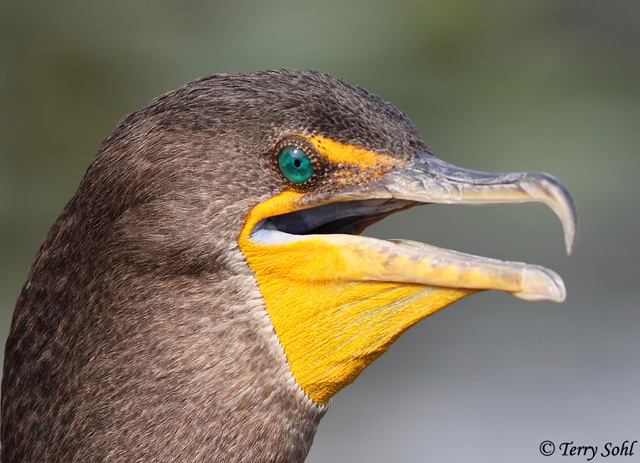
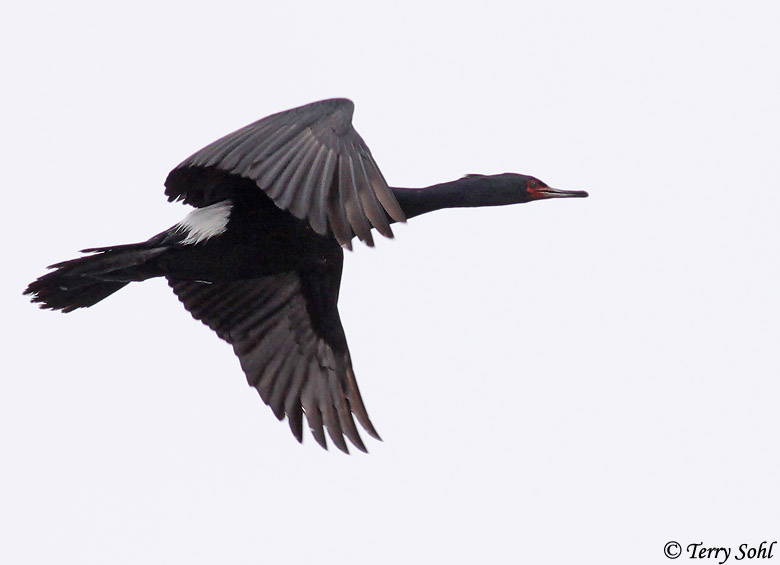
The Double-crested Cormorant is a large aquatic bird commonly found on lakes, rivers, reservoirs, wetlands, and coastal waters across much of North America. It feeds primarily on fish, which it captures by diving and pursuing prey underwater with its powerful webbed feet. During the breeding season, adults develop small tufts of feathers, or "double crests," on either side of the head, giving the species its name. Double-crested Cormorants often nest in colonies on islands, cliffs, trees, or artificial structures and are frequently seen perched with their wings spread to dry after diving. The species has expanded greatly in many areas since the mid-20th century following legal protection and improved water quality.
Habitat
The Double-crested Cormorant inhabits a wide variety of aquatic environments including lakes, reservoirs, rivers, marshes, estuaries, coastal bays, and nearshore marine waters. It prefers areas with abundant fish, open water for foraging, and nearby islands, cliffs, trees, or other structures suitable for roosting and nesting.
Diet
The Double-crested Cormorant feeds primarily on fish captured during underwater dives, including species such as perch, sunfish, minnows, catfish, and other small to medium-sized fishes. It also occasionally eats crayfish, amphibians, aquatic insects, and other aquatic prey when available.
Behavior
The Double-crested Cormorant is a highly social waterbird that often forages, roosts, and nests in large groups. It dives underwater to pursue fish with its feet and is frequently seen perched on rocks, pilings, trees, or shorelines with wings spread to dry after feeding.
Nesting
May through August. They nest in colonies, sometimes mixed colonies that include various wading bird species. The nest site is an elevated site above or near water, such as a tree or cliff. They will also sometimes nest directly on the ground on islands, provided the island location provides protection from predators. The nest itself is a platform of sticks, lined with finer vegetative material. The female lays between 2 and 6 eggs, and both parents help to incubate them. When the eggs hatch, both parents help feed the young. The young leave fledge after about 6 weeeks, but typically remain in the care of the parents for another few weeks after fledging.
Song
Double-crested Cormorants aren't a particularly vocal bird, but they do have a grunting sound that's often given in alarm, or in and around nesting colonies.
- Click here to hear the call of a Double-crested Cormorant on a breeding colony in Florida.1
- Click here to hear the grunts of a Double-crested Cormorant perched on a pier.2
Migration
Birds in the interior of the country migrate to the coasts or move southward in winter. Those found in Florida, along the West Coast, and in the Caribbean are permanent residents.
Interactive eBird Map
Click here to access an interactive eBird map of Double-crested Cormorant sightings
Similar Species
In South Dakota, there's only one other cormorant species that has ever been seen, and it's a very rare visitor. There are cormorant species elsewhere in North America as well though that could be confused with Double-crested Cormorant.
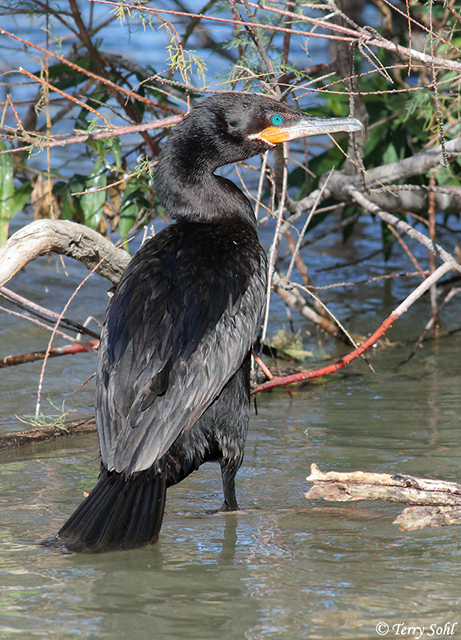
- Neotropic Cormorant. These are the only other cormorant species ever found in South Dakota. Size can be difficult to judge when a bird is alone, but when seen side by side, Neotropic Cormorants are noticeably smaller than Double-crested Cormorants, and have a longer tail. They also lack the bare patch in front of the eye found on Double-crested Cormorants. In breeding plumage, Neotropic Cormorants also have a white edging around the orange skin on the face, and wispy white head plumes.
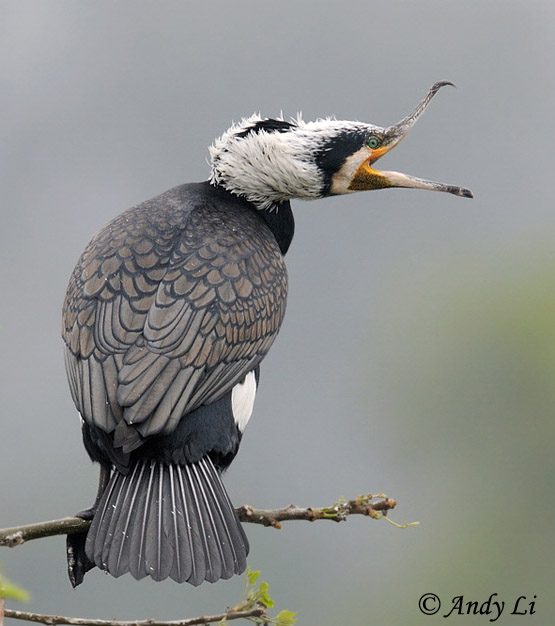
- Great Cormorant. Great Cormorants aren't likely to ever be seen in South Dakota, given their range along the northeastern coastlines of North America, but in that range they could be confused with Double-crested Cormorants. Great Cormorants are considerably larger and "bulkier" looking than Double-crested Cormorants. In breeding plumage, they have white skin around the mouth, and a white patch on the flank not seen on Double-crested Cormorants in any plumage.
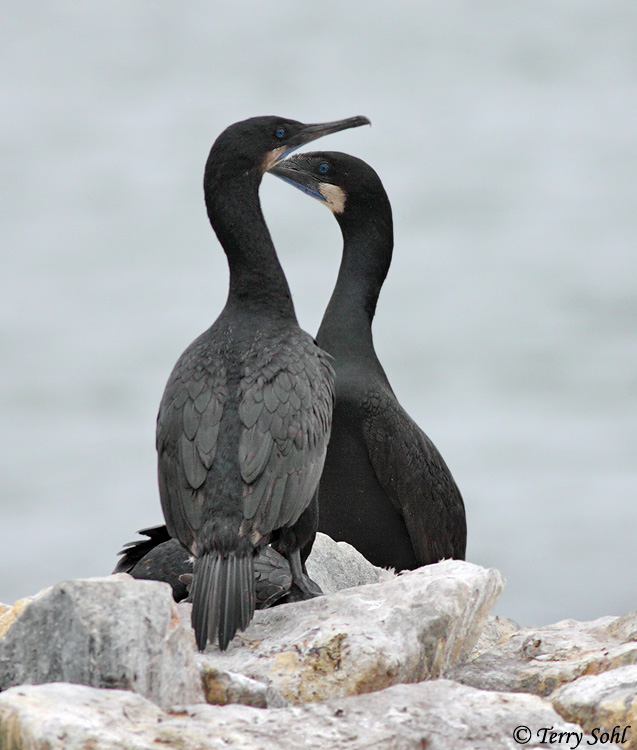
- Brandt's Cormorant. Brandt's Cormorant are a West Coast species not likely to ever be seen in South Dakota, but could be confused with Double-crested Cormorants in their range. Adult birds are easily differentiated from Double-crested Cormorants, as adult Brandt's Cormorants have a bright bluish color on the face, as opposed to orange.
- Pelagic Cormorant. Pelagic Cormorants also aren't likely to ever be seen in South Dakota, but could be confused with Double-crested Cormorants in their range on the West Coast of North America. Pelagic Cormorants are smaller and more "dainty" in appearance than a Double-crested Cormorant, with a thinner, less robust bill. Breeding birds also have a white patch on their flank that Double-crested Cormorants lack.
 |
 |
 |
 |
| Neotropic Cormorant | Great Cormorant | Brandt's Cormorant | Pelagic Cormorant |
South Dakota "Hotspot"
Double-crested Cormorants aren't difficult to find from spring through fall in South Dakota. Poking around larger water bodies during both the spring and fall migration will often result in finding Double-crested Cormorants. During migration they may sometimes be found on surprisingly small ponds and wetlands, as those can be good sources of bullheads, tiger salamanders, and other food items they love to feed on. During the breeding season they are found in breeding colonies of tree areas next to water bodies, or sometimes within water bodies if flooded timber is available for providing nesting sites. Many of these traditional nesting colonies are used year after year.
Status
After a considerable decrease until the early 1970's (probably due to DDT and other pesticides), Double-Crested Cormorants are now increasing both in numbers and range. The IUCN lists the Double-crested Cormorant as a species of "Least Concern". Note the species has recovered so well that they are (wrongly!!!) being considered as a "pest" species in some areas. In the Great Lakes area, for example, there are discussions of culling Double-crested Cormorants, with fisherman claiming a rise in populations is impacting game fish populations.
Photo Information
December 10th, 2012 - Everglades National Park in Florida - Terry L. Sohl
Audio File Credits
- 1Paul Marvin. Recorded in Everglades National Park in Florida on May 26th, 2014. Original recording and information available from xeno-canto.
- 2Paul Marvin. Recorded in Canaveral National Seashore in Brevard County, Florida on August 6th, 2013. Original recording and information available from xeno-canto.
