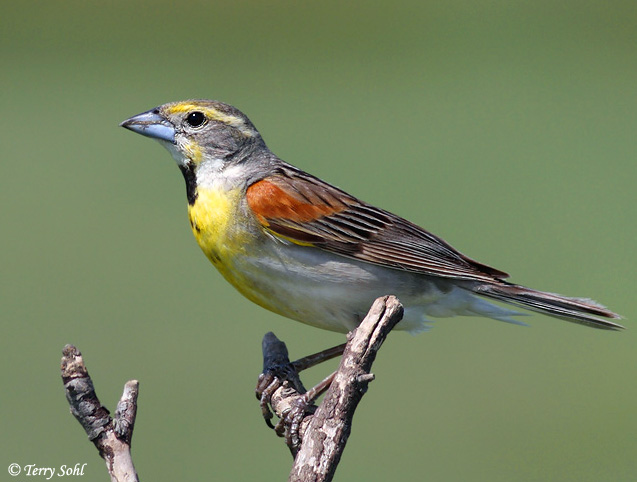
Dickcissels are a vocal summer resident in the state, especially in the eastern part, where they can often be found singing their distinctive song from fenceposts, wires, and plant tops. With their yellow chest and black "bib", they share a general resemblance to the much larger Meadowlark. They seem to vary locally quite a bit from year to year, presumably in response to vegetation condition and other habitat parameters. Several birds may utilize the same field or grassy area during the summer breeding season, but the most frequent sighting of a Dickcissel in South Dakota is of a single bird (often a vocalizing male). However, during the winter months, Dickcissels may form massive flocks numbering in the thousands.
Habitat
The Dickcissel inhabits prairies, native grasslands, hayfields, CRP fields, pastures, weedy meadows, roadside grasslands, and agricultural areas with scattered shrubs or tall forbs. It favors open habitats with dense grasses for nesting and elevated perches such as weeds, fence lines, and shrubs for singing.
Diet
The Dickcissel feeds on a variety of seeds, grains, and agricultural crops, including those of grasses, weeds, and forbs. During the breeding season, it also consumes large numbers of insects such as grasshoppers, beetles, caterpillars, and other arthropods, which are especially important for feeding nestlings.
Behavior
Uses a variety of foraging techniques dependent upon season and location. Insects may be gleaned from vegetation or plucked from the ground. Seeds are eaten while clinging to a grass or weed stalk and plucking seeds, or by consuming fallen seeds from the ground.
Nesting
June and July in South Dakota. The nest of a Dickcissel is a dense cup built of grasses, weeds, and other vegetation, placed just above the ground in a clump of grass or low in a small shrub. The female lays between 3 and 6 eggs and she alone incubates them. Incubation lasts about 13 days. The female alone also feeds and cares for the young until they fledge.
Song
The song in general is a dry dick-dick CISS CISS CISS, with the last syllables higher in pitch. There may be some variability in the number of notes. The call of a Dickcissel is a simple sharp chik.
- Click here to hear the song of a Dickcissel1
- Click here to hear the simple call of a female Dickcissel2
- Click here to here another version of a Dickcissel song3
Migration
The Dickcissel is a long-distance migrant that breeds across the central United States and southern Canada, including much of South Dakota. After breeding, it migrates south through Mexico and Central America to winter primarily in the grasslands and agricultural regions of northern and central South America, especially Venezuela and Colombia. Large flocks often gather during migration and on the wintering grounds.
Interactive eBird Map
Click here to access an interactive eBird map of Dickcissel sightings
Similar Species
Male generally distinctive, although the color pattern may resemble the much larger Western Meadowlark.
Bird Feeders
Will occasionally come to feeders for small seeds and grains.
South Dakota "Hotspot"
Any grassy pasture or alfalfa field in the eastern part of the state could hold Dickcissels. They are a very common sight in the farm and pasture land of eastern South Dakota, where they are readily visible as they sing from fence posts, telephone lines, shrubs, or any other perch that rises above the surrounding landscape. Despite their size, their characteristic song carries a fairly long distance, leading to easy detection of the species even when the bird itself can't be seen.
Conservation Status
Once a fairly common breeder in the Atlantic states, but disappeared as a breeding species there by 1900. This may be due to a "reforesting" of the East, after widespread deforestation in the 1800s and early 1900s left much more open land in the Eastern US than is there today. While reestablishing itself in pockets in the east, some local declines have occurred elsewhere in its range. Dickcissels often nest in alfalfa fields, sometimes resulting in large numbers of young being lost when the fields are mowed before the young can fledge. Dickcissels are also one of the most common hosts for Brown-headed Cowbird parasitism. Despite the challenges facing the species, however, overall numbers are strong and considered to be relatively stable. The IUCN lists the Dickcissel as a species of "Least Concern".
Photo Information
July 31st, 2008 -- Western Minnehaha County -- Terry Sohl
Audio File Credits
- 1Ethan Duke. Recorded in Saline County, Missouri on May 8th, 2017. Original recording and information from xeno-canto.
- 2Matt Wistrand. Recorded in Will County, Illinois on June 18th, 2016. Original recording and information from xeno-canto.
- 3Paul Marvin. Recorded in Stafford County, Kansas on May 24th, 2015. Original recording and information from xeno-canto.
