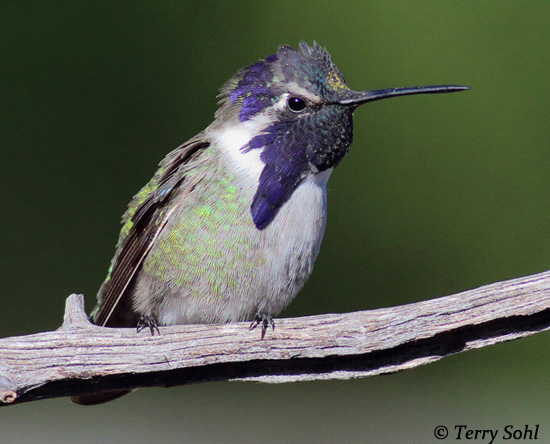
The U.S. range of the Costa's Hummingbird normally only includes the deserts of the Southwest. Unlike some other western hummingbird species, they are not known for often wandering widely from that range, and they are thus only extremely rare visitors to South Dakota. Males are generally distinctive, with very long, flared gorgets of a brilliant purple (see photo to the right). As with other hummingbird species in the West, they have adopted well to a human presence, with increased numbers and range due to year-round availability of nectar and flower sources in many urban areas.
Habitat
The Costa's Hummingbird inhabits arid desert environments, including desert scrub, washes, cactus flats, thorn scrub, and dry foothills of the southwestern United States and northwestern Mexico. It is especially associated with habitats containing flowering shrubs, ocotillo, chuparosa, agaves, and other nectar-producing desert plants. The species also occurs in desert gardens, parks, and suburban landscapes where suitable flowers are available.
Diet
The Costa's Hummingbird feeds primarily on nectar from flowering desert plants such as chuparosa, ocotillo, agaves, penstemons, and various cacti. It also consumes small insects and spiders, which provide essential protein and nutrients (particularly during the breeding season), catching them in flight or gleaning them from vegetation.
Behavior
Costa's Hummingbird is an active desert hummingbird that spends much of its time darting among flowering shrubs and aggressively defending feeding territories from other hummingbirds. Males are especially noted for their dramatic courtship dives and high-pitched display flights, during which they flash their brilliant purple throat and crown in the sunlight.
Breeding
Non-breeder in South Dakota. In their breeding range, Costa's Hummingbird nests in arid desert scrub, washes, and thorny shrublands of the Southwest. The female builds a tiny cup nest of plant fibers, down, and spider silk, usually tucked into a low bush or small tree and often shaded from intense sun. She lays 2 white eggs and alone incubates and raises the young, which fledge roughly three weeks after hatching.
Song
The Costa's Hummingbird gives a variety of high-pitched chips, tseep notes, and sharp contact calls. During courtship displays, males often produce distinctive buzzing, whistling, and metallic sounds with both their voices and wings, creating a unique combination of vocal and mechanical sounds as they dive around females.
Migration
Birds in the U.S. portion of their range are typically migratory, moving southward into Mexico in winter, although a few remain north of the border. Within the U.S., birds breeding in the desert typically breed in late winter or very early spring, and then move westward to coastal areas for the hottest weather of the summer.
Similar Species
Anna's Hummingbird , Black-chinned Hummingbird, Calliope Hummingbird. Costa's Hummingbird, Anna's Hummingbird, Black-chinned Hummingbird, and Calliope Hummingbird differ mainly in size, shape, and male throat color. Costa’s is compact with a short tail and males show a vivid purple crown and long flaring purple gorget extending down the sides of the neck. Anna’s is larger and chunkier with a rose-pink head and throat that can glow brilliantly in sunlight. Black-chinned appears plainer and more slender, with males showing a black throat bordered below by a narrow violet band, while Calliope is the smallest of all, with a short tail and males having distinctive magenta throat streaks that project outward like tiny rays rather than forming a solid patch.
Conservation Status
The Costa's Hummingbird is generally considered a species of low conservation concern and remains widespread across the deserts of the southwestern United States and northwestern Mexico. It adapts readily to desert gardens, parks, and other human-modified habitats where flowering plants provide nectar resources. Although local populations can be affected by prolonged drought, habitat alteration, and changes in desert vegetation, the species remains common and secure throughout most of its range. The IUCN considers Costa's Hummingbird to be a species of "least concern".
Photo Information
November 11th, 2015 - Santa Rita Lodge, in Madera Canyon south of Tucson, Arizona
Interactive eBird Map
Click to access an interactive eBird species page for sightings of the Costa's Hummingbird
