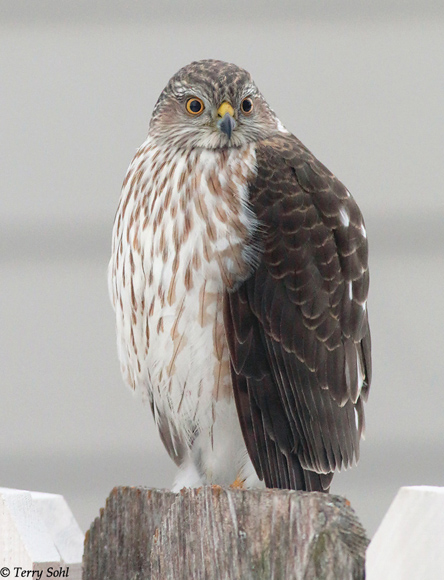
Cooper's Hawks are a medium sized hawk of the forested lands, usually found in and around forests and forest edges at all seasons. Although they generally hunt wild birds and small mammals, the Cooper's Hawk also has the somewhat unfair moniker of "Chicken Hawk" for its supposed preference for farm poultry. They have adapted very well to an increasing human footprint on the landscape, as they can now often be found around city parks and suburban areas, provided adequate nesting and foraging opportunities are available. "Foraging opportunities" now increasingly also means preying at birds at suburban bird feeders.
In South Dakota, Cooper's Hawks are found year-round, with larger numbers during the summer breeding season. In migration and in winter, both Cooper's Hawks and their close cousin the Sharp-shinned Hawk can be found in the state, leading to potential identification challenges as the two are very similar in appearance. See identification tips below for clues to differentiate Cooper's Hawks and Sharp-shinned Hawks.
Habitat
Cooper's Hawks prefer mixed forest when nesting, but can be found in and around any forest type in winter. They generally avoid open areas without trees nearby, although they will often hunt in fairly open landscapes. In South Dakota, they can be found in and around even small patches of trees, with shelterbelts and farmsteads often offering enough tree cover for a Cooper's Hawk presence.
Diet
Mostly birds and small mammals, occasionally reptiles, fish, and insects. They will prey on larger birds than will their cousins the Sharp-shinned Hawks.
Behavior
Hunts from a perch, waiting for prey to come within range, and then moving swiftly to catch it. Very acrobatic and maneuverable in the chase.
Nesting
April and May. The nest of a Cooper's Hawk is a large bowl built of sticks, lined with softer vegetative material. The female usually lays between 3 and 5 eggs, and she does most of the incubation while the male brings her food. When the eggs hatch, the male initially brings food while the female stays with the young. After a couple of weeks, both parents help bring food to the young. The young fledge after about a month.
Song
Not very vocal outside of the breeding season. The most commonly heard call is a harsh kak-kak-kak-kak-kak.
- Click here to hear the call of a Cooper's Hawk1
- Click here to hear the vocalizations around a nest as an adult brings food to the young and female2
Migration
Birds in northern part of range (northern U.S. and southern Canada) migrate south in the fall. Generally found in all seasons in other parts of its range.
Similar Species
One of the more identification challenges for a birder in North America is differentiating between a Sharp-shinned Hawk and a Cooper's Hawk. Both are very similar in appearance, although there are identification keys that allow identification, if seen well. A juvenile Northern Goshawkcould also be mistaken for a Cooper's Hawk. Specific identification keys (and comparison to a Sharp-shinned Hawk) are as follows:
- Size: Cooper's Hawks are substantially larger than a Sharp-shinned Hawk. Sharp-shined Hawks are similar in size to a Blue Jay or a Mourning Dove, and that small size is often readily apparent and can help immediately differentiate a Sharp-shinned from a Cooper's Hawk. However, size can sometimes be difficult to judge, and variation in size between the two species also can make it challenging. For both species, females are substantially larger than males (up to 1/3rd larger). Thus, a female Sharp-shinned Hawk and a male Cooper's Hawk may be relatively close in size. While studies have found only a tiny amount of overlap in size between the largest female Sharp-shinned and the smallest male Cooper's Hawk, it's close enough that in the field, identification by size can be difficult. Nonetheless, if you see an Accipiter that's clearly substantially larger than a Mourning Dove, you can likely eliminate Sharp-shinned Hawk.
- Tail: The best identification key if size isn't a clear indication of species. Cooper's Hawks have a tail that's more rounded in appearance, as the central tail feathers are the longest, and tail feathers get shorter towards the outside of the tail. In contrast, Sharp-shinned Hawks have tails that are generally squarish in appearance, as the tail feathers are somewhat more uniform in length.
Note Cooper's Hawk juveniles also tend to have a distinct white band at the end of the tail, while it's lacking or it's only a very thin band on a Sharp-shinned Hawk. However, this is usually an unreliable identification mark, as feathers get worn as more time passes since moulting. A "fresh" juvenile Cooper's Hawk thus may show a distinct white band, but wearing down of the feather ends may make that much less prominent as time passes. - Head: Cooper's Hawks appear to have a large, blocky head, that often appears to have a bit of a crest on top, with a noticeable "point" towards the back of the head. Sharp-shinned Hawks appear to have a smaller head, in relationship to body size, with a rounded look to it.
- Eye: The eye of a Cooper's Hawk often appears to be placed more forward on the head, with the eye closer to the bill than to the back of the neck. In contrast, the eye of a Sharp-shinned Hawk appears to be more centered on the side of the face than on a Cooper's Hawk. Note eye color is not a good indicator of species, as for both, eyes are typically yellowish when young, trending towards redder and redder as the bird ages.
- Flight: The shape of the bird in flight is often distinctive, if seen well. A Sharp-shinned Hawk often appears to have shorter wings, as when gliding in flight, the wings appear to be held closer to the body, with a distinctive bend and forward thrust of the wing joint. In comparison, a Cooper's Hawk in gliding flight appears to have longer wings that are held out more straight from the body.
Sharp-shinned Hawk. Juvenile Northern Goshawk also could be mistaken for a Cooper's Hawk
Conservation Status
After a severe drop in numbers by 1970, numbers have been increasing. They have even become more common as breeders in city parks and other urban settings with large trees. The IUCN lists the Cooper's Hawk as a species of "Least Concern".
Photo Information
December 2016 - Brandon, South Dakota - Terry Sohl
Audio File Credits
- 1Paul Marvin. Recorded in San Diego, California on July 19th, 2020. Original recording and information available on xeno canto.
- 2Richard Webster. Recorded in Portal, Arizona on May 5th, 2016. Original recording and information available on xeno canto.
Interactive eBird Map
Click to access an interactive eBird species sightings page for Cooper's Hawk
