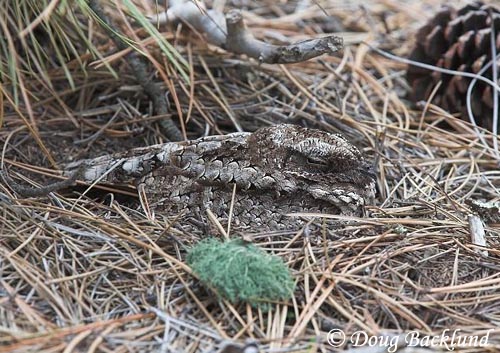
The Common Poorwill is the smallest of the "nightjars" in North America, and is considered the western counterpart of the eastern Whip-poor-will. The Hopi name for the Common Poorwill means "the sleeping one", as they are the only bird known to hibernate. Some remain throughout the year in the Southwestern U.S., but in cold weather, they enter a hibernating state with a lowered body temperature, heartbeat, and rate of breathing. They may stay in this state for days or weeks at a time.
Habitat
The Common Poorwill inhabits dry open woodlands, pinyon-juniper forests, sagebrush flats, desert scrub, chaparral, canyonlands, rocky hillsides, and open ponderosa pine forests. It favors sparsely vegetated habitats with patches of bare ground where its cryptic plumage provides excellent camouflage during the day. In South Dakota, it occurs primarily in the Black Hills and adjacent western portions of the state where suitable open woodland and rocky habitats are present.
Diet
The Common Poorwill feeds almost entirely on insects captured in flight at dusk and during the night. Its diet includes moths, beetles, flying ants, termites, mosquitoes, and other nocturnal insects that it catches with its wide mouth while flying low over open ground, roads, forest openings, and shrublands.
Behavior
The Common Poorwill is a nocturnal bird that becomes active at dusk, spending the night flying low over open areas in search of insects. During the day it rests motionless on the ground, rocks, or low branches, relying on its cryptic plumage for camouflage. It is famous for its ability to enter prolonged periods of torpor—a hibernation-like state that allows it to conserve energy during cold weather and food shortages. In the Black Hills and throughout its range, it is often detected by voice long before it is seen.
Nesting
The Common Poorwill does not build a traditional nest. Instead, the female lays 2 eggs directly on bare ground, leaf litter, gravel, or rocky soil, usually in a sheltered location beneath shrubs, trees, or other vegetation. The eggs and adults are exceptionally well camouflaged, making nests difficult to detect. Both parents participate in incubation and care of the young after hatching.
Song
The Common Poorwill is best known for its clear, repetitive poor-will, poor-will, poor-will song, usually delivered from a rock, low perch, or the ground during the evening and early morning hours. Males may repeat the phrase many times in succession while defending territories or attracting mates. Additional vocalizations include soft clucks, churrs, whistles, and low growling notes used during courtship and territorial interactions.
Migration
The Common Poorwill breeds across much of the western United States, southwestern Canada, and northern Mexico, including the Black Hills. After breeding, most populations migrate south to winter in the southwestern United States, Mexico, and parts of Central America, although birds in the southwestern US may be semi-permanent residents. Migration occurs primarily at night, and birds are often difficult to detect except by their distinctive calls.
Similar Species
Whip-poor-will: The Common Poorwill is noticeably smaller and more compact than the Eastern Whip-poor-will, with a shorter tail and a rounder-headed appearance. Common Poorwills typically occur in dry western habitats such as sagebrush, pinyon-juniper woodlands, and rocky slopes, while Eastern Whip-poor-wills are birds of eastern forests and woodland edges. Their songs are unmistakably different: the Poorwill repeatedly says “poor-will,” whereas the Whip-poor-will gives the longer, more emphatic “whip-poor-will” call.
Conservation Status
The Common Poorwill is generally considered a species of low conservation concern and remains widespread across much of western North America. However, like many nightjars, it may be affected locally by habitat loss, development, pesticide use, and declines in flying insect populations. Because it occupies a broad range of habitats and maintains a large overall population, the species is currently regarded as secure throughout most of its range. The IUCN considers the Common Poorwill to be a species of "least concern".
Photo Information
Photo taken in North Cave Hills, Harding County by Doug Backlund.
Interactive eBird Map
Click to access the interactive eBird species sightings page for Common Poorwill
