Gyrfalcon Logo - South Dakota Birds

MAIN PAGE

Species Pages

Photo Gallery

Recent Photos

Favorite Photos

Photo Usage Info

Free Calendars

S. Dakota Bird Alerts

Bird ID Quizzes

Free Screensavers

Backyard Birds

Difficult ID's

Photographing Birds

Site Information

Links/Resources

Endangered Species

Birding Hotspots

Habitat/Maps

Contact Me


Whip-poor-will

Caprimulgus vociferus

Length: 9 to 10 inches Wingspan: 16 to 20 inches Seasonality: Summer
ID Keys: Mottled gray and brown body, white tail corners (male), buff tail corners (female), rounded wingtips in flight.

Whip-poor-will - Caprilmulgus vociferusThe Whip-poor-will is heard more often than seen, as it chants it's whip-poor-will in rapid succession, often for long periods of time.  During daylight hours, they sleep motionless on the forest floor, and can be very difficult to spot because of their mottled camouflaged feathering.  Probably the easiest way to spot a bird in the daytime is if the nest is approached too closely, which often prompts the parent to hover in place while investigating the intruder.  There are slight but distinct differences in plumage and voice between eastern and western populations in North America, and there is some who classify the two as different species.

Habitat: Prefers deciduous to mixed forests.

Diet: Insects, primarily night-flying insects.

Behavior: Nocturnal forager, although much of its foraging is done near dawn and dusk, or under the light of a nearly full moon.  Captures insects by flying out from a perch and snagging them in mid-air, or by catching insects while in continuous flight.

Nesting: May and June

Breeding Map: Breeding Bird Survey map

Song: A loud rolling whip-poor-will, repeated rapidly, sometimes for long periods of time .  Click to listen to the Whip-poor-will song.

Migration: Summers throughout most of the eastern U.S., extreme southeastern Canada, and locally in the Southwestern U.S.  Winters in the extreme southeastern U.S., Mexico, and Central America. 
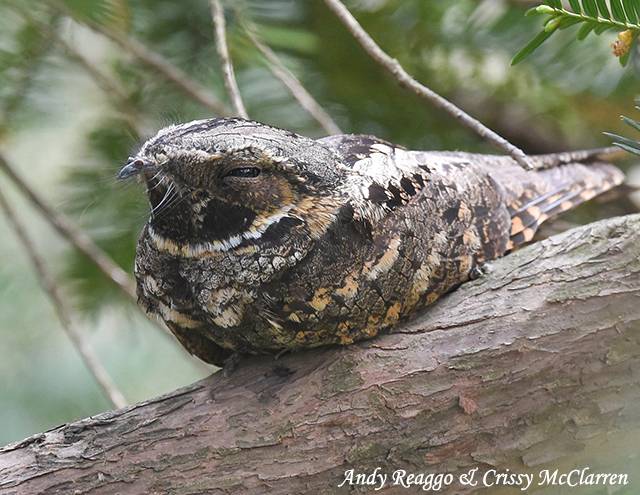
Similar Species: Chuck-will's Widow, Common Nighthawk

Conservation Status: Has declined in number in the eastern United States in the past few decades, for reasons that aren't well understood.

Further Information: 1) USGS Patuxent Bird Identification InfoCenter, Whip-poor-will

2) Cornell University's "All About Birds - Whip-poor-will"

3) eNaature.com: Whip-poor-will

Photo Information: May 31st, 2005 - Presque Isle State Park, Erie, Pennsylvania - Jake Dingel


Whip-poor-will - South Dakota Range Map
South Dakota Status: Common summer resident in the extreme southeastern part of the state.  Casual migrant elsewhere.
 

Additional Whip-poor-will Photos (Coming Soon!!)
