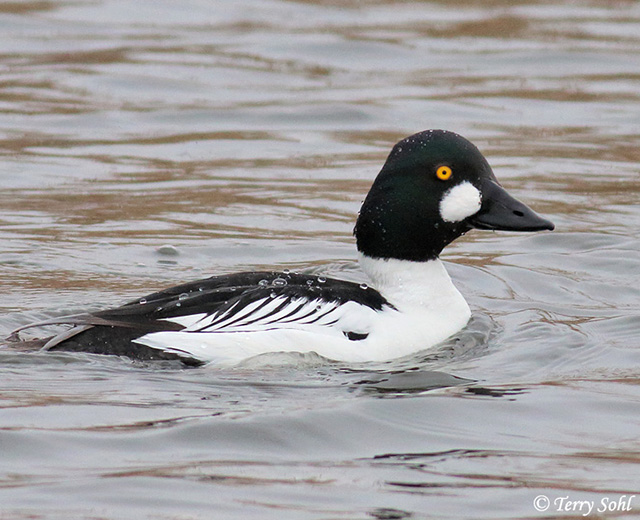
Common Goldeneyes are by far the more common and numerous goldeneye found in the state, with the Barrow's Goldeneye being only a rare visitor. Hunters often refer to them as "whistlers" due to the tendency of their wings to make a whistling sound in flight. Historical records indicate the species may have once nested in the state, but no confirmed nesting has occurred in decades. With a warming climate, it's likely normal breeding range will continue to move further away from South Dakota in the future.
Habitat
Nests in tree cavities, so requires trees near water bodies during the summer breeding season. During migration and in winter, can be found in a wide variety of aquatic habitats, from coastal areas to inland lakes and rivers.
Diet
The Common Goldeneye feeds primarily on aquatic insects, crustaceans, mollusks, and other invertebrates captured by diving underwater. It also eats small fish, fish eggs, and aquatic plants, with animal prey making up most of the diet during the breeding season.
Behavior
Common Goldeneyes are diving ducks, with the vast majority of food obtained from underwater. They will also occasionally feed like a dabbling duck at the water's surface.
Breeding
Currently a non-breeder in South Dakota. In their normal breeding range, they typically use a tree cavity for nesting, such as an old woodpecker hole. In recent decades they have also started using nest boxes. The nest cavity itself is lined with down, and the between 6 and 16 eggs are laid. The female alone incubates the eggs, which hatch after about 4 weeks. Females remember their own hatching location, and often return to the same location to breed themselves. The same nesting cavity is often used for multiple years by the same female.
Song
Grating cry from the male during courtship, and various short vocalizations from females (primarily when disturbed), but they are generally silent outside of courtship.
- 1Click here to hear the grating calls of a group of males, recorded in King County, Washington
- 2Click here to hear the wingbeats of a male.
- 3Click here to hear the vocalizations and flight sounds of a female, recorded in Finland
Migration
The Common Goldeneye breeds across boreal forests and wooded lakes of Canada, Alaska, and the northern United States, then migrates south in fall to winter on large lakes, rivers, reservoirs, coastal bays, and protected marine waters. Many birds winter throughout the northern and central United States where open water remains available, while others continue to coastal regions of both the Atlantic and Pacific coasts.
Interactive eBird map
Click here for an interactive eBird map of Common Goldeneye sightings
Similar Species
Very similar in appearance to Barrow's Goldeneye. Perhaps superficially similar to the Bufflehead if seen from a distance.
- Barrow's Goldeneye - The shape of the white spot on the face is different between the two species (males), as the Barrow's Goldeneye has a crescent shaped spot while it's a rounder spot on the Common Goldeneye. Where the dark back meets the white underparts on the flanks of the bird, white appears more extensive compared to black on the Common Goldeneye, while on the Barrow's Goldeneye, black is more extensive. Females of both species are very similar, and are best told apart by the bill. The female Barrow's Goldeneye has a primarily yellowish bill, while a Common Goldeneye female has a darker bill with dirty orange near the tip.
Conservation Status
Populations appear to be stable, and they are quite common in many parts of their range. The species will use nest boxes, and populations increases may have occurred in some locations. The IUCN considers the Common Goldeneye to be a species of "Least Concern".
South Dakota "Hotspot"
The species can be found in open water all over the state during migration. In wintertime, concentrations often are found in the open water below the Missouri River dams.
Photo Information
March 26th, 2017 - Minnehaha County, South Dakota - Terry Sohl
Audio File Credits
- 1Bruce Lagerquist, XC404502. Accessible at www.xeno-canto.org/404502.
- 2Tero Linjama, XC340626. Accessible at www.xeno-canto.org/340626.
- 3Eetu Paljakka, XC375849. Accessible at www.xeno-canto.org/375849.
