Return to Main Page

Barrow's Goldeneye

Bucephala islandica

Length: 18 inches
Wingspan: 30 inches
Seasonality: Winter / Migrant
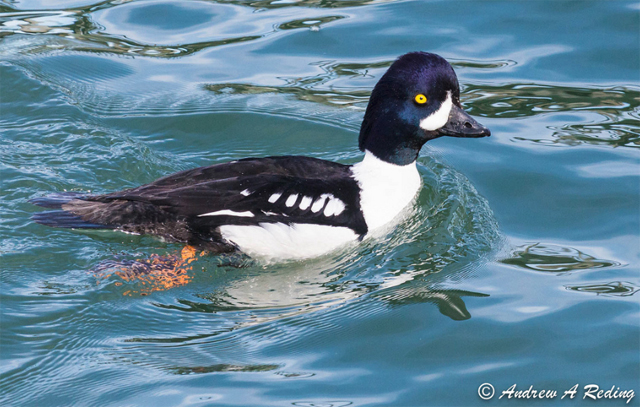
ID Keys: White crescent spot on face, yellow eye, purplish sheen on black head.
Barrow's Goldeneye - Bucephala islandica
 

Much less common in the state than it's close cousin, the Common Goldeneye, the Barrow's Goldeneye is generally a casual winter visitor.  The two species can be identified by the differing shape of the the males' facial white spots.  Barrow's Goldeneyes strongly prefer cold, inland waters for breeding, and have also recently adapted their winter range to include cold discharge waters below large dams in the southwestern United States.

Habitat

Breeds on cold waters of the interior of northwestern North America, including ponds, small lakes, and rivers.  Most wintering birds are found in coastal waters of the Pacific Northwest, but can also be found in the interior where open water is available.

Diet

Insects and insect larvae, crustaceans, mollusks, and plant material, and occasionally small fish.

Behavior

A diving duck, obtaining nearly all its food by diving underwater and propelling itself with its feet in search of food.

Nesting

Non-breeder in South Dakota. On its breeding grounds, the Barrow's Goldeneye builds its nest in a tree cavity, or sometimes in a other cavity like a rocky crevice. In lieu of any suitable cavities, they will also sometimes use a heavily protected location on the ground. The nest is simple and primarily consists of down from the female.  She lays 5 to 15 eggs, and she alone incubates them. The eggs hatch after about 4 weeks. The young leave the nest after a day or two and feed themselves, but are protected by the female.

Interactive eBird Map

Click to access an interactive eBird map of Barrow's Goldeneye sightings

Song

Barrow's Goldeneyes are not a very vocal species, but there are some guttural croaking, and various catlike squeals from males during courtship.  They also have a distinctive whistling sound given off by the wings in flight. Females also have some vocalizations that are generally only heard on their breeding grounds:

  • 1Click here to hear the vocalizations of a female near a nesting site, recorded in Alaska.
  • 2Click here to hear the vocalizations of a pair of males, recorded in Alaska.
  • 3Click here to hear the wing noises of a Barrow's Goldeneye in flight, recorded in Alaska. 
  • Migration

    Summers throughout much of northwestern North America, with smaller numbers in eastern Canada.  Winters throughout many of the same areas, although many in Canada and Alaska move to the Pacific Coast.  

    Similar Species

    Very similar in overall appearance to the Common Goldeneye.

    • Common Goldeneye - On males, the shape of the facial white spot is the key identification feature. It is crescent shaped on a Barrow's Goldeneye and more round on a Common Goldeneye. Barrow's Goldeneye males also have more extensive black on the flanks, generally appearing as "black with white spots", while there's more white than black where the two colors intersect on the side of a Common Goldeneye. Female Barrow's Goldeneyes have a bill that's primarily yellow, while the bill on a female Common Goldeneye is darker with some smudgy orangish coloring.

    Conservation Status

    Numbers appear to be stable throughout their normal range, with some indications of increases in recent decades. The IUCN considers the Barrow's Goldeneye to be a species of "Least Concern".

    South Dakota "Hotspot"

    There is no "hotspot" where you are guaranteed to find a Barrow's Goldeneye in South Dakota, as they are but a rare visitor to the state. However, in recent years, Canyon Lake within Rapid City has sometimes held a Barrow's Goldeneye in the winter.

    Further Information

    Photo Information

    Top photo courtesy of Andrew Reding Taken near Bellingham Washington, March 31st, 2014 -- Photo licensed under Creative Commons Attribution-NonCommercial-NoDerivs 2.0 Generic License

    Audio File Credits

  • 1Andrew Spencer, XC143932. Accessible at www.xeno-canto.org/143932.
  • 2Andrew Spencer, XC76291. Accessible at www.xeno-canto.org/76291.
  • 3Davyd Betchikal, XC177391. Accessible at www.xeno-canto.org/177391.