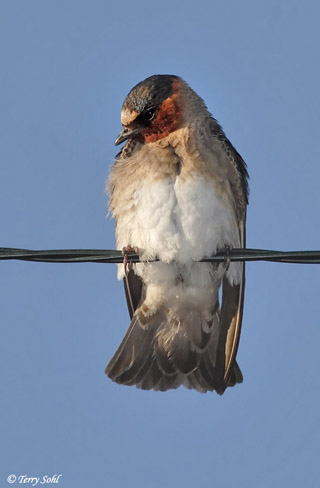
Cliff Swallows are the species celebrated upon their spring return to the mission in San Juan Capistrano, California. A very gregarious bird, Cliff Swallows often nest by the hundreds under bridges, highway overpasses, or sheltered locations on buildings. Originally building their enclosed mud nests on cliffs, Cliff Swallows have taken advantage of human structures and have greatly expanded their range and numbers. The huge Cliff Swallow colonies are welcomed with open arms by farmers because of the vast quantity of flying insects they can consume.
Habitat
Can be found in nearly any kind of semi-open country in summer in South Dakota, as long as suitable nesting locations are nearby.
Diet
The Cliff Swallow feeds primarily on flying insects captured in the air, including flies, beetles, winged ants, bees, wasps, and true bugs. It often forages in large flocks, sweeping low over fields, wetlands, rivers, and open water while catching insects on the wing.
Behavior
Primarily feeds while in flight, most often by catching flying insects, but also by plucking insects from vegetation surfaces. Gregarious, often foraging in large groups.
Nesting
June and July in South Dakota. The Cliff Swallow nests colonially, building gourd-shaped mud nests attached to vertical surfaces such as cliffs, bridges, culverts, barns, and building eaves. Both sexes help gather mud pellets and construct the enclosed nest, which is lined with grasses and feathers. Colonies may range from just a few nests to hundreds packed closely together.
Song
The Cliff Swallow gives a rapid series of dry, chattering, and sputtering calls often described as harsh “chur” or “chit” notes. Large nesting colonies are usually noisy, with constant twittering and rattling vocalizations exchanged among flock members.
Migration
The Cliff Swallow breeds across much of North America, including throughout South Dakota, where it is a common summer resident. After breeding, it migrates south in large flocks through the Great Plains, western United States, and Mexico to winter primarily in South America, especially in countries such as Argentina, Paraguay, Bolivia, and southern Brazil. During migration, thousands of birds may gather at wetlands, agricultural fields, roost sites, bridges, and utility structures, often forming immense mixed flocks with other swallow species.
Similar Species
Barn Swallow , Cave Swallow. The Cliff Swallow differs from the Barn Swallow by its squarer tail, pale buffy forehead, and blocky appearance, whereas Barn Swallows have deeply forked tails, glossy blue upperparts, and long tail streamers. Compared to the Cave Swallow, Cliff Swallows show a pale forehead and dark throat, while Cave Swallows have a richer cinnamon-colored forehead and throat with a less contrasting facial pattern.
Conservation Status
The Cliff Swallow remains widespread and common across much of North America and is generally considered a species of low conservation concern. The species has benefited in many areas from the availability of artificial nesting structures such as bridges and culverts, although local populations can still be affected by habitat loss, severe weather, and declines in flying insect populations. The IUCN considers the Cliff Swallow to be a species of "least concern".
Photo Information
July 2008 - Minnehaha County - Terry Sohl
Interactive eBird Map
Click to access the interactive eBird species sightings page for Cliff Swallow
