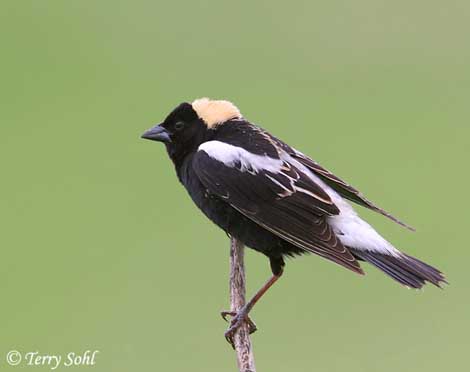
The male Bobolink has unusual "reversed" plumage (often referred to as a reverse tuxedo), with black underparts and lighter buff and white colors above. The beautiful, metallic bubbling song is a common summer sound in the state. Bobolinks were once considered delicacies at Eastern restaurants, and were heavily hunted for food throughout the 1800's. Rice farmers of the south also killed great numbers of Bobolinks, as the "Ricebirds" as they were called often fed in numbers in rice fields. After making a comeback earlier in the century, Bobolinks again began to decline in the middle to late 1900's. With their primary breeding habitat (damp meadows) in short supply, Bobolinks often nest in hay and alfalfa fields, making nests extremely vulnerable to hay-cutting. A mature breeding male is pictured on the right.
Habitat
Prefers damp meadows and dense prairies. With conversion of these habitats to other land cover types, many now nest in hay/alfalfa fields.
Diet
The diet primarily consists of insects and spiders during the summer breeding season, particularly when feeding young. They will also take some weed seeds and other seeds. During the winter months the diet shifts, consisting primarily of seeds and grains, with small amounts of insect matter. They will feed in agricultural fields, and are considered an agricultural pest in some areas, including in rice fields in their South American wintering range.
Behavior
Usually gregarious except during breeding season. They will forage either on the ground or on a low perch.
Nesting
June and July in South Dakota. The nest of a Bobolink is constructed by the female. She first denudes a small patch of ground of vegetation, forming a foundation for the nest. This is usually placed at the base of a dense clump of herbaceous vegetation. She will build a cup-shaped nest constructed of grasses and other herbaceous vegetation. She lays 3 to 7 eggs, and she alone incubates them. The young hatch after 12-14 days, and fledge from the nest about 10-12 days after hatching.
Song
Bobolinks have one of the most distinctive and memorable songs of any bird in South Dakota, with a bubbling series of rapid notes that have a distinctive metallic sound to them. Bobolinks also have a variety of different call notes used for communication or to raise an alarm.
1Click here to hear the song of a male Bobolink
2Click here to hear the short call notes of a Bobolink
3Click here to hear a variety of calls and the song of a Bobolink
Migration
Summers throughout much of the northern half of the U.S. and southern Canada. Winters in southern South America.
Interactive eBird Map
Click to access an interactive eBird map of Bobolink sightings
Similar Species
Male Bobolinks are distinctive if seen well. However, there is potential confusion if not seen well, and there is some potential confusion of juvenile and female Bobolinks, which have dramatically different plumage than do the breeding-plumaged males (see photos below):
- Lark Bunting -Male Lark Buntings are somewhat similar in size and are primarily black with a white patch on their wing. However, they lack the buffy patch on the back of the head of a male Bobolink, and the white rump and back of a Bobolink. The white on the shoulder is also lower on the wing, compared to the white on the shoulder of the male Bobolink.
- Red-winged Blackbird - Male Red-winged Blackbirds are easily differentiated from male Bobolinks, as they lack any white coloring, lack the buffy patch on the back of the head, and have the bright red shoulder. Females of the two species could be confused, however. They may appear similar structurally, and will sometimes use the same habitat. However, female Red-winged Blackbirds are much more heavily streaked than female Bobolinks, who have some streaking on the flanks, but lack the streaking on the rest of the underparts.
South Dakota "Hotspot"
Bobolinks are usually found in areas of lush grassland and wet meadows, habitats that are much more frequently found in the eastern part of South Dakota. They've also learned to use some pastures and even alfalfa fields. The key to finding Bobolinks is to simply find a large patch of healthy grassland. Note that while the western part of South Dakota may have extensive areas of grassland, Bobolinks are found much less frequently in those drier, short-grass prairie habitats than they are in mixed and tall-grass prairies and wet meadows of the eastern part of the state.
Conservation Status
Bobolinks were killed in great numbers for food in the 1800's. They also have sometimes been considered agricultural pests, and were targeted for elimination (particularly when found in and around rice fields). In the 20th century populations rebounded, but then began declining again due to habitat destruction across much of their range. Factors driving their declines in recent decades have been active both in their North American summer breeding range, and on their South American wintering range. Numbers have decreased in parts of the Midwest and Great Plains as suitable grassland has been converted to cropland, while in the eastern US, populations have declined as lands once cleared for cropland and pasture have been regenerating back to forest. Overall, Bobolinks are still found across a broad geographic area, and are relatively common in parts of that range. Thus, despite the declines, the IUCN still considers the Bobolink to be a species of "Least Concern".
Further Information
- eBird - Bobolink
- Audubon Field Guide - Bobolink
- Cornell Lab of Ornithology - All About Birds: Bobolink
Photo Information
June 5th, 2005 -- Eastern Minnehaha County -- Terry Sohl
Audio File Credits
1Gabriel Leite. Recorded in New York state on June 16th, 2018. Original recording and information from xeno-canto.
2Paul Marvin. Recorded in Brevard County, Florida on September 4th, 2013. Original recording and information from xeno-canto.
3Arley Omar. Recorded in Columbia on April 7th, 2020. Original recording and information from xeno-canto.
