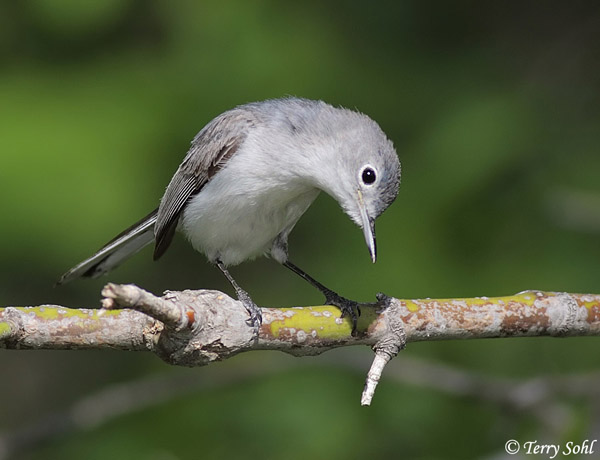
The range of the Blue-gray Gnatcatcher has been steadily expanding throughout the 20th century. Most range maps show them barely reaching the extreme southeastern corner of South Dakota, but they've become quite established as breeding birds in the forested lands and riparian areas in the southeastern part of the state. Very small birds normally found in woodlands, they can sometimes be difficult to observe as they flit about the tree tops.
Habitat
Varies by region, preferring deciduous forests in the East, pine forests with a deciduous understory in the South, and shrubby habitat in the West.
Diet
Feeds almost exclusively on insects and spiders.
Behavior
Extremely active, foraging actively among trees and shrubs in search of insects. Will take prey while perched, hovering, or by flycatching and catching insects in mid-air.
Nesting
May and June in South Dakota. The nest consists of a small cup of grassees, weeds, strips of bark, and other material, lined with softer material such as plant down or feathers. The outside of the nest is often camouflaged with mosses and lichen. The female lays 4 or 5 eggs, and both parents help to incubate them. Upon hatching, both parents help to feed the young, although the male does most of the feeding early on, while the female tends to the young.
Song
Blue-gray Gnatcatchers are skilled songsters and mimics, with a very broad variety of songs that include musical notes, whistles, chips, and mew notes of variable length, sometimes also incorporating bits of songs of other species. A broad variety of vocalizations may also be used as alarm calls and other calls, although the most frequently heard call is a thin, nasal whistling.
- Click here to hear the thin alarm calls of a Blue-gray Gnatcatcher near a nest site1
- Click here to hear the complex song of a Blue-gray Gnatcatcher2
- Click here to a mix of calls and songs from a Blue-gray Gnatcatcher3
Migration
Summers throughout much of the United States except for the Pacific Northwest and the northern tier of states. Winters in the extreme southern United States and southward.
Interactive eBird Map
Click to access an interactive eBird map of Blue-gray Gnatcatcher sightings
Similar Species
Similar to the several other Gnatcatchers, but these other species all have normal ranges well to the south of South Dakota and have never been seen in this state. In their normal ranges outside of South Dakota, here are the keys to differentiating Gnatcatcher species.
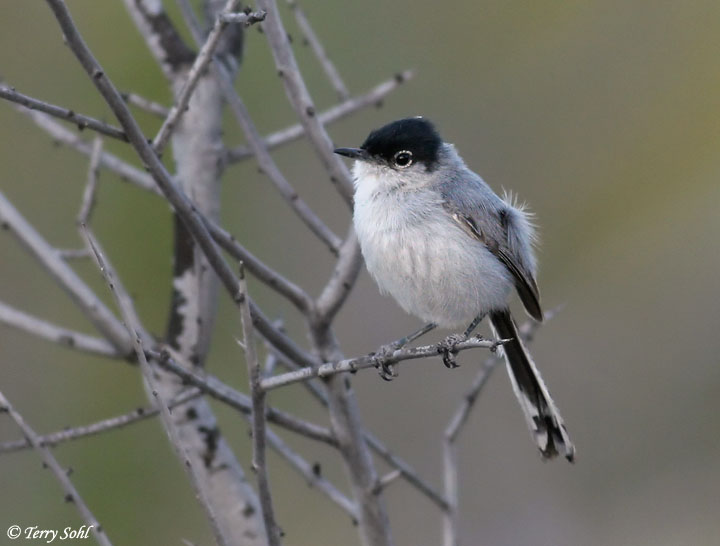
- Black-tailed Gnatcatcher - Black-tailed Gnatcatchers are birds of the southwestern US and Mexico, where their range may overlap with Blue-gray Gnatcatchers. Male Black-tailed Gnatcatchers in breeding plumage have a black cap, while male Blue-gray Gnatcatchers have a grey head with thin black "eyebrows". In all plumages, the underside of the tail is a good identification key, as the underside of a Black-tailed Gnatcatcher's tail is (surprisingly!!) Black, with white spots. The underside of a Blue-gray Gnatcatcher's tail usually appears to be white, given the white outer tail feathers.
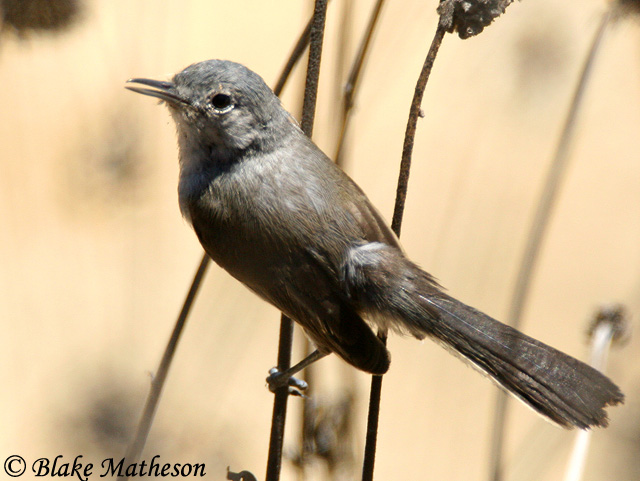
- California Gnatcatcher - California Gnatcatchers have a very limited range in far southern California and Baja California. They too are very similar in appearance to a Blue-gray Gnatcatcher, but have a nearly completely black underside of the tail, compared to the white on a Blue-gray Gnatcatcher.
- Black-capped Gnatcatcher - Black-capped Gnatcatchers are primarily found in Mexico, but there are increasing numbers of sightings in southern Arizona in recent years. They are very similar to Blue-gray Gnatcatchers in overall appearance, but males in the breeding season have a black cap lacking on Blue-gray Gnatcatchers.
 |
 |
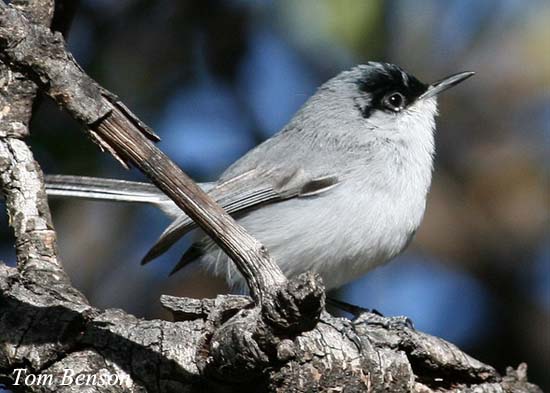 |
| Black-tailed Gnatcatcher | California Gnatcatcher | Black-capped Gnatcatcher |
Conservation Status
They have expanded in numbers and in range in the 20th century, and systematic surveys in recent years show that numbers continue to increase. They are found across a very broad geographic area and are common in parts of that range. The IUCN lists the Blue-gray Gnatcatcher as a species of "Least Concern".
South Dakota "Hotspot"
Most common in the extreme southeastern part of the state, I've had very good luck finding them at all of the heavily forested parks, including Newton Hills State Park, Good Earth State Park, the Outdoor Campus in Sioux Falls, and the Big Sioux Recreation Area.
Further Information
- eBird - Blue-gray Gnatcatcher
- Audubon Field Guide - Blue-gray Gnatcatcher
- Cornell Lab of Ornithology - All About Birds: Blue-gray Gnatcatcher
Photo Information
May 16th, 2011 - Big Sioux Recreation Area near Brandon, South Dakota - Terry Sohl
Audio File Credits
- 1Russ Wigh. Recorded in Chatham County, Georgia on May 24th, 2020. Original recording and information available from xeno-canto.
- 2Bobby Wilcox. Recorded in Clark County, Nevada on May 12th, 2019. Original recording and information available from xeno-canto.
- 3Andrew Spencer. Recorded on West Grand Bahama on the Bahama Islands on May 16th, 2016. Original recording and information available from xeno-canto.
