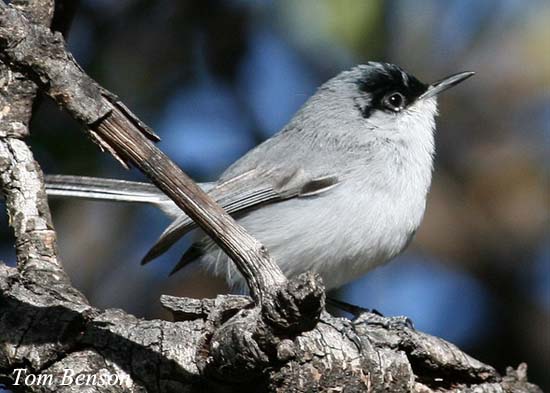
The Black-capped Gnatcatcher is a species with a relatively small range in western Mexico. In the United States, it is a rare, but increasingly seen vagrant, primarily in southeastern Arizona but also in northwestern New Mexico. It has now been documented as occasionally breeding in both states, with the first documentation of nesting occurring near Patagonia in Arizona in 1971. There are now a few select locations in southeastern Arizona where breeding pairs have become established and are relatively reliable in locating.
Habitat:
The Black-capped Gnatcatcher is primarily found in dense, thorny scrublands and arid woodlands, particularly along desert washes and riparian corridors in the southwestern United States and Mexico. They show a strong preference for habitats featuring hackberry, mesquite, and acacia trees, where they can forage for insects deep within thick vegetation..
Diet:
Feeds heavily on insects and spiders. They will also occasionally feed on seeds.
Behavior:
Foraging is often done by gleaning insects from foliage, often while hovering. They will also observe from a perch and fly out and capture insects in mid-air.
Nesting:
Black-capped Gnatcatchers typically build small, neat cup-nests made of plant fibers, spiderwebs, and lichens, often placed in the fork of a small tree or shrub. Both members of the pair participate in building the nest and incubating the eggs, frequently choosing sites in dense streamside vegetation or desert scrub.
Song:
The call is a rising then descending, very weak mee-ur. The song is a quiet series of tinkly warbles.
Migration:
Considered a permanent resident throughout its normal range.
Interactive eBird map:
Click here to access an interactive eBird map of Black-capped Gnatcatcher sightings
Similar Species:
California Gnatcatcher , Black-tailed Gnatcatcher. To differentiate these delicate songbirds, look at the extent of black on the cap and the color of the outer tail feathers. The California Gnatcatcher is the darkest overall, with a dusky brownish-gray wash on the underparts and very little white on the edges of its black tail. The Black-tailed Gnatcatcher is distinguished by having mostly black outer tail feathers (showing only narrow white tips) and a male breeding cap that extends further down the nape than the others. The Black-capped Gnatcatcher features a much more extensive black cap that reaches below the eye, a longer bill, and remarkably broad white outer tail feathers that make the tail appear mostly white from underneath.
Conservation Status:
Populations are in a noted decline. However, they are still relatively common in many areas and are found over a large geographic area. The IUCN lists the Black-capped Gnatcatcher as a species of "Least Concern".
Photo Information:
Photo taken by Tom Benson - Pima County, Arizona - Photo licensed under Creative Commons Attribution NonCommercial NoDerivs 2.0 Generic License
