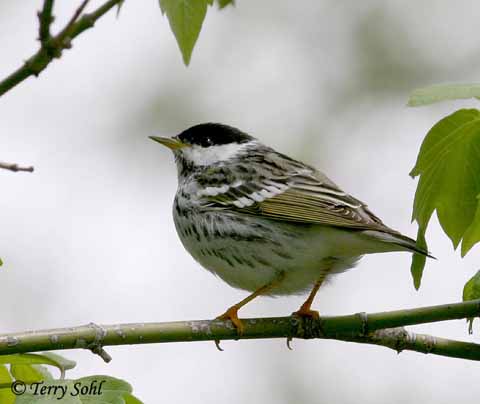
Blackpoll Warblers are a champion migrant, often going non-stop from the Northeastern coast of the U.S. to northern South America every fall. It's been estimated that the non-stop flight may take individual birds up to 3 days to complete. Blackpoll Warblers are usually fairly common in Spring migration through South Dakota, but are much less common during the fall.
Habitat
Diet
Behavior
Nesting
A non-breeder in South Dakota. On their breeding grounds in Canada and Alaska, the nest of a Blackpoll Warblers is constructed by the female, placed near the trunk of a small evergreen tree, usually from 1 to 20 feet from the ground. The nest is built of sticks and grasses, sometimes lined with lichen, feathers, or moss. The female lays 3 to 5 eggs, and she alone incubates them. The young hatch after about 12 days.
Interactive eBird Map
Song
The song of a Blackpoll Warbler is a short series of notes, quiet at first, rising in volume, and then fading again at the end. Both males and females also have a sharp chip note call.
1Click here to hear the song of a Blackpoll Warbler
2Click here to hear the call notes of a Blackpoll Warbler
Migration
Similar Species
If seen well, male Blackpoll Warblers do have a distinctive plumage pattern. Females may be more difficult to identify. Species most likely to be confused with a Blackpoll Warbler include the following:
- Black-and-White Warbler - Black-and-White Warblers are common migrants in South Dakota, with much smaller numbers staying to breed during the summer months (primarily in the far western part of the state). Both species may be present together at the same time during migration, and could pose an identification challenge. Male Black-and-White Warblers have a striped crown a black cheek, while male Blackpoll Warblers have a completely black crown and a white cheek. Note behavior also separates the species, as Black-and-White Warblers typically forage by clinging to the trunk or branches of a tree and clambering over it "nuthatch style" as they feed.
- Black-throated Gray Warbler - Just a very rare visitor to South Dakota, they could potentially overlap with Blackpoll Warblers on the rare instances where they are found in the state. Black-throated Gray Warblers have a black crown like a Blackpoll Warbler, but have a more complex facial pattern, with a white stripe above the eye, black through the eye and upper check, and white stripe on the lower cheek, and a black throat. Black-throated Gray Warblers also have a yellow spot in front of the eye.
- Cape May Warbler (Female) - Females of both species may be similar, but Cape May Warblers are typically more brightly colored, with stronger yellow tones than a female Blackpoll Warbler. Cape May Warblers typically have one white wingbar while Blackpoll Warblers have two.
- Blackburnian Warbler (Female) - Both species share the pair of bold white wing bars, and some faint streaking on the flanks. Blackburnian Warbler females, however, tend to have an pale orangish hue on the breast, throat, and head, while female Blackpoll Warblers are plainer or have a faint yellowish wash.
Conservation Status
Further Information
- eBird - Blackpoll Warbler
- Audubon Field Guide - Blackpoll Warbler
- Cornell Lab of Ornithology - All About Birds: Blackpoll Warbler
Additional Photos
Audio File Credits
1Aiden Place. Recorded in Rutland County, Vermont on July 9th, 2019. Original recording and information from xeno-canto.
2Lucas Berrigan. Recorded in Yarmouth County, Nova Scotia on June 5th, 2016. Original recording and information from xeno-canto.
