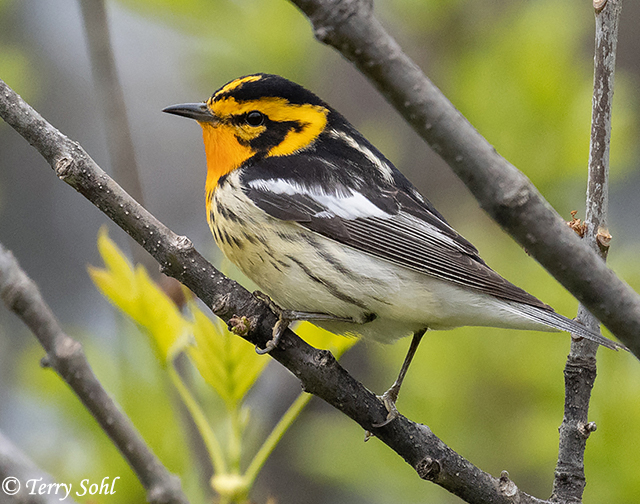
Blackburnian Warblers are a long-distance migrant, summering around the U.S./Canada border, and wintering near the forests of the Andes in South America. The brilliantly colored males often spend much of their time high in the treetops, especially during breeding season when singing their song. While the plumage pattern may somewhat resemble other warbler species, the fiery orange color distinguishes it from most other warblers. They are the only North American warbler species with an orange throat. The females are more plainly marked, but still may have hints of the orangish tones of the male. In South Dakota, Blackburnian Warblers are relatively uncommon migrants, with decreasing frequency as you move from east to west in the state.
Habitat
Diet
Behavior
Nesting
Non-breeder in South Dakota. The nest of a Blackburnian Warbler is a cup built of twigs, lined with mosses, lichens, and hair. It is typically placed in a evergreen, usually quite a bit higher from than ground than other warbler species. The female lays 3 to 5 eggs, and she alone incubates them. The young hatch after about 12 days, and fledge from the nest about 10 days after hatching.
Interactive eBird Map
Song
The song of a Blackburnian Warbler is a series of tzeep notes, followed by 2 or 3 higher-pitched whistles. The call is a primarily a short, crisp tsip.
1Click here to hear the song of a Blackburnian Warbler
2Click here to hear the call of a Blackburnian Warbler
Migration
Similar Species
Male Blackburnian Warblers, with that brilliant orange color and strong plumage pattern, are unlikely to be confused with other species if seen well. Female and immature Blackburnian Warblers have a more subtle plumage and might possibly be confused with several species. Here are the species most likely to be confused with Blackburnian Warbler.
- Townsend's Warbler - Townsend's Warblers are rare migrants in the far western part of the state, while Blackburnian Warblers are primarily found in the eastern part of the state while in migration. However, in the thin sliver of geography where they may possibly overlap in migration, the two species do share similar plumage patterns, but with different colors. Townsend's Warbler males have a strong facial pattern with black around the eye, a black cap, and a black throat, on a background of yellow. Blackburnian Warbler males have a similar strong facial pattern with black around the eye and a black cap, but they lack a black throat (it's orange) and the background color is the brilliant fiery orange typical of the species.
- Bay-breasted Warbler - Female Bay-breasted Warblers may be confused with female Blackburnian Warblers. However, Bay-breasted Warblers have a weaker facial pattern than a female Blackburnian Warbler, with more consistent coloring and a lack of a paler "eyebrow" found on the Blackburnian. Female Bay-breasted Warblers also have unmarked flanks, while immature or female Blackburnian Warblers have faint streaking on the flanks.
- Cape May Warbler - Female Cape May Warblers are similar to female Blackburnian Warblers. However, they lack the darker shaded "triangle" behind the eye of a Blackburnian Warbler. They also have streaks on the flanks that are less extensive than those of a Blackburnian Warbler, which has streaks on the flanks, and the throat.
Conservation Status
Image Information
Audio File Credits
1Paul Marvin. Recorded in Nicolet National Forest of Wisconsin on May 24th, 2011. Original recording and information from xeno-canto.
2Andrew Spencer. Recorded in Napo, Ecuador on January 12th, 2008. Original recording and information from xeno-canto.
