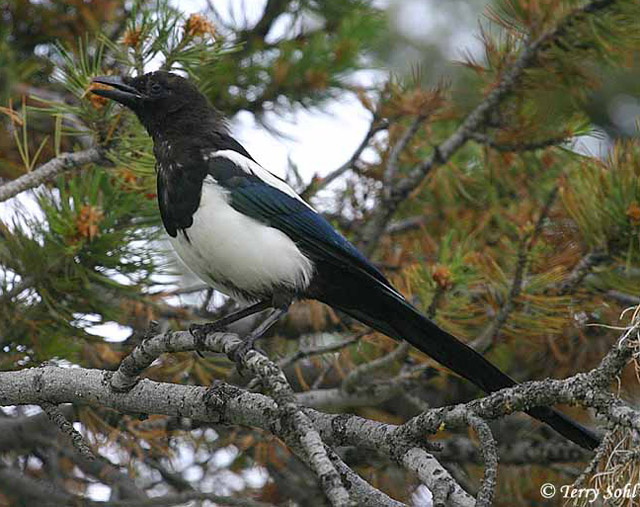
A boldly patterned bird of the western U.S., Black-billed Magpies are conspicuous both in appearance, and in nesting behavior. With a bold black-and-white plumage pattern and an extremely long tail, they are unmistakable bird in flight in much of western North America. As nesting birds, they build massive domed nests that may be more than three feet wide in diameter. Black-billed Magpies were once commonly kept as cage birds. They were often the direct targets of farmers and ranchers trying to eliminate them, and were indirectly affected by poison baits set out for predators. However, they are now once again common and widespread in much of western North America.
Habitat
Diet
Behavior
Nesting
Interactive eBird Map
Song and Calls
- 1Click here to hear the noisy chattering of a Black-billed Magpie, recorded in Washington state.
- 2Click here to hear alarm calls of a Black-billed Magpie, recorded in Apache County, Arizona.
- 3Click here to hear more vocalizations of a Black-billed Magpie, recorded in Salt Lake County, Utah.
Migration
Similar Species
In South Dakota, you're unlikely to mistake the Black-billed Magpie with any other species. The large size and structure of the bird may initially lead to confusion with corvids (American Crow, Common Raven) if seen from a distance, but the bold black-and-white plumage pattern and that impossibly long tail make it readily identifiable if seen well. Outside of South Dakota, Black-billed Magpie may be confused with the following:
- Yellow-billed Magpie - Nearly identical in overall appearance, the trademark yellow-bill of a Yellow-billed Magpie is the easy way to differentiate the two species. Note Yellow-billed Magpie has an extremely restricted range as well, only being found in and around the Central Valley of California.
Conservation Status
Further Information
- eBird - Black-billed Magpie
- Audubon Field Guide - Black-billed Magpie
- Cornell Lab of Ornithology - All About Birds: Black-billed Magpie
Photo Information
Additional Photos
Audio File Credits
- 1Bruce Lagerquist, XC437510. Accessible at www.xeno-canto.org/437510.
- 2Eric Hough, XC291049. Accessible at www.xeno-canto.org/291049
- 3Michael Lester, XC300056. Accessible at www.xeno-canto.org/300056.
