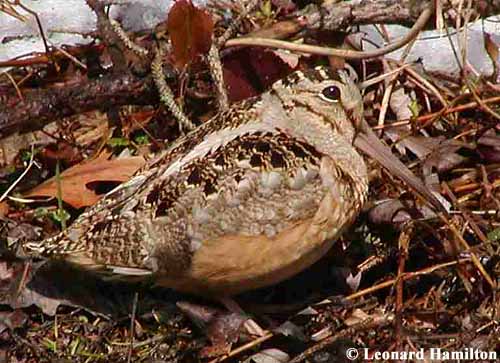
The American Woodcock may be related to similar looking sandpipers such as the Long- and Short-billed Dowitchers and Wilson's Snipe, but are upland birds found in thickets and forest edges. Its long bill is flexible at the tip, and is used to probe in the soil for its favorite food item, the earthworm. In the spring, males perform spectacular courtship flights in with an odd bubbling and twittering song produced partially by air moving over the wings.
Habitat
Prefers a mix of forest land and open areas, such as woodland edges, forest clearings, and regenerating clear-cut forest land.
Diet
Earthworms are the primary food item. Also feeds on insects and insect larvae, spiders, slugs, snails, seeds, and berries.
Behavior
American Woodcocks use their flexible bill to probe in the soil for earthworms, as well as insects and other prey items that live in the soil. They will also feed on the surface, and eat plant material.
Nesting
May and June
Interactive eBird Map
Click to access an interactive eBird map of American Woodcock sightings
Song
Makes a peent like call with a nasal quality. When doing mating flights, males make bubbling sounds, while the wings make twittering sounds.
Click to listen to American Woodcock peent calls.
Click to listen to American Woodcock flight calls.
Migration
Summers in the eastern half of the U.S. and southeastern Canada. Winters in the southeastern U.S.
Similar Species
Status
Still relatively common, but possibly in decline in the United States as thickets resulting from past clear-cutting in the eastern United States gradually are returning to mature forest.
Further Information
- eBird - American Woodcock
- Audubon Field Guide - American Woodcock
- Cornell Lab of Ornithology - All About Birds: American Woodcock
Photo Information
March 19th, 2004 at the Great Swamp National Wildlife Refuge in Morris County, New Jersey. Photo courtesy of Leonard Hamilton.
