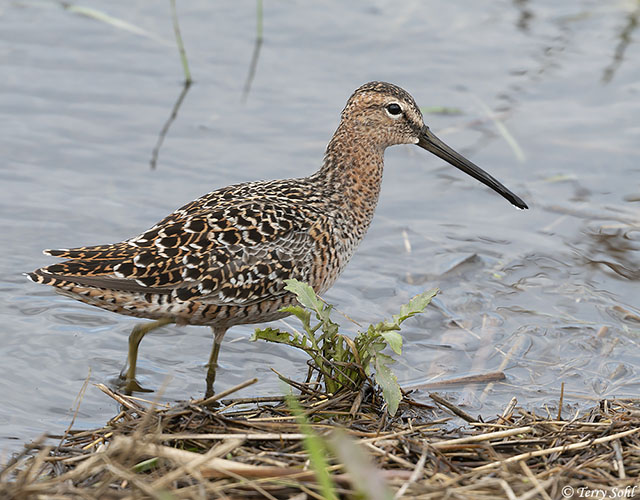
The Short-billed Dowitcher is nearly identical in appearance to its cousin, the Long-billed Dowitcher. The Short-billed tend to prefer coastal habitats in most seasons, however, while the Long-billed prefers fresh-water habitats. This is particularly true during the winter season, when Short-billed Dowitchers are found along coastlines from the US and Mexico, southward through Central and South America, and in the Caribbean. Some Short-billed Dowitchers do migrate through the interior of the continent, but they are not as common in South Dakota as the Long-billed Dowitcher. Differences in call are a reliable way to tell the two species apart, but visual clues tend to be much more subtle (see identification differences below).
Habitat
During breeding season, uses marshes, bogs, and lake edges in the northern conifer forests of Canada and Alaska. During migration and winter, they strongly prefer saltwater coastal habitats, although some may migrate through the interior of the continent.
Diet
Diet varies with season, but includes insects and insect larvae, mollusks, crustaceans, marine worms, and the seeds of aquatic plants. May feed heavily on horseshoe crab eggs during migration.
Behavior
Uses its bill to probe in soft mud for food, usually while wading in shallow water, although sometimes on mud flats.
Breeding / Nesting
Non-breeder in South Dakota. On their breeding grounds, Short-billed Dowitchers nest in marshy vegetated areas, typically with scattered cover such as small trees and shrubs, and/or thick clumps of herbaceous vegetation. Ground nesters, Short-billed Dowitchers will mold a depressing into the grasses and herbaceous vegetation, and line it with leaves, feathers, grasses, and other vegetation. The female lays 3 or 4 eggs, with both parents helping to incubate them. Incubation takes about 3 weeks. Upon hatching, the female typically leaves the family, with the male tending to the young.
Song
Generally silent, Short-billed Dowitchers may give a mellow tu-tu-tu when flushed. They also have a soft chattering call.
- Click here to hear the chattering call of a Short-billed Dowticher1
- Click here the mellow tu-tu-tu calls of a Short-billed Dowticher2
Migration
Summers in central and western Canada, and southern Alaska. Winters along coasts of the southern half of the U.S., and points south. Given their predilection to winter along coastlines and use brackish and salt-water habitats, migration to their summer breeding grounds is also often along the coastlines, with fewer birds moving through the continent's interior. Thus, Short-billed Dowitchers are less frequent migrants in South Dakota than Long-billed Dowitchers.
Interactive eBird map
Click here to access an interactive eBird map of Short-billed Dowitcher sightings
Similar Species
Short-billed Dowitchers could be confused with the following species, with the first one a particularly thorny identification challenge:
- Long-billed Dowitcher
- Long-billed Dowitchers are the more common of the two Dowitcher
species that migrate through South Dakota, but both can be found here.
Identification of the two is extremely difficult, as both overall
structure and plumage are very similar. None of the following
identification clues are glaringly obvious when you see a bird in the
field, but these are some of the features various sources note as
identification keys:
- Bill characteristics - On average, a Long-billed Dowitcher does indeed have a longer bill than a Short-billed Dowitcher. However, there's a lot of variability, and using length alone to judge species is extremely difficult on all but the very shortest or longest-billed birds. Long-billed Dowitchers are typically described as having a slightly thinner, straighter bill, with while Short-billed Dowitchers have a slightly more stout bill (particularly towards the base) and often display a slight droop in the last 1/3rd of the bill.
- Leg length - If you see multiple Dowtichers in a group standing together, leg length can sometimes be used to differentiate the two species. Long-billed Dowitchers have slightly longer legs than a Short-billed Dowitchers, which can be noticeable if the two species are standing near each other.
- Primary flight feathers - Long-billed Dowitchers have slightly shorter wings, so on a bird at rest, the longest flight feathers appear to not reach the end of the tail feathers. Short-billed Dowitchers have slightly longer wings, so in a bird at rest, the primary wing feathers appear to reach just to the end of the tail, or very slightly past it.
- Lower Back - Long-billed Dowitchers tend to have an "indented" look along their lower back, where the body meets the base of the tail. In contrast, Short-billed Dowitchers generally appear to have a straighter line from the shoulder to the tip of the tail, with less of an indentation at the tail base. In reality, a bird's posture has a strong bearing on this (supposed) identification key.
- Supercillium - The "eyebrow" of a Long-billed Dowitcher is said to be straighter than the more curved supercillium of a Short-billed Dowitcher. Good luck actually trying to use this supposed feature in ID'ing a bird in the field!!
- Forehead - Long-billed Dowitchers are said to have a more gradual forehead, while Short-billed Dowitchers have a more steeply pitched forehead.
- Covert feathering - The feathers that cover the primary and secondary flight feathers of a bird at rest tend to have white tips. On a Long-billed Dowitcher, the white edging on those feathers tends to stay down towards the tip of the feather. On a Short-billed Dowitcher, the white sometimes extends up along the edge of the feather more, giving the white a more pronounced "V" shape. Note that this may only be reliable on a bird with fresh plumage, as the wearing of feathers over time may eliminate this ID mark.
- Wilson's Snipe - Wilson's Snipe are a common migrant and summer resident in South Dakota. They share the same stocky build and long bill of a Short-billed Dowitcher. Plumage is substantially different, particularly in breeding plumage when the Short-billed Dowitcher has rich ruddy colors on the underparts, compared to the whiter belly on a Wilson's Snipe. Wilson's Snipe also have a stronger facial pattern with apparent stripes, and an eye that seems larger in proportion to the head than a Short-billed Dowitcher.
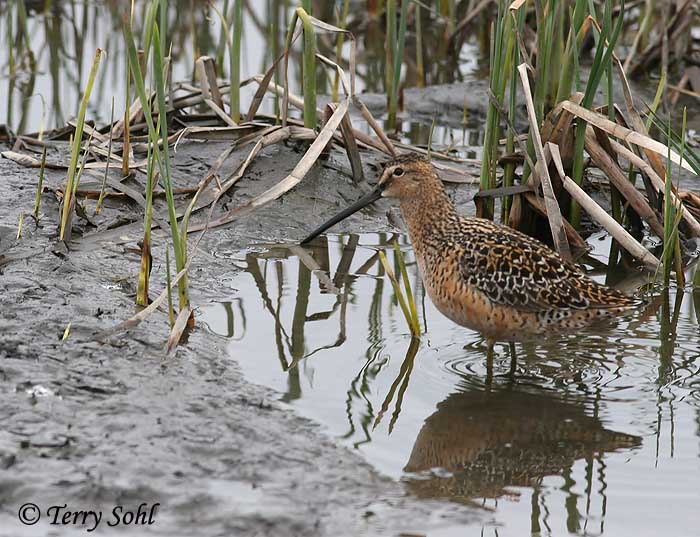 |
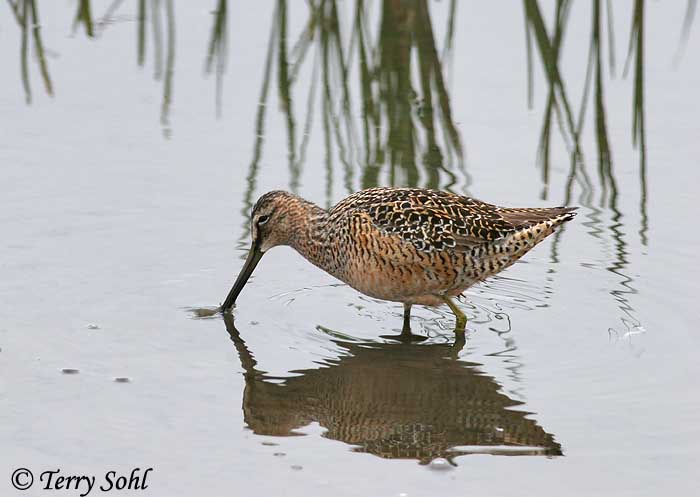 |
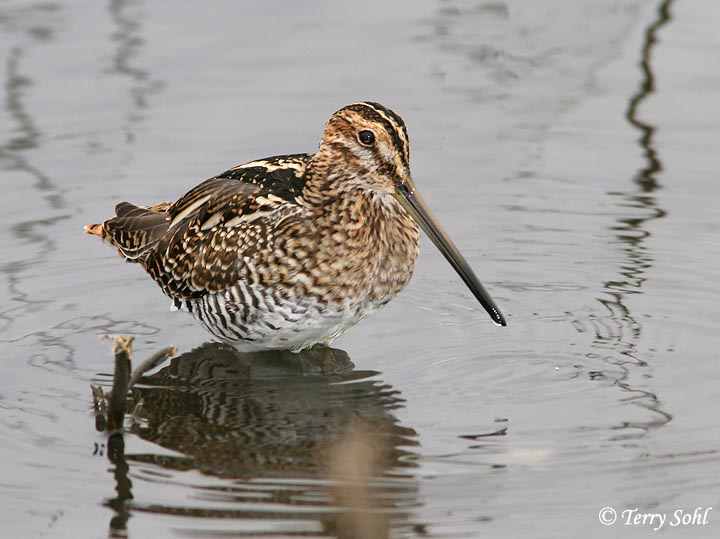 |
 |
| Long-billed Dowticher | Long-billed Dowitcher | Wilson's Snipe | Wilson's Snipe |
Conservation Status
The Short-billed Dowitcher has experienced population declines in parts of its range, likely due to wetland loss, coastal habitat degradation, climate-related changes in Arctic breeding areas, and disturbance along migration routes. Conservation efforts emphasize protecting coastal estuaries, prairie wetlands, and important stopover habitats that provide critical feeding areas during migration. The IUCN considers the Short-billed Dowitcher to be a species that is "Vulnerable".
Photo Information
Photo taken on May 4th, 2019 in Minnehaha County, Dakota - Terry Sohl
Audio File Credits
- 1Jim Holmes. Recorded in Jefferson Parrish, Louisiana on April 21st, 2017. Original recording and information available from xeno-canto.
- 2Paul Marvin. Recorded in Brevard County, Florida on Julyl 16th, 2013. Original recording and information available from xeno-canto
