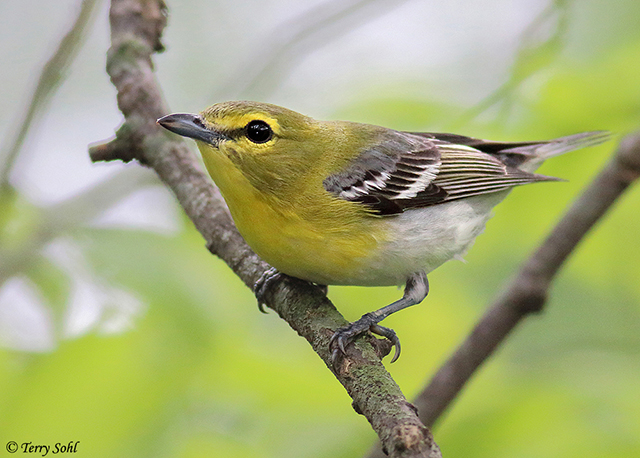
The Yellow-throated Vireo is considered the most brightly colored of the Vireos, with a bright yellow throat, breast, and "spectacles" around a dark eye. They prefer mature deciduous forest, and are most often found high in the canopy and among the foliage.
In South Dakota, they are primarily found in the southeastern and northeastern parts of the state, where they can be found as summer breeding birds. In most of the rest of the state they are migrants.
Habitat
Uses mature deciduous forests during the summer breeding season, especially along lakeshores and streams. They generally avoid mixed or coniferous forests, as well as forests with a thick shrubby undergrowth. Uses a wide variety of habitats during the winter, from tropical rain forest to dry scrublands.
Diet
Most of the summer diet is insects. Fruits and berries are also consumed, primarily in the winter months.
Behavior
The Yellow-throated Vireo forages deliberately through the middle and upper levels of trees, searching leaves and branches for caterpillars, beetles, and other insects. It is usually solitary or found in pairs during breeding season and often pauses motionless between short movements while giving its rich, deliberate song from exposed perches..
Nesting
Late May through early July. Males arrive on the breeding grounds before the females and begin scouting out nesting sites, even gathering nesting materials and placing it a number of locations it deems may be suitable. When the female arrives, the male actively courts her, displaying near his selected nesting sites in the hope that the female selects both him, and his site. The female makes the choice of nesting sites and begins constructing the nest, a cup-shaped structure that hangs from the branch of a deciduous tree, anywhere from 5 to 50 feet from the ground. It is constructed of grasses, roots, moss, weed stems, and other herbaceous material, and often bound with spiderwebs. The female lays three to five eggs, and both parents help to incubate them. The young hatch after about 12 to 14 days, and fledge from the nest in another 12 to 14 days.
Song
Short 2- or 3-note phrases, separated by deliberate pauses. Another vocalization is a scolding, harsher chatter that's typically heard when defending the nest, or when mobbing an owl.
- Click here to hear the song of a Yellow-throated Vireo1
- Click here to hear another singing Yellow-throated Vireo2
- Click here to hear the scolding calls of a Yellow-throated Vireo3
Migration
Summers throughout the eastern half of the United States. A few overwinter in southern Florida, but most move out of the United States for the winter. In South Dakota, they are present both as migrants, and as summer breeding birds, with confirmed breeding occurring in the southeastern and northeastern parts of the state.
Interactive eBird map
Click here to access an interactive eBird map of Yellow-throated Vireo sightingsSimilar Species
There a number of small, yellowish songbirds that either migrate through the state, or are residents at certain times of the year. Most are easily differentiated form the Yellow-throated Warbler, as the combination of the yellow head and breast, white belly, and dark wing with wing-bars is unique, as is that typical vireo bill. However, there is one species that could potentially cause confusion:
- Pine Warbler - Plumage patterns are quite similar between the two species, with a hello head, throat, and breast, a pale belly, and a dark wing with two white wing bars. The bill is a good identification mark, as vireos in general have thicker, more robust bills than the typically pointier, thinner bills of a warbler. Yellow-throated Warblers typically have a yellow "eye-goggles" look to them, and while Pine Warblers can appear to have a yellow eye-ring, it's much less pronounced.
South Dakota "Hotspot"
Research in other parts of the country show that Yellow-throated Vireos require large tracts of forest land for nesting, and don't do as well in fragmented forest environments. Thus, unlike many "forest" songbirds that could also be found in small shelterbelts or woodlots in South Dakota, Yellow-throated Warblers are primarily restricted to the larger, contiguous areas of forest. Good places to look are the forested state parks of southeastern South Dakota (Big Sioux Recreation Area, Good Earth State Park, Newton Hills State Park, Union Grove State Park, Beaver Creek Nature Area).
Conservation Status
Regional fluctuations in populations have occurred in recent decades in response to either favorable or unfavorable changes in habitat. They are fairly common hosts to Brown-headed Cowbird parasitism, a problem that becomes worse when forested habitats are fragmented and more nesting sites are accessible by cowbirds. However, systematic surveys in recent decades show stable or slightly increasing numbers. They are found across a broad geographic area, and are common in parts of that range, Overall, the IUCN considers the Yellow-throated Vireo to be a species of "Least Concern".
Photo Information
May 14th, 2015 -- Newton Hills State Park -- Terry Sohl
Audio File Credits
- 1Richard E. Webster. Recorded near Portal, Arizona on May 26th, 2020. Original recording and information available from xeno-canto.
- 2Russ Wigh. Recorded in Chatham County, Georgia on May 25th, 2020. Original recording and information available from xeno-canto.
- 3Robin Carter. Recorded in Congaree National Park in South Carolina on May 10th, 2006. Original recording and information available from xeno-canto.
