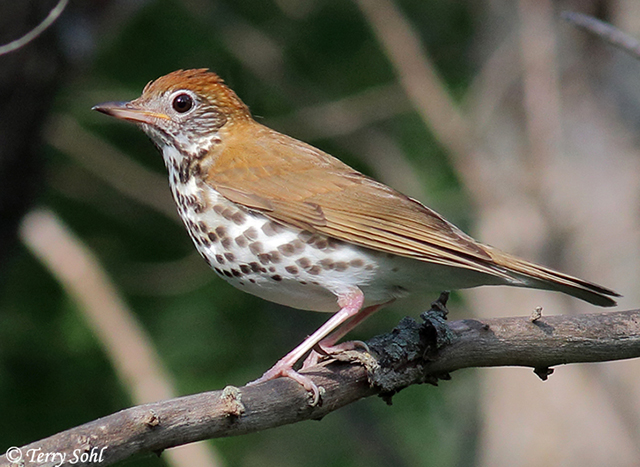
Wood Thrushes are probably best known for their clear fluty calls heard from the early spring through the summer. Dedicated songsters, the male may start singing early in the morning before the sun rises, and likewise may sing until just after sunset. They are primarily found in deciduous forests, but can sometimes be found in heavily vegetated residential areas. Numbers have seriously declined in recent decades (see status notes below).
In South Dakota, Wood Thrush are primarily known from the far southeastern part of the state, where they are summer breeders in select locations. They are relatively rare migrants elsewhere in the state.
Habitat
Wood Thrush are primarily found in the undergrowth of deciduous forests, but also sometimes in mixed coniferous and deciduous forest. Found more often in lowland forests near water than in dryer upland forests.Diet
Insects, fruits, and berries. Also will feed on spiders, snails, and earthworms. The summer diet is weighted more heavily towards insects and invertebrates, while on their wintering grounds, fruits and berries may make up a majority of the diet.Behavior
Does most of its foraging down on the ground, where they'll move through leaf litter, flipping vegetative material around as they look for insects and small invertebrates. They will also forage for fruits and berries up in trees and shrubs.
Nesting
June and July. The nest of a Wood thrush is typically placed in a shrub or branches of a tree, in an area where dense foliage provides concealment and protection. The nest is a cup, built of grasses, leaves, and moss as a foundation, and then lined and bound together with mud. The inside is then lined with fine rootlets and small grasses. The female lays between 2 and 5 eggs, and she alone incubates them. Incubation takes 12 to 14 days, and the young fledge from the nest about 12-14 days after hatching.
Song
The "standard" phonetic representation of a Wood Thrush song is a three-phrase song with ee-oo-lay as the middle phrase. However, there can be substantial variation from a general theme, with individual male Wood Thrush even singing different songs. Wood Thrush also have various calls given when threatened, or around the nest.
- Click here to hear the song of a Wood Thrush1
- Click here to hear another variation of a Wood Thrush song2
- Click here to hear the whit-whit-whit call of a Wood Thrush3
- Click here to hear the alarm/distress calls of a Wood Thrush4
Migration
Wood Thrush summers throughout most of the eastern half of the United States. They winter in Central America and southern Mexico. In South Dakota, they are found as summer breeding birds in the far southeastern part of the state, while are rare migrants elsewhere.
Interactive eBird map
Click here to access an interactive eBird map of Wood Thrush sightings
Similar Species
There are a number of thrush species that are either summer breeding residents in South Dakota, or are frequent migrants. The following are the species most likely to be confused with a Wood Thrush:
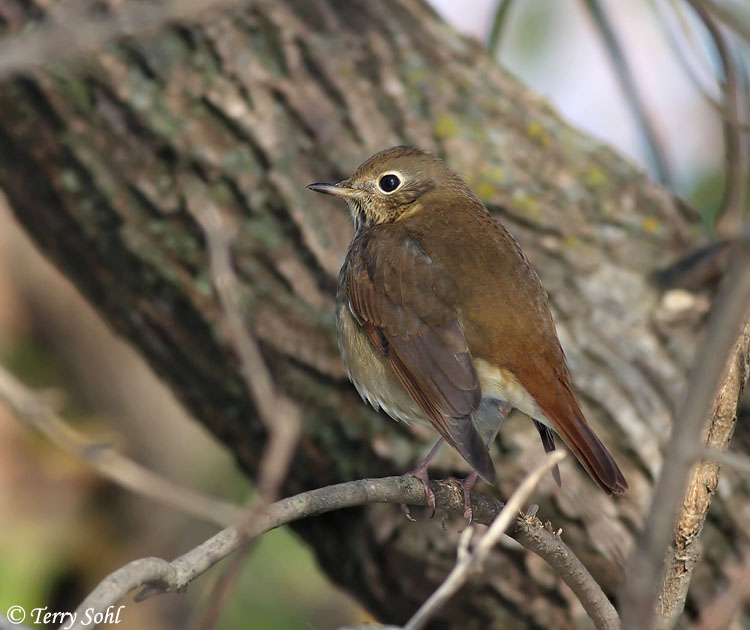
- Hermit Thrush - Hermit Thrush are migrants in South Dakota, but both species may potentially be found in the state at the same time and cause identification problems. Wood Thrush have bold spots that extend far down the breast onto the belly and flanks, while Hermit Thrush have spots restricted to the chest. Wood Thrush also have a rich, reddish brown color on the entirety of their upperparts, while a Hermit Thrush has a reddish-brown rump, but the upper back is a duller brown.
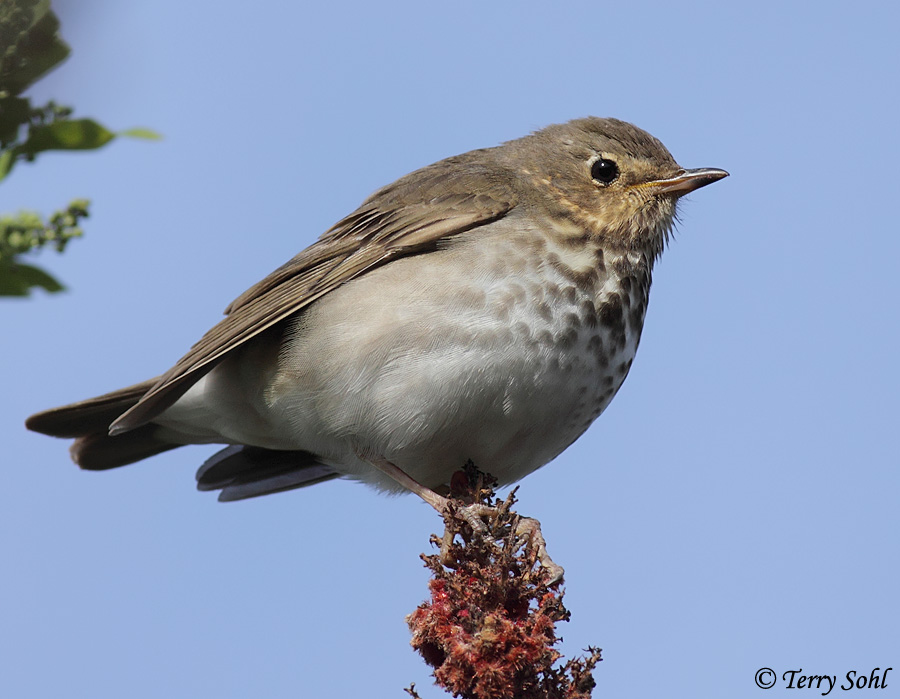
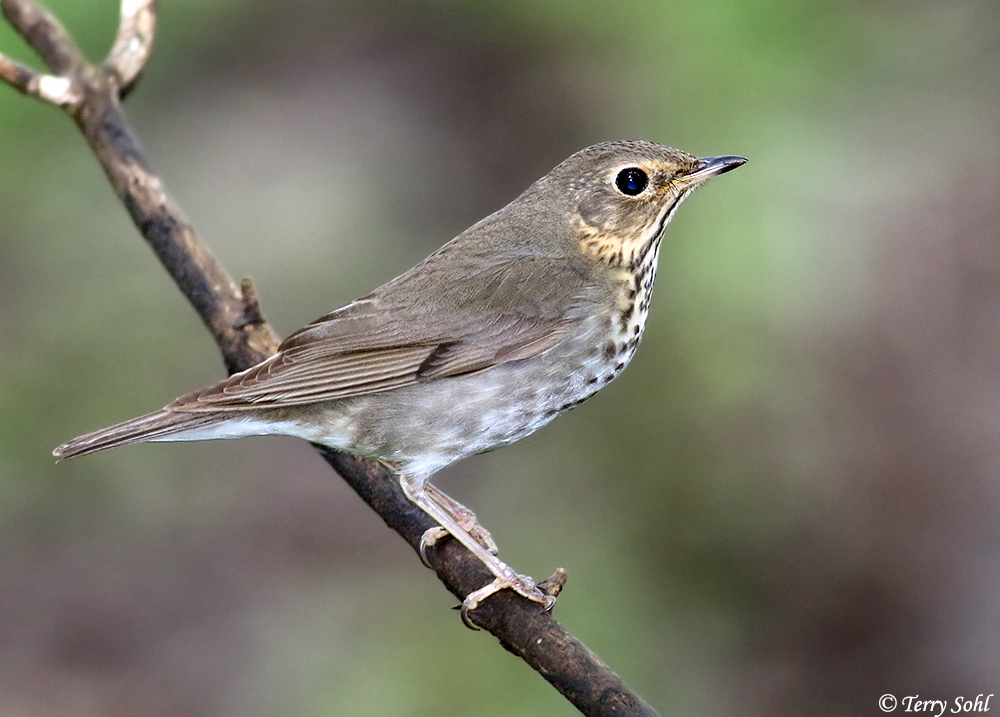
- Swainson's Thrush - Swainson's Thrush are also a common migrant in South Dakota, and could be found in the same habitats as Wood Thrush. Again, the spotting of a Wood Thrush is more extensive than the spotting on a Swainson's Thrush, which tends to fade out on below the chest. Wood Thrush have a richer, reddish brown coloring compared to the duller brown color of a Swainson's Thrush.
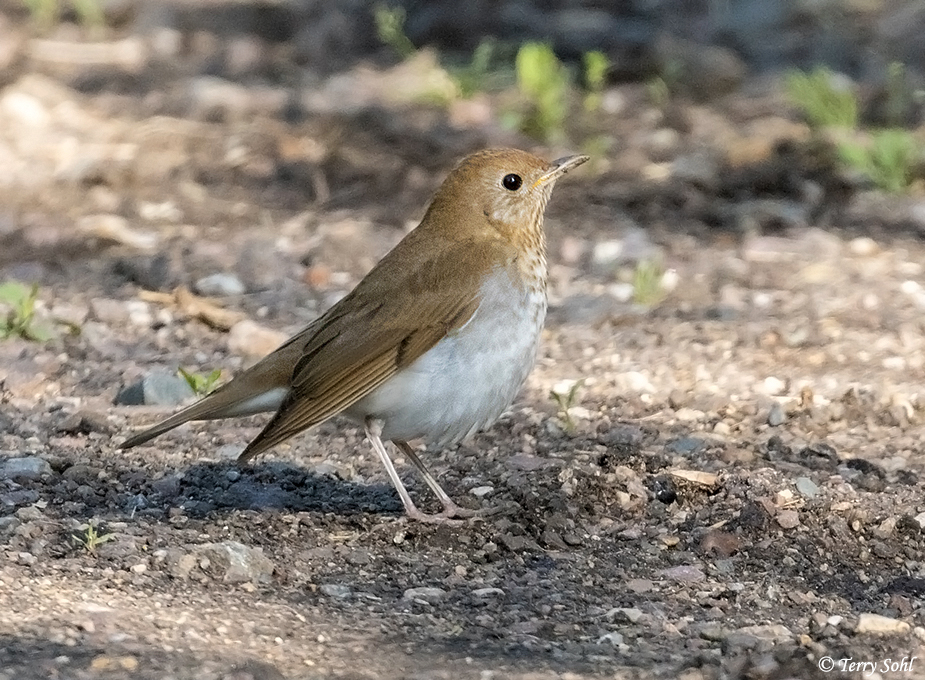
- Veery - Veery are uncommon migrants through most of south Dakota, but small numbers do breed in the Black Hills. They share a rich reddish-brown color on the upperpart of the body, like a Wood Thrush. However, while Wood Thrush have bold, extensive, blackish spotting on their underparts, the spotting on Veery is reddish brown, less distinct, and much less extensive.
 |
 |
 |
 |
| Hermit Thrush | Swainson's Thrush | Swainson's Thrush | Veery |
South Dakota Hotspot
Newton Hills State Park always has breeding Wood Thrush in the summer months. The picnic shelter at the end of the Sergeant Creek trail is an area where I have always heard and seen Wood Thrush from mid-May and into the summer months. Other similar, heavily wooded parks and riparian areas in the far southeastern part of the state are good places to look, including Good Earth State Park. Despite being two areas I bird a lot in the spring and early summer, for some reason I have not found Wood Thrush at the Outdoor Campus in Sioux Falls or the Big Sioux Recreation Area, despite both areas having some seemingly suitable forest area.
Conservation Status
Populations have shown sharp declines in recent decades. Wood Thrushes are common Brown-headed Cowbird hosts, and in many areas, Wood Thrushes end up raising more Cowbirds than they do their own species. Habitat fragmentation has probably played a very significant role in this decline. As forests become more fragmented, Cowbirds, which don't inhabit dense forest, have greater access to forests because of increased forest edges. This provides them with greater access to Wood Thrush nests. Despite the sharp population declines in recent decades, there are indications populations are stabilizing in recent years. Due to this, the IUCN changed their characterization of the Wood Thrush from "Near Threatened" in 2017, to "Least Concern" in subsequent years.
Photo Information
June 3rd, 2017 - Newton Hills State Park, South Dakota - Terry Sohl
Audio File Credits
- 1Jacob Saucier. Recorded in Stafford County, Virginia on June 18th, 2017. Original recording and information available from xeno-canto.
- 2William Whitehead. Recorded in Union County, New Jersey on June 4th, 2020. Original recording and information available from xeno-canto.
- 3David Darell-Lambert. Recorded in Chatham-Kent, Ontario on May 19th, 2019. Original recording and information available from xeno-canto.
- 4Peter Boesman. Recorded in Heredia, Costa Rica on March 13th, 2010. Original recording and information available from xeno-canto.
