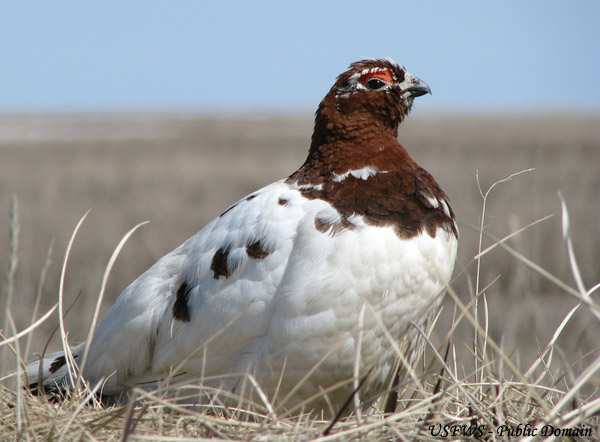
ID Keys: Nonbreeding birds all white. In spring, males develop
dark heads during courtship. In summer, rusty brown upperparts
and white underparts Females: Females a rich brown overall with dark barring underneath,
dark spots above
The
Willow Ptarmigan is the largest of the North American Ptarmigan species, and
are also the most common ptarmigan species. They are well named, as
their preferred habitat are in areas of dwarf willow in the far northern
reaches of North America. A sub-species lives in Great Britain, and
unlike birds in North American which turn all white in the winter, the
British sub-species maintains a brownish plumage all year round.
Habitat
In the northern tundra north of the
timberline, Willow Ptarmigan are found in lowland tundra with scattered
thickets of dwarf willow. In forested areas in the north, they can
also be found in forest clearings and forest edges.
Diet
The Willow Ptarmigan is almost entirely
vegetarian as an adult, feeding on dwarf willow and other shrubby trees,
including the leaves, buds, and fresh shoots. They also feed
heavily on berries when available. The young feed mostly on
insects and spiders, but gradually switch to a diet that is primarily
vegetarian.
Behavior
Forages by walking along the ground
and plucking pieces of vegetation from shrubs and plants.
Nesting
The nest of a Willow Ptarmigan is a
shallow depression lined with grasses, moss, and other plant material.
The nest is typically at least partially sheltered under a shrub or
clump of vegetation. The female alone incubates the eggs.
The young leave the nest soon after hatching, and the female will
protect them, but the young feed themselves. Unlike other
ptarmigan species, the male will also stay with the young after hatching
and will help protect them from predators.
Song
The display of a male Willow Ptarmigan
has a series of whiny barking calls.
Migration
Considered a permanent resident
throughout much of its range. However, some birds do move well
south of their breeding range in the winter.
The Willow Ptarmigan is
generally common throughout much of its range. Its main habitat is
often far from human disturbance, and populations are considered strong
and stable. The
IUCN lists the Willow Ptarmigan as a species of "least concern".