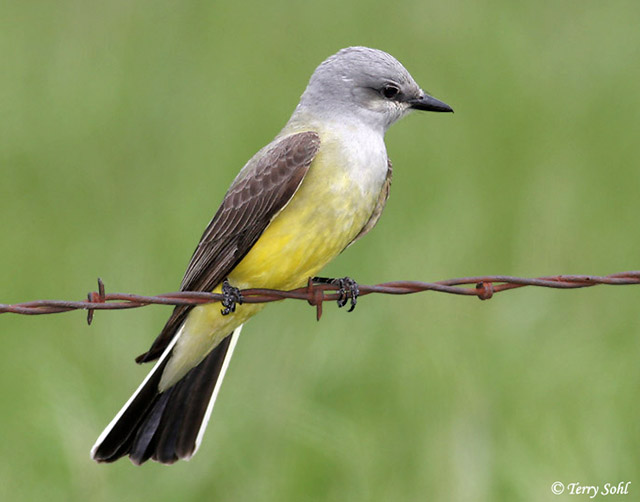
With similar mannerisms to the Eastern Kingbird, the Western Kingbird can often be found perched on roadsides fences as it watches for insects. Very aggressive, they are fierce defenders of their nests and young, often driving away birds as large as hawks. Western Kingbirds have adapted extremely well to the presence of humans, and can sometimes be found nesting well within urban areas. They are more common in the western part of South Dakota, but they can be found statewide.
Habitat
Prefers semi-open terrain with scattered patches of trees for nesting. Can sometimes be found within urban areas, and will nest on man-made structures when trees are absent.
Diet
Primarily insects. Also sometimes takes fruits and berries.
Behavior
Usually feeds by observing from a perch, and flying out to catch insects in mid-air, in typical flycatcher fashion. They also are very capable of hovering, dropping down to catch prey when spotted.
Nesting
June and July. Western Kingbirds build nests in a variety of locations, most frequently in the branches of a tree or shrub, but also sometimes using man-made structures. The nest is a cup of grasses, roots, weed stems, and other vegetative material, lined with finer grasses, hair, feathers, and other finer/softer material. The female lays between 3 and 7 eggs, and she alone incubates them. The young hatch after about 15 to 18 days, with young fledging from the nest after another 2 weeks or so. Both the male and female continue to protect and feed the young for a few weeks after they fledge.
Song
The most frequently heard vocalization is a short, relatively quiet kek call. They also have a babbling, chattering song most frequently given in the morning, and a buzzier, chattering call most frequently heard when agitated or defending terrirtory.
- Click here to hear the simple, single note kek calls of a Western Kingbird1
- Click here to hear the babbling morning song of a Western Kingbird2
- Click here to hear a buzzier, chattering call of a Western Kingbird3
Migration
Summers in the western 1/2 of the United States. Primarily winters in central and South America, although some do over-winter in Florida and other strays are occasionally found along the East Coast in the Fall.
Interactive eBird map
Click here to access an interactive eBird map of Western Kingbird sightings
Similar Species
There are several other flycatcher species with similar plumage (gray backs, yellow bellies), some of which can be found in South Dakota as well, and some that are found out of state. the following are the species most likely to be confused with a Western Kingbird:
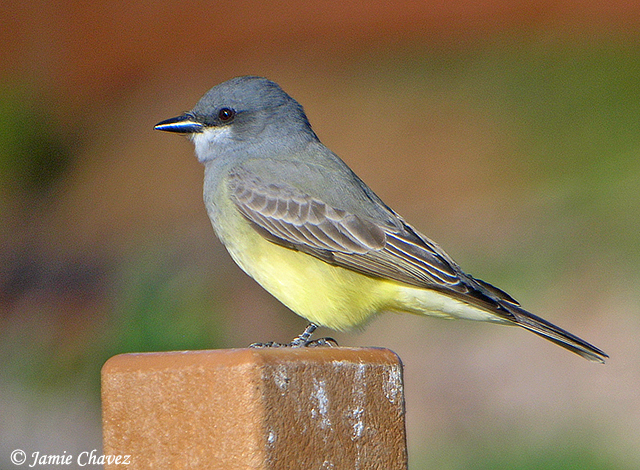
- Cassin's Kingbird - Cassin's Kingbird are found in select locations in the southwestern part of South Dakota, never as commonly found as Western Kingbirds. They are very similar in overall appearance, but Cassin's Kingbirds have a darker gray head and upper breast, which makes for an obvious contrast with a lighter throat than is seen on Western Kingbird. Cassin's Kingbirds have a white-tipped tail somewhat reminiscent of the white-tipped tail of an Eastern Kingbird, although not as obvious. Western Kingbirds lack that feature but instead have white edging on the outside of their tail feathers (most obviously seen in flight).
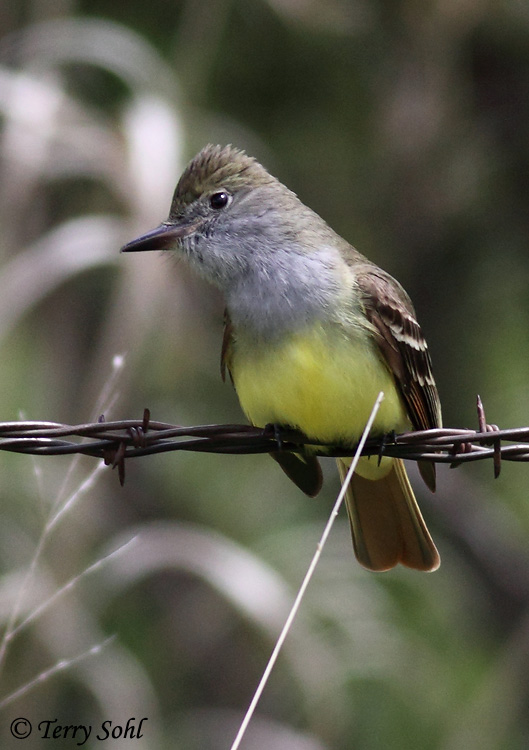
- Great-crested Flycatcher - Another flycatcher species with a yellow belly that's seen in South Dakota, habitat is one clue for differentiating from Western Kingbirds, as Great-crested Flycatchers are birds of the forest, while Western Kingbirds are found in open habitats. However, I have seen Great-crested Flycatchers perched on fencelines as Western Kingbirds are apt to do (albeit, fencelines next to forest edges). Great-crested Flycatchers have a bit of a shaggy brown crest lacking on a Western Kingbird. They also have that same warm brown color as a wash on parts of the wing, while Western Kingbirds are more drab. The belly of a Great-crested Flycatcher is a paler yellow than that of a Western Kingbird.
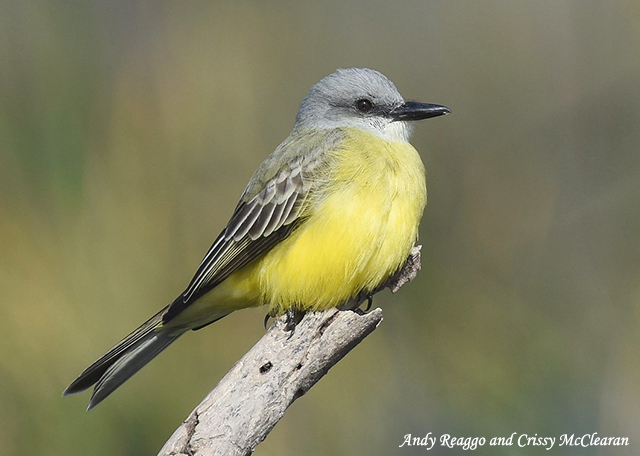
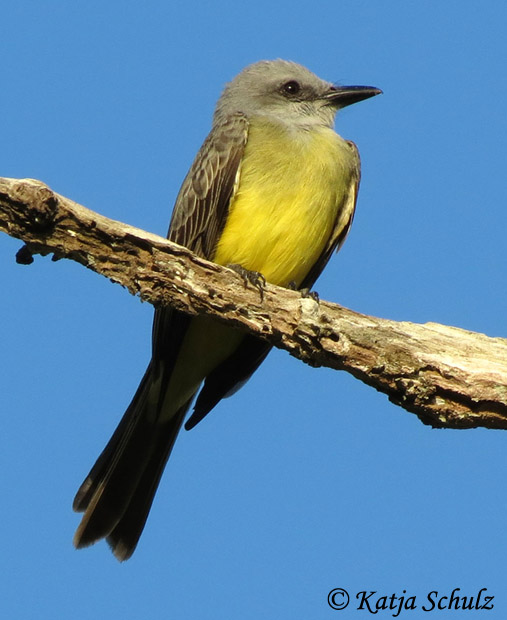
- Couch's Kingbird - There are two tropical kingbird species that are not found in South Dakota, but can cause major identification challenges where they overlap with Western Kingbirds. Couch's Kingbirds are found in extreme southern Texas and Mexico. Couch's Kingbirds have more consistent, extensive yellow on their underparts, with the yellow extending up towards the throat. They also lack the white outer tail feathers seen on Western Kingbirds (primarily when they're in flight).
- Tropical Kingbird - Tropical Kingbirds are primarily found in Mexico, Central America, and South America, but their summer breeding range does extend northward into southern Arizona. They are extremely similar to Couch's Kingbird, and can be differentiated from Western Kingbirds by more extensive yellow underneath, and a lack of white edging on the tail feathers. Differentiating Tropical Kingbirds and Couch's Kingbirds is best done by differences in voice, rather than differences in appearance.
 |
 |
 |
 |
| Cassin's Kingbird | Great-crested Flycatcher | Couch's Kingbird | Tropical Kingbird |
Conservation Status
Systematic surveys have shown Western Kingbird populations have undergone modest increases in recent decades, including some potential eastward range expansion. They are found acros a very broad geographic area and are common in parts of that range. The IUCN considers the Western Kingbird to be a species of "Least Concern".
Photo Information
May 27th, 2007 - Minnehaha County, South Dakota-- Terry Sohl
Audio File Credits
- 1Thomas Magarian. Recorded in Toole County, Montana on July 4th, 2017. Original recording and information from xeno-canto.
- 2Ed Pandolfino. Recorded in Glenn County, California on June 19th, 2020. Original recording and information from xeno-canto.
- 3Brian Sullivan. Recorded in San Benito, California on June 16th, 2013. Original recording and information from xeno-canto.
